# 月之暗面发布 Kimi K3.1 Pro,100 万 token 上下文,开放权重将于 11 月 4 日前释出
> 原标题:Kimi K3.1 Pro
- 来源:Moonshot AI:Kimi Blog
- 发布时间:2026-10-23T16:00:00.000Z
- AIHOT:https://aihot.news/items/okgjn7r72wo7c5j0bu3o1vbie
- 原文:https://www.kimi.com/blog/kimi-k3-1-pro
## 摘要
月之暗面发布 Kimi K3.1 系列首个模型 Kimi K3.1 Pro,为 3T 级开放权重模型,上下文窗口 100 万 token,并同步推出速度快 2-3 倍的 Kimi K3.1 Pro Highspeed。
## 推荐理由
官方公布了关键基准成绩、开放权重时间表和网络安全数据清理做法,读者可据此评估这代开放权重模型的实际能力边界。
## 正文 · 中文译文
## 推出 Kimi K3.1 Pro
我们推出 **Kimi K3.1 Pro**,这是我们全新 K3.1 系列的首个模型,也是我们迄今为止能力最强的 3T 级开放权重模型,具备 100 万 token 上下文窗口。它在编程、3D 创作、金融研究及其他智能体能力方面均有大幅提升。
我们还发布了 **Kimi K3.1 Pro Highspeed**,其速度是 K3.1 Pro 的 2-3 倍,交互响应更迅捷。
Kimi K3.1 Pro 和 Kimi K3.1 Pro Highspeed 即日起可在 [Kimi.com](https://www.kimi.com/en)、[Kimi Work](https://www.kimi.com/en/products/kimi-work)、[Kimi Code](https://www.kimi.com/code/en) 和 [Kimi API](https://platform.kimi.com/) 上使用。完整模型权重将于 11 月 4 日前发布。
## 拓展开放智能的边界
Kimi K3.1 Pro 是 Kimi K3 的后训练版本,后训练算力大幅增加。为实现跨**数百个下游领域**的大规模联合强化学习,我们优化了技术栈的每一层——强化学习框架、长上下文推理、训练效率、沙箱基础设施、rollout 调度,以及用于环境质量检查的共享平台——使每一份强化学习算力的投入都能带来稳定、可预期的回报。因此,K3.1 Pro 在每个领域都取得了持续提升。
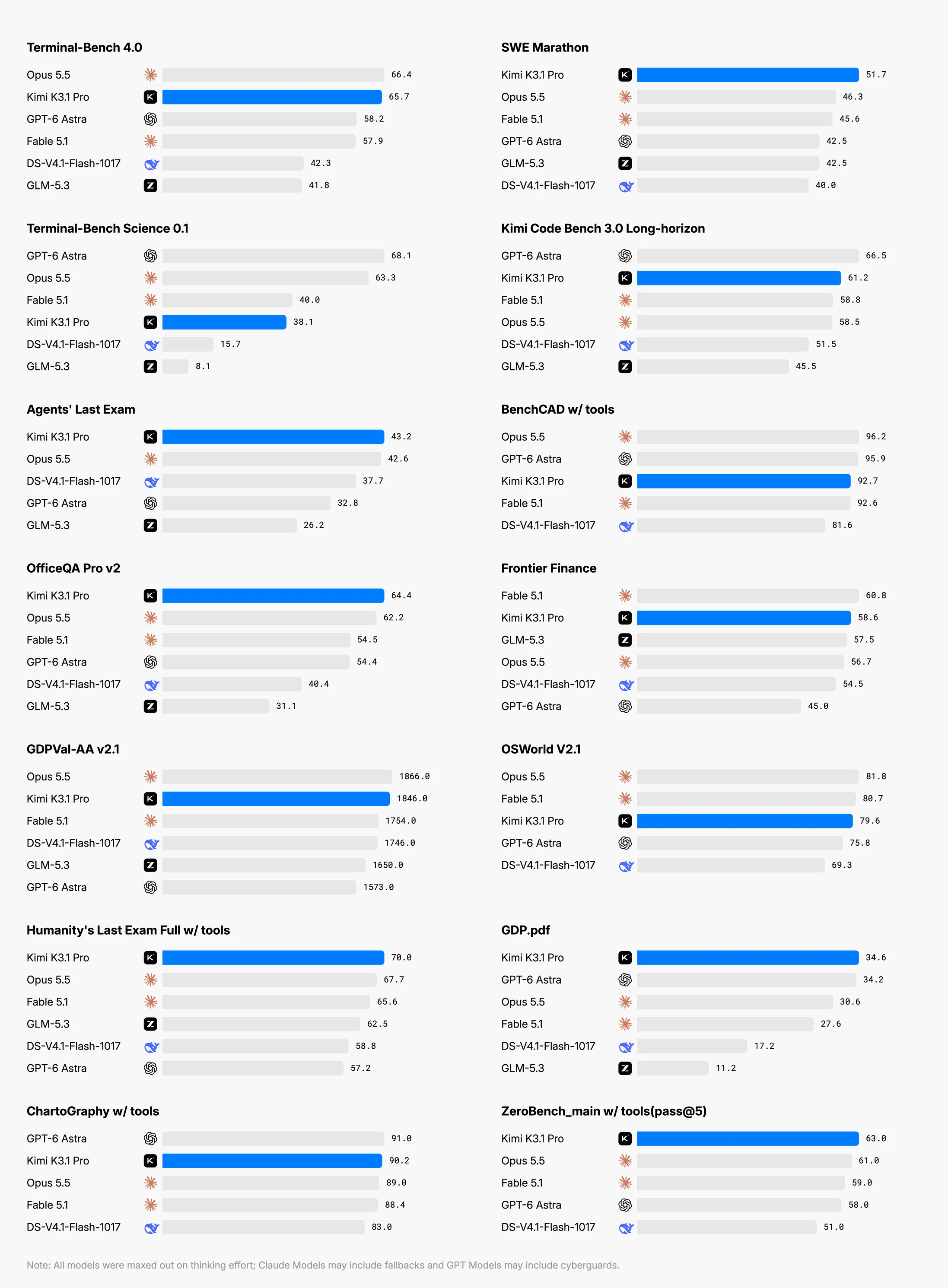
在编程、智能体和知识类基准测试中,K3.1 Pro 达到或接近最强专有模型的水平。在 **Terminal-Bench 4.0** 上——该基准使用严格的任务专属测试,评估编程智能体在贴近真实、资源受限的终端任务中的表现——**K3.1 Pro 得分 65.7%,领先 GPT-6 Astra(58.2%),仅略低于 Claude Opus 5.5(66.4%)**。在 **Kimi Code Bench 3.0 Long-horizon** 上——这是我们内部的基准,用于测试编程智能体在多样工程领域中多步骤执行、工具使用和端到端问题解决的能力——K3.1 Pro 得分 **61.2%**,高于 K3 的 **55.95%**。
## 编程
**K3.1 Pro 覆盖完整的编程工作,从真实代码库中的快速修复到完整项目构建。它还为游戏和网页体验带来更考究的视觉风格,并懂得如何用合适的工具来构建它们。**
K3.1 Pro 可在 **Unity、Unreal Engine 和 Godot** 等游戏引擎中高效工作,并结合网页搜索和 3D 生成来打造完整体验。其前端页面、交互式 Three.js 场景和 3D 资产在构图、排版、动画和精致度上表现更强。以下示例均由 K3.1 Pro 端到端创作:
**K3.1 Pro 的长程编码能力也通过大规模强化学习得到增强。**在一项内部测试中,它在 [_human-atlas_](https://github.com/ashemag/human-atlas) 之上构建了一个集成训练与评估流水线的人体行走动力学模拟器;human-atlas 是一个开源的人体解剖模型,包含 296 个骨骼组件(含软骨)和 402 个肌肉组件。在 167 项任务和 420 次独立评审中,它分析实验结果、诊断问题并迭代改进行走控制器,使模拟人从数秒内瘫倒变为以交替步态连续行走 11.2 秒。当奖励塑形未能改善手臂运动时,K3.1 Pro 并未一味继续调整奖励:它对模拟器的动力学进行了开环探测,识别并纠正了肩部肌肉力臂计算中的 36 处错误,然后重新训练了控制器。
## 3D 建模与设计
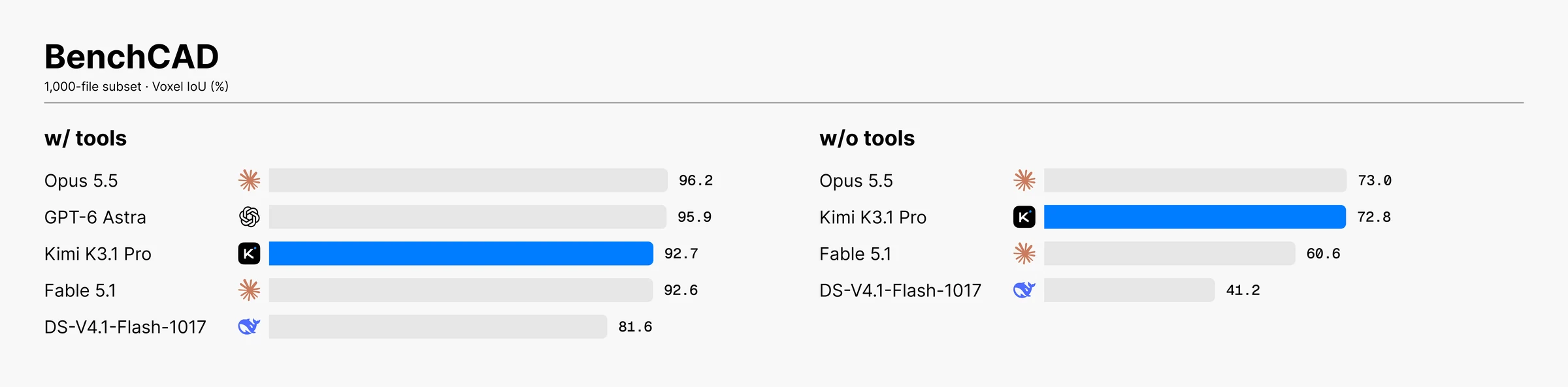
**K3.1 Pro 在 3D 创作和空间推理方面表现出色。**在 **BenchCAD** 上(该基准通过生成 CAD 代码来测试基于多视角渲染的 3D 重建),**K3.1 Pro 在使用工具时得分 92.7%**,接近 **Claude Opus 5.5(96.2%)**和 **GPT-6 Astra(95.9%)**的表现。根据文本简述、草图或参考图像,它能够推断形状、比例和空间关系,创建可用的 3D 模型。它对现有资产库和模型集合也有更强的掌握。
**K3.1 Pro 尤其擅长参数化建模,涵盖机械零件、建筑模型到可配置产品和定制家具。**无需 MCP 连接器,它就能为 Blender 和 CAD 软件等工具编写并运行脚本,以构建和优化资产、编辑组件,并调整几何形状、材质和场景布局。
以下是 K3.1 Pro 为品牌影片、游戏和交互式网页体验创建的 3D 资产示例:
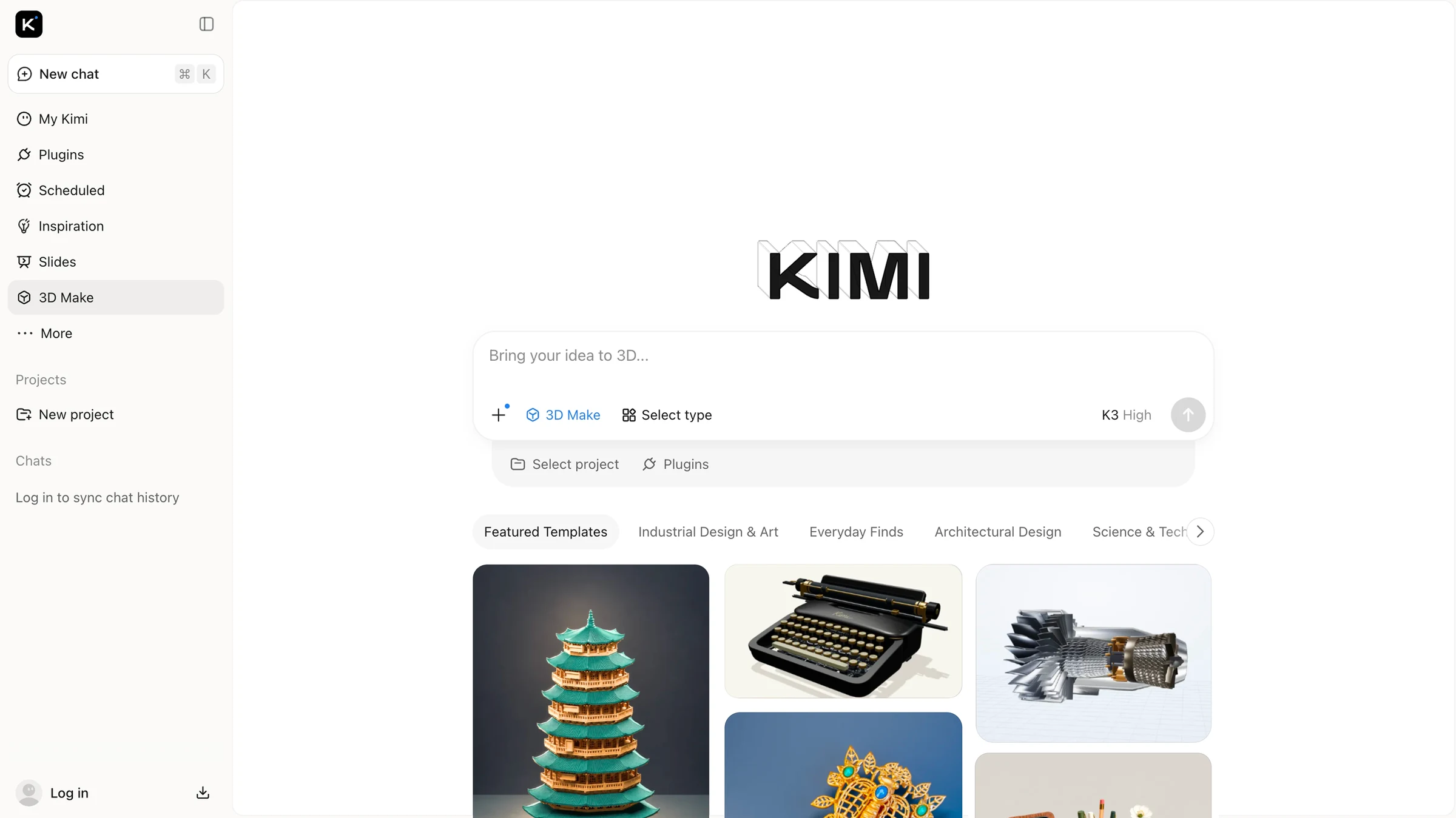
**3D Make** 现已在 [kimi.com](https://www.kimi.com/en) 和 Kimi 应用上线——在线预览和编辑你的 3D 模型,下载可直接用于 3D 打印的模型,或将其导出为视频或实况照片,随时随地分享。
## 金融
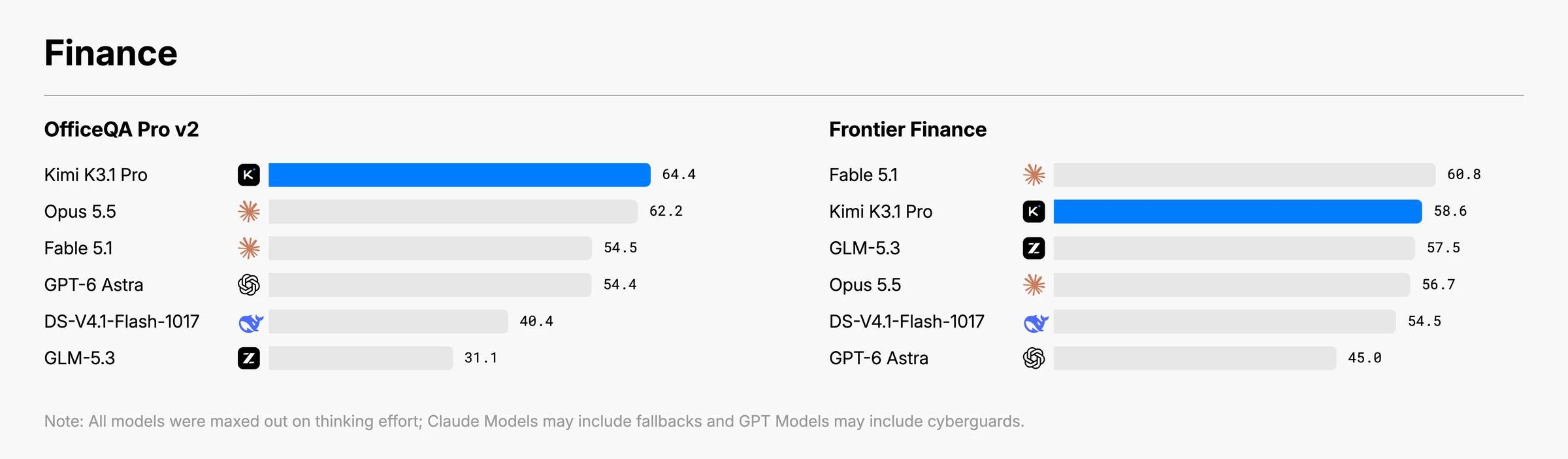
**凭借更强的推理和智能体能力,K3.1 Pro 能够端到端交付完整的金融工作流。K3.1 Pro 在 OfficeQA Pro v2 上取得最先进的结果(64.4),**该基准通过检索、跨文档验证和多步数值推理,测试对真实金融文档的复杂财务数据分析。在衡量从筛选到盈利能力分析的完整投资工作流支持的 Frontier Finance 上,K3.1 Pro 也较 K3 有所提升。
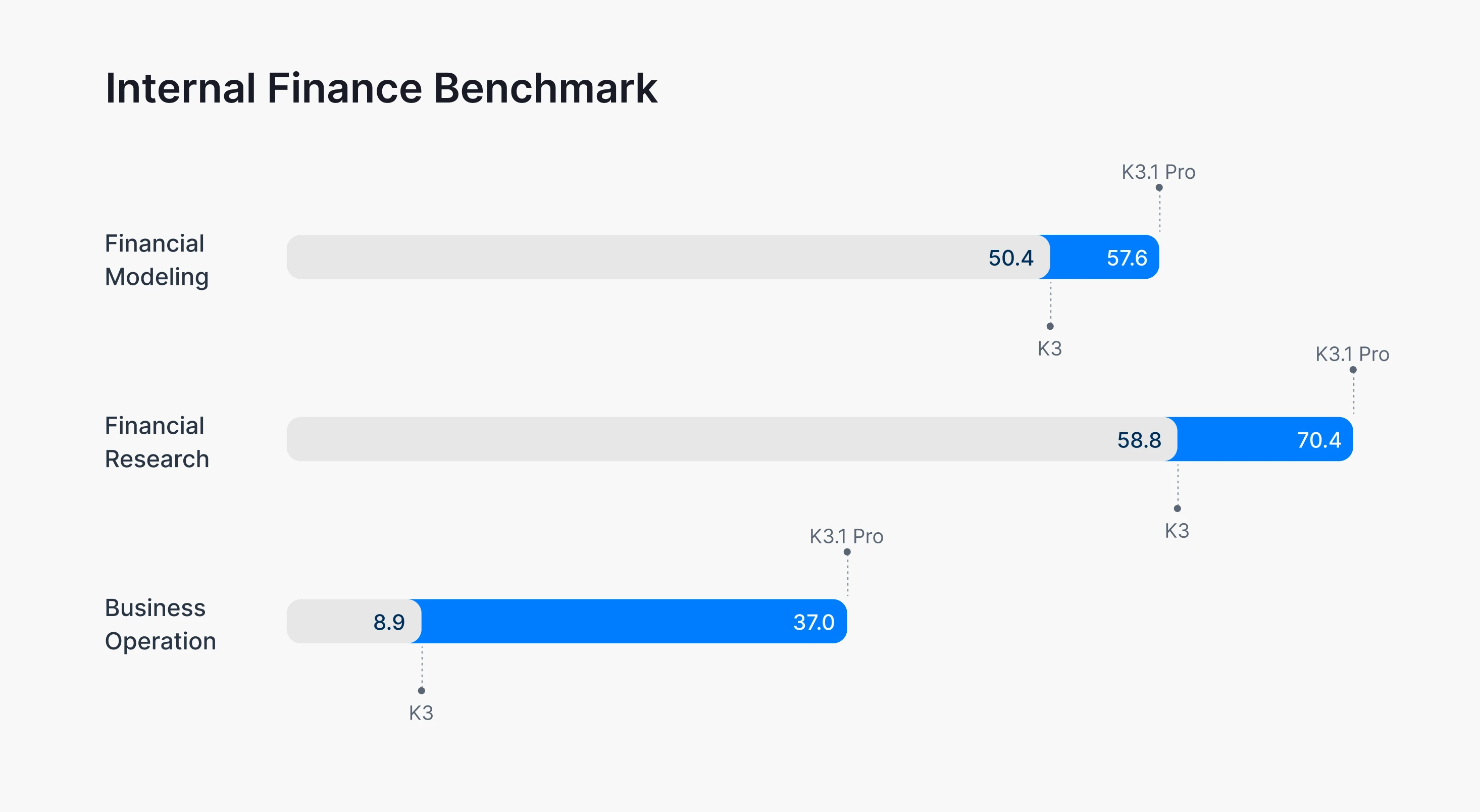
K3.1 Pro 在我们所有内部金融基准上也均有显著提升:
- **金融建模**评估真实建模任务中的公式联动、金融逻辑和最终工作簿质量。K3.1 Pro 较 K3 提升 7.2 分。
- **金融研究**评估模型能否在证据和截止时间约束下产出可审计的研究。K3.1 Pro 较 K3 提升 11.6 分。
- **商业运营**评估模拟商业环境中的长程管理和决策能力。K3.1 Pro 达到约 K3 的 4.2 倍表现。
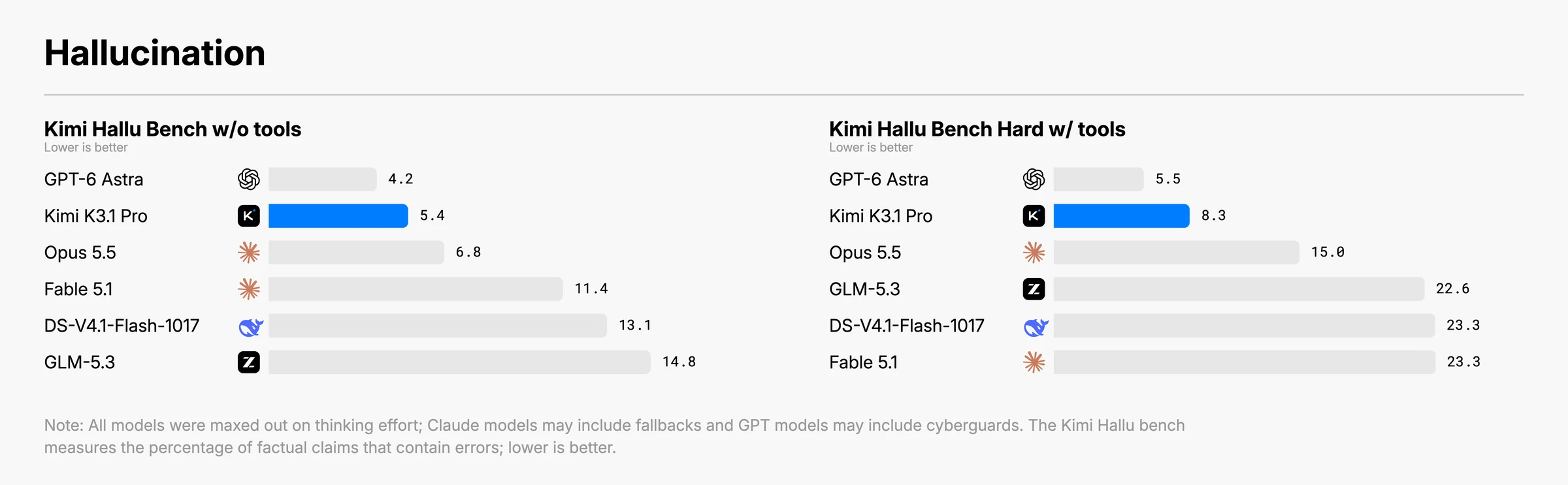
财务分析与投资研究对事实准确性的要求极高。为此,我们针对 K3.1 Pro 在真实任务和挑战性提示上的**事实准确性**进行了定向改进。在 Kimi Hallu Bench Hard 基准(我们内部用于压力测试事实准确性的基准)上,其声明级幻觉率从 K3 的 23.4% 降至 8.3%,而包含至少一处事实错误的回答占比仅为前代模型的 42.4%。(该评估是对事实准确性的压力测试,示例刻意设计用于探查模型容易出错的场景。所报告的比率不代表日常使用中的整体错误率。)
以下案例展示了 K3.1 Pro 在财务建模、投资分析和基于来源的研究中的实际表现:
## 网络安全
随着 K3.1 Pro 能力增强,我们相应投入了更大比例的努力来理解网络能力的来源,以及我们能在多大程度上控制它。因此,我们分析并评估了 K3.1 Pro 的漏洞研究能力,并在训练期间施加定向控制,以降低潜在滥用风险,同时保留通用实用性。
**识别并移除网络相关数据。**在开发过程中,我们观察到漏洞研究性能随着后训练规模扩大而稳步提升。追溯这一趋势的来源,我们发现网络相关内容嵌入在通用中期训练语料中,且网络相关任务存在于 RL 环境组合中——这是基于广泛数据训练的自然产物。在内部模型的初步实验中,我们发现若在中期训练或 RL 阶段均不移除数据,下游网络能力将大幅提升。这些发现为我们提供了具体的控制杠杆。对于 K3.1 Pro 的开放权重发布,我们在两个训练阶段均识别并移除了网络相关数据,同时保留了模型实用性所需的通用编程任务。我们将继续在每个训练阶段施加适当控制,网络相关数据的识别与限制便是其中一例。
**评估与结果。**数据清洗后,我们在 xdev-bench-hard 上评估了 K3.1 Pro,这是我们内部的基准,由专家策划、基于源代码的漏洞发现与利用任务构成,经过校准以在当前能力水平上提供有意义的区分度。大多数任务忠实复现了 Linux 内核、Node.js、JavaScriptCore、Exim 和 VirGL 等软件中近期披露的漏洞,并启用了缓解措施。每个任务提供存在漏洞的源代码、简短的缺陷提示以及相应的二进制文件;智能体必须开发漏洞利用,在独立沙箱中实现任意代码执行,并获取一个秘密字符串以供自动验证。我们报告随机运行子集上的 pass@3,不设硬性超时或输出 token 限制。
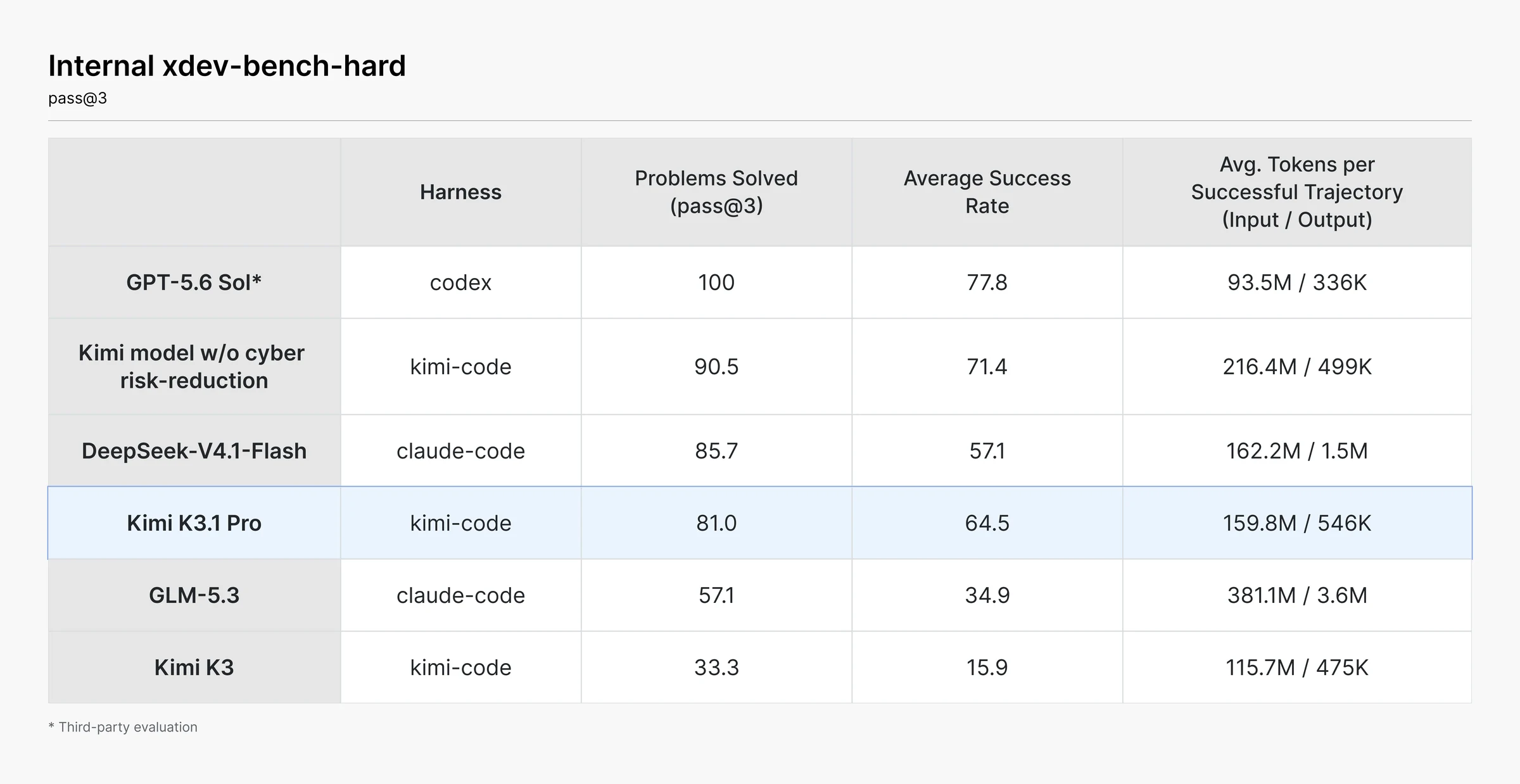
在 xdev-bench-hard 上,未采取这些风险降低措施(训练中期未移除网络相关数据,也未对网络相关 RL 环境进行过滤)的检查点,在 pass@3 下解决了 90.5% 的问题;最终的 K3.1 Pro 达到 81.0%。这一对比表明,相对于同一训练流程原本会产出的结果,数据移除显著降低了网络能力。与此同时,K3.1 Pro 较其前代有大幅提升,表明更强的通用编码与长程调试能力即使在定向数据移除之后,仍能泛化到网络任务上。K3.1 Pro 的网络能力仍落后于已公开可用至少三个月的前沿专有模型。我们将持续演进内部基准,使评估在模型能力不断进步时仍保持信息量。
**开放权重原则。**这些评估构成了我们开放权重发布决策的框架。第一,我们力求不发布会拓展网络能力绝对前沿的开放权重。K3.1 Pro 的进攻性网络能力在设计上低于我们流程所能产出的水平,并且仍落后于前沿专有模型。第二,我们打算逐步提升开放权重中可用的网络能力。我们相信,以非歧视的方式提供 K3.1 Pro 有利于那些需要两用能力用于防御目的的人。当一个有能力的模型是开放的、并在用户自己控制的基础设施上运行时,更多团队获得了审计其维护代码的手段——包括很少接受专门安全审查的遗留系统。我们相信,让这种能力逐步扩散——而不是集中在少数专有系统中——最终会让所有软件更加安全。
## 可用性
Kimi K3.1 Pro 今日在 Kimi 产品家族全面上线:[Kimi.com](https://www.kimi.com/en) 与 Kimi 移动应用、Kimi Work 和 Kimi Code,以及通过 [Kimi API](https://platform.kimi.com/) 提供。
完整模型权重将于 2026 年 11 月 4 日前发布。
[Kimi Enterprise 管理员](https://www.kimi.com/en/business)可为其组织启用 K3.1 Pro;发布时该访问权限默认关闭。
各渠道详情:
- **Kimi Agents:**从移动应用商店下载或更新至最新版 Kimi 应用,支持 iOS、Android 和 HarmonyOS,或访问 [kimi.com](https://www.kimi.com/en)。
- **使用 Kimi K3.1 Pro 工作:**下载最新的 [Kimi Work 桌面应用](https://www.kimi.com/en/products/kimi-work),版本 3.1.0 或更高,支持 Windows 和 Apple 芯片 Mac。
- **使用 Kimi K3.1 Pro 编码:**运行 [Kimi Code](https://www.kimi.com/code/en),并使用 `/model` 命令选择 Kimi K3.1 Pro。
- **使用 Kimi API 构建:**访问 [Kimi API 平台](https://platform.kimi.com/)并选择 kimi-k3.1-pro / kimi-k3.1-pro-highspeed。API 客户可享受零数据保留。
- **将 Kimi 引入你的组织:**[Kimi Business](https://www.kimi.com/en/business) 提供企业级数据隐私与成员管理,个人账户与组织账户完全隔离。访问定价页面并选择“Get Kimi Business”为你的团队订阅。
## 基准测试
## 脚注
除非另有说明,下文报告的所有 Kimi K3.1 Pro 结果均在推理强度设为“max”、temperature = 1.0、top-p = 0.95 的条件下获得。
### 编码基准测试
1. Terminal-Bench 4.0。Kimi K3.1 Pro 使用 Claude-Code harness 进行评估。DeepSeek-V4.1-Flash-1017 的数据取自发布博客([https://huggingface.co/deepseek-ai/DeepSeek-V4.1-Flash-1017](https://huggingface.co/deepseek-ai/DeepSeek-V4.1-Flash-1017))。其余所有分数均取其在博客文章或官方 Terminal-Bench 4.0 排行榜([https://www.tbench.ai/](https://www.tbench.ai/))中报告的最高值。
2. Terminal-Bench Science 0.1。Kimi K3.1 Pro 使用 Claude-Code harness 进行评估。我们对 DeepSeek-V4.1-Flash-1017 的内部评估得分为 9.3;但较早版本 DeepSeek-V4.1-Flash 在官方 Terminal-Bench Science 上得分为 15.7,因此我们在此报告 15.7;其余所有分数均来自官方 Terminal-Bench Science 排行榜([https://www.terminal-bench-science.ai/](https://www.terminal-bench-science.ai/))。
3. DeepSWE v1.1。Kimi K3.1 Pro 使用 Claude-Code harness 进行评估。所有分数均取自各模型各自的技术报告。GPT-6 Astra([https://openai.com/index/gpt-6-astra/](https://openai.com/index/gpt-6-astra/))。Claude Opus 5.5 和 Claude Fable 5.1([https://www.anthropic.com/claude-opus-5-5-system-card](https://www.anthropic.com/claude-opus-5-5-system-card) 和 [https://www.anthropic.com/claude-fable-5-1-mythos-5-1-system-card](https://www.anthropic.com/claude-fable-5-1-mythos-5-1-system-card));DeepSeek-V4.1-Flash-1017([https://api-docs.deepseek.com/news/news261017/](https://api-docs.deepseek.com/news/news261017/));GLM-5.3([https://z.ai/blog/glm-5.3](https://z.ai/blog/glm-5.3))。
4. SWE-Marathon v1.1。Kimi K3.1 Pro 使用 Claude-Code harness 进行评估。DeepSeek-V4.1-Flash-1017 使用 ClaudeCode harness 进行评估。其余所有分数均取自官方 SWE-Marathon 排行榜([https://www.swe-marathon.org/](https://www.swe-marathon.org/))。
5. PostTrainBench。Kimi K3.1 Pro 和 DeepSeek-V4.1-Flash-1017 在 v1.2 上使用 Claude-Code harness 和 H20 GPU(而非 H100 GPU)进行了内部评估。为稳定评估,所有评判模型均使用最大努力程度的 DeepSeek-V4.1-Flash-1017,其在测试中与官方 GPT-5.6-Terra(xhigh)评判模型最为匹配。其他分数来自官方排行榜([https://posttrainbench.com/](https://posttrainbench.com/))。
6. ProgramBench(二值分数)。我们报告二值分数而非原始 ProgramBench 分数:若任务的 ProgramBench 分数 ≥95%,则得分为 1,否则为 0。Kimi K3.1 Pro 使用 Claude-Code harness 进行评估。DeepSeek-V4.1-Flash-1017 和 GLM-5.3 的分数取自发布博客([https://huggingface.co/deepseek-ai/DeepSeek-V4.1-Flash-1017](https://huggingface.co/deepseek-ai/DeepSeek-V4.1-Flash-1017));其余所有分数均来自 Vals ProgramBench 排行榜([https://www.vals.ai/benchmarks/programbench](https://www.vals.ai/benchmarks/programbench))。
7. 内部编码基准:Kimi Code Bench 2.0 和 Kimi Code Bench 3.0 Long-horizon。Kimi K3.1 Pro 使用 Claude-Code harness 进行评估;所有其他模型均在其最大努力设置下进行评估。请注意,专有模型测试可能涉及一些回退行为。
8. BenchCAD。开放模型由我们在从完整的 17,900 个案例的 Vision2Code 数据集中随机抽样的 1,000 个案例子集上以最大推理努力进行评估。带工具的结果使用 Claude Code harness;不带工具的结果使用官方 BenchCAD 提示词和评分流程进行单次生成。Claude Fable 5.1 和 Claude Opus 5.5 的分数取自 [Claude Opus 5.5 System Card](https://www-cdn.anthropic.com/fc1b44717c85dc068bc6ba5024219938094694bd/Claude%20Opus%205.5%20System%20Card.pdf);GPT‑6 Astra 的带工具分数取自其[官方报告](https://openai.com/zh-Hans-CN/index/gpt-6-astra/)。GPT‑6 Astra 未报告不带工具分数,标记为“—”。
### Agentic 基准
1. BioMysteryBench 数据集取自[官方 v11 版本](https://huggingface.co/datasets/Anthropic/BioMysteryBench-full/commit/b5a889c),以 Kimi K3 作为评判模型。我们评估了使用 Kimi Code 的 Kimi K3.1 Pro、使用 Claude Code 的 GLM-5.3 和 DeepSeek-V4.1-Flash-1017,以及使用 Codex 的 GPT-6 Astra。Claude 模型的分数直接取自其官方系统卡。
2. Our Agents’ Last Exam 数据集取自[官方 v1.1 版本](https://github.com/rdi-berkeley/agents-last-exam),包含 122 项任务,其中 86 项为 CLI 任务,环境镜像与官方 Hugging Face 发布版本保持一致。此外,对于绕过任务既定要求的运行,例如在线检索答案而非在 Wireshark 中执行所需分析,我们将其分数记为零分。DeepSeek 和 Kimi 分别使用 Claude Code 和 Kimi Code 进行评估。其余结果均取自官方基准网站。
3. OfficeQA Pro、OfficeQA Pro v2。GPT-6 Astra 使用 Codex 评估,其余所有模型均使用 Claude Code 评估。每项任务向智能体提供完整的 PDF 语料库,所有 PDF 均以图像形式呈现,不提供机器可读文本。我们在某些外部模型的轨迹中观察到其在线检索参考答案的情况;因此,我们将这些任务的分数记为零分。
4. Frontier Finance 使用官方 finance agent v2 harness 进行评估。
5. HANDBOOK.md 使用基于 OpenHands 构建的官方 harness 进行评估,评估任务取自该基准早期开源的 v1 版本。
6. Harvey Legal Agent 在包含 1,251 项任务的公开数据集上使用 Artificial Analysis 的 Stirrup harness 进行评估,性能以全通过率(即通过所有评分标准的任务百分比)报告。
7. OSWorld V2.1 在官方 OSWorld v2 仓库中使用 Kimi Agent harness 进行评估,而 GPT-6 Astra 的分数取自 Muse Wonder 的技术报告。
8. DECK-Arena 评估基于真实世界查询的演示文稿生成,而 Design Bench 通过直接提示和参考图像少样本提示覆盖平面设计;两者均在集成了搜索和图像生成的 harness 中,跨 python-pptx、pptxjs 和 Kimi 自研 DSL 运行模型,并使用基于 10,000+ 人类判断校准的自动评分器。
9. MCP Atlas。所有模型均在 500 项任务的公开子集上以 100 轮为上限进行评估,使用 Gemini 3.1 Pro 作为评判模型。
10. BrowseComp。我们采用 Claude 模型卡中使用的上下文压缩策略,在 200K token 时触发。我们允许最多 500 步;若在任务完成前达到该上限,我们强制智能体给出答案,随后对其进行评判。所有 BrowseComp 运行均在 temperature=1.0 和 top-p=1.0 下进行。
11. GDPval-AA v2.1、AA-Briefcase v1.1 和 AutomationBench-AA 的分数引自[https://artificialanalysis.ai/](https://artificialanalysis.ai/),Apex Agents 的分数引自[https://www.mercor.com/apex/apex-agents-leaderboard/](https://www.mercor.com/apex/apex-agents-leaderboard/)
12. GDP.pdf w/ python、ZeroBench w/ python 和 ChartoGraphy w/ python 的结果为五次运行的平均值。其他多模态基准(w/ python)为四次运行的平均值。对于 GDP.pdf w/ python:每个原始 PDF 文件被发送到沙箱,模型可在其中使用 IPython 工具进行处理。最终回答使用 Gemini-3.5-Flash(中等推理强度)和官方评判提示词,依据每条评分标准进行评分。我们报告任务宏平均评分标准通过率:对于每个任务,我们对五次独立运行中通过的评分标准比例取平均,然后对所有任务的这些任务级分数等权平均。
### 推理与知识 & 多模态基准
1. GDP.pdf。每个 PDF 以页面图像形式提供,最长边缩放至 1,152 像素,并按页面顺序与 Docling 提取的文本交错排列。回答使用 Gemini-3.5-Flash Medium 和官方评判提示词,依据每条评分标准进行评分。我们报告完全评分回答中的严格通过率。
2. HLE 和 HLE-Diamond 评估通用知识与推理能力。我们报告在完整评估集上的准确率,其中 HLE 有 2,500 道题,HLE-Diamond 有 1,000 道题。对于标有星号(\*)的模型,准确率报告在纯文本题目子集上。
3. GDP.pdf、ZeroBench 和 ChartoGraphy 为五次运行的平均值。其他多模态基准为四次运行的平均值。GLM-5.3 Max 和 DeepSeek-V4.1-Flash-1017 Max 的 GDP.pdf 分数引自 [https://artificialanalysis.ai/](https://artificialanalysis.ai/)。
4. MMMU-Pro 按照官方协议进行评估,保留原始输入顺序,并将图像前置到文本输入之前。
5. Kimi Hallucination Benchmark 在内部一组取自实际工作任务、经过脱敏处理的挑战性提示词上评估事实准确性。我们报告由事实核查代理评估的声明级幻觉率。
### 网络安全基准
1. ExploitBench。Kimi K3.1 Pro 使用官方 ExploitBench 测试框架在 300 轮预算下进行评估。我们报告 pass@5 最大能力分数:对于每个环境,取 5 个随机种子中最佳的一次运行,按达到的 16 项能力标志数量评分,其中实现任意代码执行计为达到全部 16 项能力。GPT-6 Astra 的分数取自 [https://openai.com/index/gpt-6-astra/](https://openai.com/index/gpt-6-astra/);Claude Opus 5.5 和 Claude Mythos 5.1 的分数取自 [https://www.anthropic.com/claude-opus-5-5-system-card](https://www.anthropic.com/claude-opus-5-5-system-card);GLM-5.3 的分数取自 [https://z.ai/blog/glm-5.3](https://z.ai/blog/glm-5.3)。
2. ExploitGym。Kimi K3.1 Pro 使用 KimiCode 测试框架,在每个任务 6 小时实际时间预算下进行评估。GPT-6 Astra 的分数取自 [https://openai.com/index/gpt-6-astra/](https://openai.com/index/gpt-6-astra/);Claude Opus 5.5 和 Claude Mythos 5.1 的分数取自 [https://www.anthropic.com/claude-opus-5-5-system-card](https://www.anthropic.com/claude-opus-5-5-system-card)(6 小时预算下);GLM-5.3 的分数取自 [https://z.ai/blog/glm-5.3](https://z.ai/blog/glm-5.3)。
3. xdev-Bench-hard:Kimi K3.1 Pro 使用 KimiCode 测试框架进行评估。GLM-5.3 和 DeepSeek-V4.1-Flash-1017 使用 Claude Code 测试框架进行评估。
## 正文 · 原文
## Introducing Kimi K3.1 Pro
We're introducing **Kimi K3.1 Pro**, the first model in our new K3.1 series and our most capable 3T-class open-weight model to date, with a 1-million-token context window. It delivers substantial improvements across coding, 3D creation, financial research, and other agentic capabilities.
We are also releasing **Kimi K3.1 Pro Highspeed**, which delivers 2-3× the speed of K3.1 Pro for more responsive interactions.
Kimi K3.1 Pro and Kimi K3.1 Pro Highspeed are available today on [Kimi.com](https://www.kimi.com/en), [Kimi Work](https://www.kimi.com/en/products/kimi-work), [Kimi Code](https://www.kimi.com/code/en), and the [Kimi API](https://platform.kimi.com/). The full model weights will be released by Nov 4.

## Advancing the Frontier of Open Intelligence
Kimi K3.1 Pro is a post-trained version of Kimi K3, with substantially larger post-training compute. To enable large-scale joint RL across **hundreds of downstream domains**, we optimized every layer of the stack — the RL framework, long-context inference, training efficiency, sandbox infrastructure, rollout scheduling, and a shared platform for environment quality checks — so that each increment of RL compute delivers stable, predictable returns. As a result, K3.1 Pro achieves consistent gains in every domain.
Across coding, agentic, and knowledge benchmarks, K3.1 Pro matches or approaches the strongest proprietary models. On **Terminal-Bench 4.0**, which evaluates coding agents on realistic, resource-constrained terminal tasks using strict task-specific tests, **K3.1 Pro scores 65.7%, ahead of GPT-6 Astra (58.2%) and narrowly behind Claude Opus 5.5 (66.4%)**. And on **Kimi Code Bench 3.0 Long-horizon**, our internal benchmark that tests coding agents' multi-step execution, tool use, and end-to-end problem solving across diverse engineering domains, K3.1 Pro scores **61.2%**, above K3's **55.95%**.
## Coding
**K3.1 Pro covers the full range of coding work, from quick fixes in real codebases to full-project builds. It also brings a more considered visual style to games and web experiences, and knows how to build them with the right tools.**
K3.1 Pro works effectively across game engines such as **Unity, Unreal Engine, and Godot**, combining them with web search and 3D generation to create complete experiences. Its front-end pages, interactive Three.js scenes, and 3D assets show stronger composition, typography, animation, and polish. The examples below were created end to end by K3.1 Pro:
**K3.1 Pro's long-horizon coding capabilities are also strengthened through large-scale reinforcement learning.** In one internal test, it built a human walking dynamics simulator with integrated training and evaluation pipelines on top of [_human-atlas_](https://github.com/ashemag/human-atlas), an open-source anatomical model of the human body comprising 296 skeletal components, including cartilage, and 402 muscle components. Across 167 missions and 420 independent reviews, it analyzed experimental results, diagnosed problems, and iteratively refined the walking controller, enabling the simulated human to go from collapsing within seconds to walking continuously with alternating strides for 11.2 seconds. When reward shaping failed to improve arm motion, K3.1 Pro did not simply keep adjusting the reward: it ran open-loop probes of the simulator's dynamics, identified and corrected 36 errors in shoulder-muscle moment-arm calculations, and then retrained the controller.
## 3D Modeling and Design
**K3.1 Pro is strong at 3D creation and spatial reasoning.** On **BenchCAD**, which tests 3D reconstruction from multi-view renderings through CAD code generation, **K3.1 Pro scores 92.7% with tools**, approaching the performance of **Claude Opus 5.5 (96.2%)** and **GPT-6 Astra (95.9%)**. From a text brief, sketch, or reference image, it can infer shape, proportions, and spatial relationships to create usable 3D models. It also has a stronger grasp of existing asset libraries and model collections.

**K3.1 Pro particularly excels at parametric modeling, from mechanical parts and architectural models to configurable products and custom furniture.** Without MCP connectors, it can write and run scripts for tools like Blender and CAD software to build and refine assets, edit components, and adjust geometry, materials, and scene layout.
Below are examples of 3D assets K3.1 Pro created for brand films, games, and interactive web experiences:
**3D Make** is now live on [kimi.com](https://www.kimi.com/en) and the Kimi app — preview and edit your 3D models online, download them ready for 3D printing, or export them as videos or Live Photos to share anywhere.

## Finance
**With stronger reasoning and agentic capability, K3.1 Pro is capable of end-to-end delivery of complete financial workflows. K3.1 Pro achieves state-of-the-art results on OfficeQA Pro v2 (64.4),** which tests complex fiscal data analysis over real financial documents through retrieval, cross-document verification, and multi-step numerical reasoning. K3.1 Pro also improves over K3 on Frontier Finance, which measures support for complete investment workflows from screening to profitability analysis.

K3.1 Pro also improves significantly across all our internal finance benchmarks:
- **Financial Modeling** evaluates formula linkage, financial logic, and final workbook quality in real-world modeling tasks. K3.1 Pro improves on K3 by 7.2 points.
- **Financial Research** evaluates whether models can produce auditable research under evidence and cutoff constraints. K3.1 Pro improves on K3 by 11.6 points.
- **Business Operation** evaluates long-horizon management and decision-making in a simulated business environment. K3.1 Pro achieves about 4.2× K3's performance.

Financial analysis and investment research demand a high degree of factual accuracy. To address this, we made targeted improvements to K3.1 Pro's **factual accuracy** on real-world tasks and challenging prompts. On Kimi Hallu Bench Hard bench, an internal benchmark designed to stress-test factual accuracy, its claim-level hallucination rate fell from 23.4% for K3 to 8.3%, while the share of responses containing at least one factual error was just 42.4% of its predecessor's rate. (The evaluation is a stress test for factual accuracy, with examples deliberately crafted to probe situations where models are prone to errors. The reported rates do not represent overall error rates in daily use.)

The cases below show how K3.1 Pro handles financial modeling, investment analysis, and source-grounded research in practice:
## Cybersecurity
As K3.1 Pro became more capable, we spent a correspondingly larger share of our effort understanding where cyber capability comes from, and how much of it we can control. We therefore analyzed and evaluated K3.1 Pro's vulnerability research capabilities, and applied targeted controls during training to reduce potential misuse risk while preserving general usefulness.
**Identifying and removing cyber-related data.** During development, we observed vulnerability research performance improving steadily as post-training scaled. Tracing the source of this trend, we found that cyber-related content was embedded within the general mid-training corpus, and cyber-related tasks were present in the RL environment mix — a natural byproduct of training on broad data. In preliminary experiments on internal models, we found that without data removal at either the mid-training or the RL stage, downstream cyber capability would increase substantially. These findings gave us a concrete lever for control. For the open-weight release of K3.1 Pro, we identified and removed cyber-related data from both training stages, while retaining the general-purpose coding tasks needed for model usefulness. We will continue to apply appropriate controls at every training stage, of which cyber-related data identification and restriction is one example.
**Evaluation and results.** After data cleaning, we evaluated K3.1 Pro on xdev-bench-hard, our in-house benchmark of expert-curated, source-code-based vulnerability discovery and exploitation tasks, calibrated to provide meaningful differentiation at our current capability level. Most tasks faithfully reproduce recently disclosed vulnerabilities in software such as the Linux kernel, Node.js, JavaScriptCore, Exim, and VirGL, with mitigations enabled. Each task provides the vulnerable source code, a short bug hint, and the corresponding binary; the agent must develop an exploit, achieve arbitrary code execution in a separate sandbox, and retrieve a secret string for automated verification. We report pass@3 over a random subset of runs, with no hard timeouts or output token limits.

On xdev-bench-hard, the checkpoint without these risk-reduction measures — no cyber-related data removal at mid-training and no cyber-related RL environment filtering — solves 90.5% of problems at pass@3; the final K3.1 Pro reaches 81.0%. The comparison shows that data removal meaningfully reduces cyber capability relative to what the same training pipeline would otherwise produce. At the same time, K3.1 Pro improves substantially over its predecessor, indicating that stronger general coding and long-horizon debugging capabilities generalize to cyber tasks even after targeted data removal. K3.1 Pro's cyber capability remains behind that of frontier proprietary models that have been publicly available for at least three months. We will keep evolving our internal benchmarks so that evaluation stays informative as model capabilities continue to advance.
**Open-weight principles.** These evaluations frame our open-weight release decision. First, we aim not to release open weights that would extend the absolute frontier of cyber capability. K3.1 Pro's offensive cyber capability is, by design, below what our pipeline can produce, and remains behind that of frontier proprietary models. Second, we intend to progressively raise the cyber capability available in open weights. We believe making K3.1 Pro available in a non-discriminatory way benefits people who need dual-use capabilities for defensive purposes. When a capable model is open and runs on infrastructure its users control, many more teams gain the means to audit the code they maintain — including legacy systems that rarely receive dedicated security reviews. We believe that letting this capability diffuse gradually — rather than concentrating it in a few proprietary systems — ultimately makes all software more secure.
## Availability
Kimi K3.1 Pro rolls out today across the Kimi product family: on [Kimi.com](https://www.kimi.com/en) and the Kimi mobile apps, Kimi Work and Kimi Code, and through the [Kimi API](https://platform.kimi.com/).
Full model weights will be released by Nov 4, 2026.
[Kimi Enterprise administrators](https://www.kimi.com/en/business) can enable K3.1 Pro for their organization; access is off by default at launch.
Details for each channel:
- **Kimi Agents:** Download or update to the latest Kimi app from your mobile app store, available on iOS, Android, and HarmonyOS, or visit [kimi.com](https://www.kimi.com/en).
- **Work with Kimi K3.1 Pro:** Download the latest [Kimi Work desktop app](https://www.kimi.com/en/products/kimi-work), version 3.1.0 or later, available for Windows and Apple silicon Macs.
- **Code with Kimi K3.1 Pro:** Run [Kimi Code](https://www.kimi.com/code/en) and select Kimi K3.1 Pro using the `/model` command.
- **Build with the Kimi API:** Visit the [Kimi API Platform](https://platform.kimi.com/) and select kimi-k3.1-pro / kimi-k3.1-pro-highspeed. Zero Data Retention is available for API customers.
- **Bring Kimi to your organization:** [Kimi Business](https://www.kimi.com/en/business) provides enterprise-grade data privacy and member management, with complete separation between personal and organization accounts. Visit the pricing page and select “Get Kimi Business” to subscribe for your team.
## Benchmarks
## Footnotes
Unless otherwise specified, all Kimi K3.1 Pro results reported below are obtained with the reasoning effort set to 'max', temperature = 1.0, and top-p = 0.95.
### Coding benchmarks
1. Terminal-Bench 4.0. Kimi K3.1 Pro is evaluated with the Claude-Code harness. The DeepSeek-V4.1-Flash-1017 is taken from the release blog ([https://huggingface.co/deepseek-ai/DeepSeek-V4.1-Flash-1017](https://huggingface.co/deepseek-ai/DeepSeek-V4.1-Flash-1017)). All remaining scores are taken as the maximum value reported in either their blog posts or the official Terminal-Bench 4.0 leaderboard ([https://www.tbench.ai/](https://www.tbench.ai/)).
2. Terminal-Bench Science 0.1. Kimi K3.1 Pro is evaluated with the Claude-Code harness. Our internal evaluation of DeepSeek-V4.1-Flash-1017 yields a score of 9.3; However, an older version, DeepSeek-V4.1-Flash, scores 15.7 on the official Terminal-Bench Science, so we report 15.7 here; all remaining scores are from the official Terminal-Bench Science leaderboard ([https://www.terminal-bench-science.ai/](https://www.terminal-bench-science.ai/)).
3. DeepSWE v1.1. Kimi K3.1 Pro is evaluated with the Claude-Code harness. All scores are taken from each model's respective technical report. GPT-6 Astra([https://openai.com/index/gpt-6-astra/](https://openai.com/index/gpt-6-astra/)). Claude Opus 5.5 and Claude Fable 5.1([https://www.anthropic.com/claude-opus-5-5-system-card](https://www.anthropic.com/claude-opus-5-5-system-card) and [https://www.anthropic.com/claude-fable-5-1-mythos-5-1-system-card](https://www.anthropic.com/claude-fable-5-1-mythos-5-1-system-card)); DeepSeek-V4.1-Flash-1017 ([https://api-docs.deepseek.com/news/news261017/](https://api-docs.deepseek.com/news/news261017/)); GLM-5.3 ([https://z.ai/blog/glm-5.3](https://z.ai/blog/glm-5.3)).
4. SWE-Marathon v1.1. Kimi K3.1 Pro is evaluated with the Claude-Code harness. DeepSeek-V4.1-Flash-1017 is evaluated with the ClaudeCode harness. All other scores are taken from the official SWE-Marathon leaderboard ([https://www.swe-marathon.org/](https://www.swe-marathon.org/)).
5. PostTrainBench. Kimi K3.1 Pro and DeepSeek-V4.1-Flash-1017 were evaluated internally on v1.2 using the Claude-Code harness and H20 GPUs instead of H100 GPUs. For stable evaluation, all judge models used DeepSeek-V4.1-Flash-1017 at maximum effort, which best matched the official GPT-5.6-Terra (xhigh) judge in testing. Other scores are from the official leaderboard ([https://posttrainbench.com/](https://posttrainbench.com/)).
6. ProgramBench (binary score). We report binary scores rather than raw ProgramBench scores: a task receives a score of 1 if its ProgramBench score is ≥95%, and 0 otherwise. Kimi K3.1 Pro is evaluated with the Claude-Code harness. The DeepSeek-V4.1-Flash-1017 and GLM-5.3 scores are taken from the release blog ([https://huggingface.co/deepseek-ai/DeepSeek-V4.1-Flash-1017](https://huggingface.co/deepseek-ai/DeepSeek-V4.1-Flash-1017)); all remaining scores are from the Vals ProgramBench leaderboard ([https://www.vals.ai/benchmarks/programbench](https://www.vals.ai/benchmarks/programbench)).
7. Internal Coding Bench: Kimi Code Bench 2.0 and Kimi Code Bench 3.0 Long-horizon. Kimi K3.1 Pro is evaluated with Claude-Code harnesses; All other models are evaluated at their max-effort setting. Note that proprietary model testing may involve some fallback behavior.
8. BenchCAD. Open models are evaluated by us on 1,000-case subsets randomly sampled from the full 17,900-case Vision2Code dataset, at maximum reasoning effort. With-tools results use the Claude Code harness; without-tools results use single-shot generation with the official BenchCAD prompts and scoring pipeline. Scores for Claude Fable 5.1 and Claude Opus 5.5 are taken from the [Claude Opus 5.5 System Card](https://www-cdn.anthropic.com/fc1b44717c85dc068bc6ba5024219938094694bd/Claude%20Opus%205.5%20System%20Card.pdf); GPT‑6 Astra’s with-tools score is taken from its [official report](https://openai.com/zh-Hans-CN/index/gpt-6-astra/). GPT‑6 Astra has not reported a without-tools score and is marked “—”.
### Agentic benchmarks
1. BioMysteryBench dataset is drawn from the [official v11 release](https://huggingface.co/datasets/Anthropic/BioMysteryBench-full/commit/b5a889c), with Kimi K3 as the judge model. We evaluate Kimi K3.1 Pro with Kimi Code, GLM-5.3 and DeepSeek-V4.1-Flash-1017 with Claude Code, and GPT-6 Astra with Codex. Scores for the Claude models are taken directly from their official system cards.
2. Our Agents’ Last Exam dataset is drawn from the [official v1.1 release](https://github.com/rdi-berkeley/agents-last-exam), comprising 122 tasks, including 86 CLI tasks, with environment images aligned with the official Hugging Face release. We additionally assign a score of zero to runs that bypass the task’s stated requirements, such as retrieving answers online instead of performing the required analysis in Wireshark. DeepSeek and Kimi are evaluated using Claude Code and Kimi Code, respectively. All other results are taken from the official benchmark website.
3. OfficeQA Pro, OfficeQA Pro v2. GPT-6 Astra is evaluated with Codex, while all other models are evaluated with Claude Code. Each task provides the agent with the entire PDF corpus, with all PDFs rendered as images and no machine-readable text available. We observed instances in the trajectories of certain external models where they retrieved reference answers online; Consequently, we assigned a score of zero to these tasks.
4. Frontier Finance is evaluated with the official finance agent v2 harness.
5. HANDBOOK.md is evaluated using the official harness built on OpenHands, with evaluation tasks drawn from the benchmark’s early open-source v1 release.
6. Harvey Legal Agent is evaluated on a public dataset of 1,251 tasks using Artificial Analysis’s Stirrup harness, with performance reported as the all-pass rate (i.e., the percentage of tasks that pass all rubric criteria).
7. OSWorld V2.1 is evaluated with the Kimi Agent harness in the official OSWorld v2 repo, while GPT-6 Astra's score is taken from Muse Wonder's technical report.
8. DECK-Arena evaluates presentation generation on real-world queries, while Design Bench covers graphic design via direct and reference-image few-shot prompting; Both run models across python-pptx, pptxjs, and Kimi's in-house DSL in a harness with integrated search and image generation, using an automated grader calibrated on 10,000+ human judgments.
9. MCP Atlas. All models are evaluated on the 500-task public subset with a 100-turn limit, using Gemini 3.1 Pro as the judge.
10. BrowseComp. We adopt the context-compaction strategy used in the Claude model cards, triggered at 200K tokens. We allow a maximum of 500 steps; if this limit is reached before a task is completed, we force the agent to provide an answer, which is then judged. All BrowseComp runs are conducted with temperature=1.0 and top-p=1.0.
11. GDPval-AA v2.1, AA-Briefcase v1.1 and AutomationBench-AA scores are cited from [https://artificialanalysis.ai/](https://artificialanalysis.ai/), Apex Agents scores are cited from [https://www.mercor.com/apex/apex-agents-leaderboard/](https://www.mercor.com/apex/apex-agents-leaderboard/)
12. GDP.pdf w/ python, ZeroBench w/ python and ChartoGraphy w/ python are averaged over five runs. Other multimodal benchmarks (w/ python) are averaged over four runs. For GDP.pdf w/ python: Each original PDF file is sent to the sandbox, where the model can use IPython tool to process it. Final responses are graded against each rubric criterion using Gemini-3.5-Flash (medium reasoning effort) and the official judging prompt. We report the task-macro mean rubric pass rate: for each task, we average the fraction of rubric criteria passed over five independent runs, then average these task-level scores equally across all tasks.
### Reasoning & Knowledge & Multimodal benchmarks
1. GDP.pdf. Each PDF is provided as page images resized to a longest edge of 1,152 pixels, interleaved with Docling-extracted text in page order. Responses are graded against each rubric criterion using Gemini-3.5-Flash Medium and the official judging prompt. We report the strict pass rate among fully scored responses.
2. HLE and HLE-Diamond evaluate general knowledge and reasoning capabilities. We report accuracy on the full evaluation sets, with 2,500 questions for HLE and 1,000 questions for HLE-Diamond. For models marked with an asterisk (\*), accuracy is reported on the text-only subset of questions.
3. GDP.pdf, ZeroBench and ChartoGraphy are averaged over five runs. Other multimodal benchmarks are averaged over four runs. GDP.pdf scores of GLM-5.3 Max and DeepSeek-V4.1-Flash-1017 Max is cited from [https://artificialanalysis.ai/](https://artificialanalysis.ai/).
4. MMMU-Pro is evaluated following the official protocol, preserving the original input order and prepending images to the text input.
5. Kimi Hallucination Benchmark evaluates factual accuracy on an internal set of challenging, de-identified prompts drawn from practical work tasks. We report the claim-level hallucination rate assessed by fact-checking agents.
### Cybersecurity benchmarks
1. ExploitBench. Kimi K3.1 Pro is evaluated with the official ExploitBench harness under the 300-turn budget. We report the pass@5 max capability score: for each environment, the best run across 5 seeds, scored by the number of capability flags reached out of 16, where achieving arbitrary code execution counts as achieving all 16 capabilities. The GPT-6 Astra score is taken from [https://openai.com/index/gpt-6-astra/](https://openai.com/index/gpt-6-astra/); the Claude Opus 5.5 and Claude Mythos 5.1 scores are taken from [https://www.anthropic.com/claude-opus-5-5-system-card](https://www.anthropic.com/claude-opus-5-5-system-card); the GLM-5.3 score is taken from [https://z.ai/blog/glm-5.3](https://z.ai/blog/glm-5.3).
2. ExploitGym. Kimi K3.1 Pro is evaluated with the KimiCode harness under a 6-hour wall-clock budget per task. The GPT-6 Astra score is taken from [https://openai.com/index/gpt-6-astra/](https://openai.com/index/gpt-6-astra/); the Claude Opus 5.5 and Claude Mythos 5.1 scores are taken from [https://www.anthropic.com/claude-opus-5-5-system-card](https://www.anthropic.com/claude-opus-5-5-system-card) at the 6-hour budget; the GLM-5.3 score is taken from [https://z.ai/blog/glm-5.3](https://z.ai/blog/glm-5.3).
3. xdev-Bench-hard: Kimi K3.1 Pro is evaluated with the KimiCode harness. GLM-5.3 and DeepSeek-V4.1-Flash-1017 are evaluated with the Claude Code harness.