# Anthropic 用 Claude 设计出针对蝎子神经毒素的蛋白质迷你结合剂
> 原标题:How Claude designed protein binders against scorpion neurotoxins
- 来源:Anthropic:Research
- 发布时间:2026-10-19T16:00:00.000Z
- AIHOT:https://aihot.news/items/oxl50pfymja6rgxkem3y0de9j
- 原文:https://www.anthropic.com/research/claude-scorpion-toxin-binder-design
## 摘要
Anthropic 让内部研究模型在 Claude Science 中主要自主运行 64 小时,设计针对五种蝎子神经毒素的蛋白质迷你结合剂,共生成 318,484 个设计、筛选出 180 个。
## 推荐理由
原文完整披露设计流程、筛选标准和实验数据,读者可以了解 AI 驱动蛋白质设计在被忽视疾病上的真实进展与局限。
## 正文 · 中文译文
_**摘要:**作为我们探索 Claude 如何帮助加速药物发现工作的一部分,我们让一个内部研究模型设计针对蝎子神经毒素的_minibinders_(能紧密附着于靶标的小型蛋白质)。Claude 根据我们的提示词以及四次后续指令开展工作,这些指令是我们与金融投资研究公司 Citrini Research 合作制定的。Adaptyv Bio 和 Twist Bioscience 的团队对 211 个设计进行了结合实验测试。其中,17 个符合我们的标准。我们将全部 211 个设计及其数据作为该领域的资源公开发布。_
今年 8 月,我们展示了[Claude 在获得单条提示词后如何设计蛋白质 minibinders](https://www.anthropic.com/research/Claude-accelerates-protein-design)。在我们发布这些结果的一个月前,[Citrini Research](https://www.citriniresearch.com/) 的一个团队向我们提出了一个有趣的问题:Claude(以及更广泛意义上的 AI 药物发现)能否让一群有积极性的非专家解决人类健康中的一个真实问题?我们生命科学研究团队的成员着手回答这个问题,首先与 Claude 一起进行头脑风暴。我们最终决定请 Claude 帮助设计针对蝎子神经毒素的新型蛋白质结合体,希望它们有朝一日能用于开发蝎子抗蛇毒血清。
每年有 120 万人或更多人被蝎子蜇伤,导致超过 3,250 人死亡,其中大多是医疗条件有限地区的儿童。新疗法的生产成本高昂,而且也不太可能收回开发成本。由于投资如此之少,蝎子蜇伤中毒[被描述为](https://gh.bmj.com/content/10/11/e020682)一种被忽视的热带疾病。
我们首先将早先蛋白质结合体研究中使用的相同提示词交给 Claude,并用 Citrini 对其进行了修改。1在接下来的 64 小时里,一个内部研究模型在 Claude Science 中运行,主要自主工作,不过我们用四次后续指令指导了它的工作。在我们的监督下,Claude 分析了研究数据、生成了图表,并起草了最终报告。
Claude 的设计活动产生了 17 个蛋白质结合体,它们各自与四种已知对人类危险的蝎子神经毒素之一结合。在整个过程中,Claude 生成了 318,484 个蛋白质设计,并从中选出 180 个进行测试。在 Claude 的帮助下,我们的团队又增加了 31 个。我们的合作伙伴 Adaptyv Bio 和 Twist Bioscience 这两家合同研究组织(CRO)对所有 211 个设计进行了实验室测试,以确定它们是否能与设计针对的毒素结合,其中 17 个设计符合我们对结合体的标准。我们尚未确认这些结合体能否在细胞环境中中和蝎毒,因此我们不声称已生产出抗蛇毒血清。
我们将 Claude 的工作发送给了两位外部专家 Susana Vázquez Torres 和 Timothy P. Jenkins,他们表示认为这项工作是有前景的第一步。如果 AI 现在能在数天内针对多种难以靶向的毒素设计出可信的结合体,并且能在数周内在实验室得到确认,那么从理论上讲,这可以加速蜇伤中毒和其他被忽视疾病的发现进程。一如既往,挑战在于将这些结合体转化为安全、可负担且广泛可及的药物。
我们在[技术报告](https://www-cdn.anthropic.com/31ac578806cffd8b3d92d8affe6edc4c04d502e1.pdf)中分享了更多细节,并[公开了全部 211 个设计及其数据](https://huggingface.co/datasets/Anthropic/scorpion-toxin-binder-design)。
> 针对几乎任何靶点设计结合蛋白似乎不再是不切实际的幻想。如今我们能够以惊人的速度获得结合非常紧密的结合蛋白,而结合本身已不再是主要瓶颈。对于蛇和蝎子等有毒动物——其咬伤和蜇伤在医疗资源匮乏地区造成大量人员死亡或重伤——真正的影响将来自攻克治疗流程中结合之外的其他环节。挑战在于利用这些非凡的工具开发出能够成为真正药物的分子,即安全、可负担且广泛可及的药物。
_**Susana Vázquez Torres**,西班牙马德里西班牙国家癌症研究中心(CNIO)结构生物学项目博士后研究员。_
## 针对来自四种蝎子的五种毒素设计_从头_结合蛋白
蝎毒含有多种蛋白质神经毒素。最可能伤害或致死人类的神经毒素会附着在_钠通道_上——钠通道是嵌入神经细胞膜的大型蛋白质,使神经细胞得以放电。当钠通道受到干扰时,神经会在错误的时间放电——这会释放大量应激化学物质,如肾上腺素。严重情况下,这可能导致心力衰竭和肺部积液过多,偶尔导致死亡。
目前已有一些针对蝎蜇伤的抗蛇毒血清。它们通常利用免疫动物的抗体制造,这一过程可能需要数月。从数千只蝎子中提取毒液,用于免疫马匹;随后科学家从马血中纯化出产生的抗体。传统抗蛇毒血清在早期给药时可能有效,但通常仅对少数神经毒素有效。其生产成本也很高,在许多地区价格昂贵或供应短缺。
_从头_设计提供了一种潜在的解决方案。结合蛋白是一种能紧密附着于特定靶点的分子;抗体就是一个天然的例子。原则上,靶向神经毒素上附着钠通道部位的结合蛋白可以阻止毒素到达通道。在_从头_设计中,蛋白质结合蛋白是针对特定靶点从零开始生成的。这些结合蛋白通过计算设计,并可针对效力和稳定性等类药特性进行优化,这可能使它们更容易在蜇伤最常发生的地区供应。
我们的方法受到[一项早期工作](https://www.nature.com/articles/s41586-024-08393-x)的启发,该工作设计了_从头_蛋白质,可中和蛇神经毒素并保护小鼠。据我们所知,目前尚无针对蝎神经毒素的_从头_设计结合蛋白的报道。
在本项研究中,我们选择靶向四个地区的五种蝎毒神经毒素:墨西哥(Cn2)、巴西(Ts1)、北非(AaH I和AaH II)以及中东(LqhIII)。我们还选择将设计瞄准每种毒素的通道结合位点。Claude通过检索蛋白质数据库(PDB)以及AlphaFold数据库(AFDB)来挑选用于设计的毒素结构。对于每种毒素,它选择了五个_热点_,即毒素上其结合蛋白设计所要附着的特定氨基酸位置。
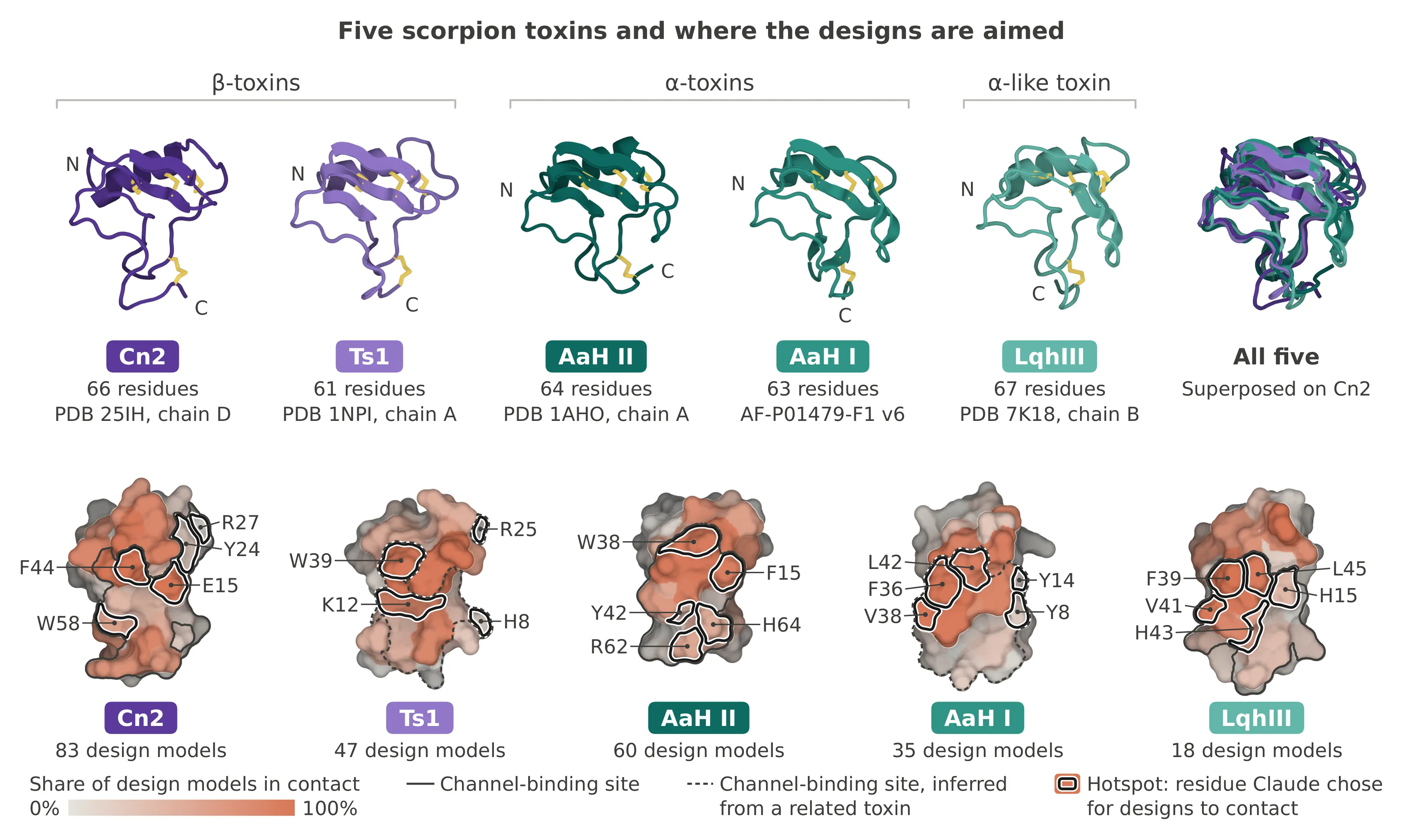
我们主要想知道 Claude 能否针对_单个_毒素设计结合蛋白。但我们也好奇 Claude 能否设计出靶向_多种_毒素的结合蛋白。尝试设计多毒素结合蛋白有一个实际原因,即它可以减少通用抗蛇毒血清混合物所需的分子数量——这将是最具成本效益且区域中立的治疗方法。我们选择了这五种蝎毒素(Cn2、Ts1、AaH I、AaH II 和 LqhIII)作为多毒素设计的挑战性测试:它们整体蛋白质形状共享一种折叠,但任意两种之间的氨基酸序列同一性仅为 26% 到 62%。
为了看看 Claude 能走多远,我们要求它设计四种结合蛋白:针对五种毒素各自的结合蛋白;靶向 β 家族毒素 Ts1 和 Cn2 的结合蛋白;靶向 α 家族毒素 AaH II、AaH I 和 LqhIII 的结合蛋白;以及同时靶向全部五种毒素的结合蛋白。
> 在短短几天内并行设计出针对五种毒素的可信结合蛋白,是我们在治疗发现领域所看到的 AI 驱动范式转变的绝佳展示。对于动物蜇伤等被忽视的疾病尤其如此,这些疾病由于商业激励低而长期缺乏创新。能够以智能体方式应对动物毒素这一独特广泛的靶点空间,显著加快了发现速度,并使现实的治疗方案更近一步。
_**Timothy P. Jenkins**,丹麦技术大学副教授。_
### Claude 以相当大的自主性运行了设计活动
我们最初的提示词定义了神经毒素靶点、蛋白质设计与折叠工具,以及新颖性、评分和过滤的规则。除了选择结构和氨基酸热点外,Claude 还设定了设计必须达到的质量阈值,决定了在多大程度上依赖每种可用的设计工具,并制定了针对多种毒素设计结合蛋白的策略。
最终,Claude 使用了 12 种设计工具生成了 318,484 个设计,并过滤掉任何与毒素或已知蛋白质相似的设计。Claude 对 553,052 个设计-毒素配对进行了共折叠和筛选,将每个配对预测为一个复合物。在我们给出初始提示词 64 小时后,它产出了包含 180 个设计的最终列表。该活动使用了约 10,000 GPU 小时。2
在我们第一次提示后,Claude 自主工作了 24 小时。其结果鼓励我们提示 Claude 继续其活动并寻找更好的设计。我们的后续提示主要集中于引导 Claude 设计多毒素结合蛋白。Claude 在第三次后续提示之后才选出了 180 个设计中的大部分——包括我们最强的结合蛋白(Cn2-B1)。应我们的要求,Claude 将蛋白质序列发送给了 Twist Bioscience(在电子邮件中表明这些邮件由 Claude 撰写),后者生产了这些蛋白质,以观察它们与毒素的结合效果。我们后来与 Claude 合作又添加了 31 个设计,使总数达到 211 个设计:60 个针对单一毒素的设计(每种毒素 12 个)、30 个针对两种 β 家族毒素的设计、30 个针对三种 α 家族毒素的设计,以及 91 个针对全部五种毒素的设计。
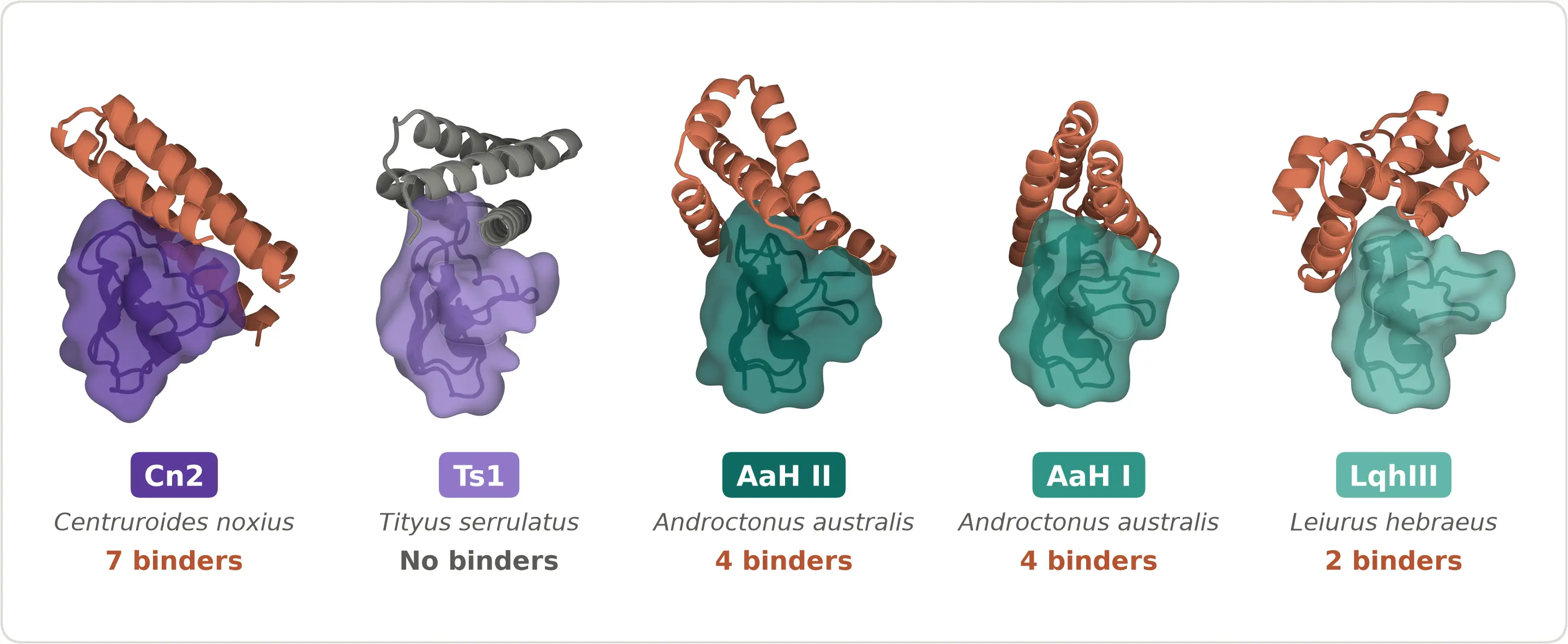
在我们团队评估的 211 个设计中,有 17 个符合我们对结合蛋白(binder)的标准,每个都针对单一毒素。没有任何针对多种毒素的设计在一种以上毒素上符合我们的标准。(除了受其当前能力所限之外,Claude 在这方面表现不佳可能还有许多解释,包括我们的提示方式、可用设计工具的局限,甚至多毒素设计在生物学上的可行性。)有七个设计是针对 Cn2 的结合蛋白,四个针对 AaH II,四个针对 AaH I,两个针对 LqhIII。在 60 个单毒素设计中,有 11 个是结合蛋白(18%)。这一比例与典型的蛋白质设计项目(包括我们之前的工作)相符。
### 在实验室中测试 Claude 的设计
完成该项目后,我们将设计发送给 Adaptyv Bio 和 Twist Bioscience 进行结合测试。两家机构各自在其实验室中生产这些设计,但形式不同。Adaptyv Bio 在_无细胞系统_中表达它们,该系统使用从细菌中提取的蛋白质合成机制,而非活细胞。Twist Bioscience 在哺乳动物细胞(此处为人肾细胞)中表达这些设计,并将其与_Fc_(抗体的茎部)融合。这些是测量底层结合过程的互补方法,我们将二者结合起来以提高结果的置信度。
两家实验室均通过_表面等离子体共振_(SPR)测量结合,在测量中,毒素流经设计分子,同时 SPR 仪器实时追踪毒素与设计分子结合和解离的速度。所得曲线称为传感图,可产生称为_解离常数_(KD)的测量值,这是衡量结合强度(或_亲和力_)的指标。KD 越低,结合越紧密。
在评估所得设计时,我们设定了严格的标准来判定某个设计是否为针对某种毒素的结合蛋白。该设计必须在两家实验室均为_命中_3——也就是说,它必须在每个重复实验中均显示出与该毒素结合的迹象,且每个 KD 均需为 1 µM 或更强。我们还要求该设计对 CLEC12A 不显示信号,CLEC12A 是一种无关的人类蛋白,用于测量脱靶结合或“黏性”。
### Claude 的 Cn2 结合蛋白可能与一种毒素中和抗体结合同一位点
抗体和纳米抗体仍是_从头_设计需要超越的标准。已有三种此类分子报告了对 Cn2 或 AaH II 的亲和力(KD)低于 1 nM(纳摩尔),并已被证明能保护小鼠免受蝎毒素侵害。
我们最强的两个结合蛋白,我们称之为 Cn2-B1 和 Cn2-B2,靶向 Cn2,这是一种来自墨西哥蝎 _Centruroides noxius_ 的神经毒素。它们在 Adaptyv Bio 和 Twist Bioscience 均与 Cn2 紧密结合,亲和力(KD)处于个位数纳摩尔范围。
要判断两个分子(例如抗体和微型蛋白)是否结合靶标上的同一位点,一种方法是进行_竞争实验_,该实验测试两种结合蛋白能否同时附着到靶标上。如果一种分子的存在降低了另一种分子的结合,那么它们很可能竞争同一位点。
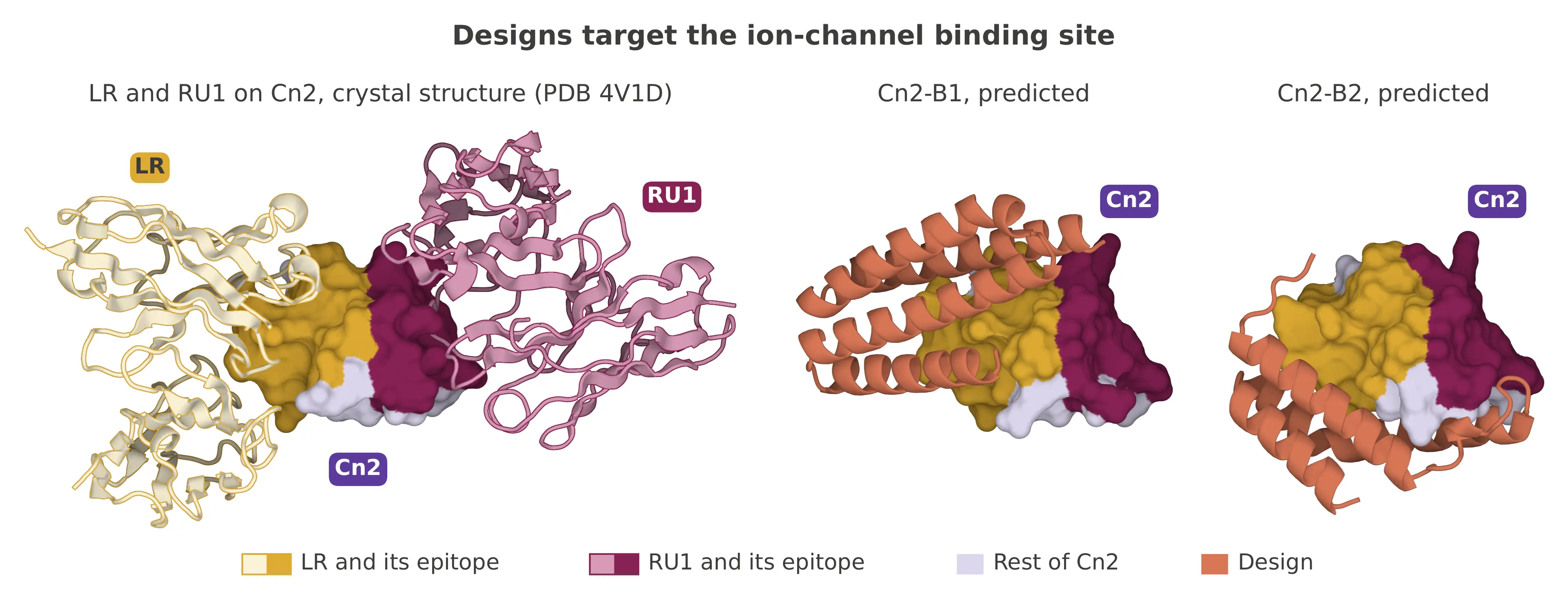
我们的竞争实验表明,我们的 Cn2 结合蛋白各自附着在一种名为 LR 的抗体的同一_表位_(结合位点)上或附近,[据报道该抗体能在小鼠体内中和 Cn2](https://pmc.ncbi.nlm.nih.gov/articles/PMC4722445/)。LR 的结合位点覆盖了 Cn2 中附着于钠通道并导致神经异常放电的部分。我们尚未在细胞环境或活体动物中测试我们最强的结合蛋白 Cn2-B1 和 Cn2-B2,但它们与 LR 竞争这一事实表明,它们很可能能中和 Cn2。
## 结合蛋白只是开发抗蛇毒血清的第一步
我们的结果仅显示了对_重组_毒素的结合,这些毒素是在实验室中根据每种毒素的基因培养出来的,而非从蛇毒中纯化而来。这项研究最大的两个局限在于,我们没有测试任何设计在_体外_(针对实验室培养的细胞)的中和能力,也没有测试其在_体内_(在活体动物中,如小鼠)的功效。
如果我们要将某一设计推进为疗法,Cn2-B1 将是我们最强的候选之一。不过,首先我们需要确认该设计也能结合从蛇毒中纯化的毒素。然后,我们会通过膜片钳记录(可测量通过钠通道的电流)在_体外_评估其功能,看它是否能阻止毒素作用于通道。接着,我们需要在小鼠中测试该结合蛋白,看它是否真能保护它们。除了中和毒素外,治疗方法还必须安全、稳定、可负担,并能在发生蜇伤的地方获得。要让患者用上,还需要临床医生、资助者和政策制定者的合作。
我们正在公开[全部 211 个设计及其结合数据](https://huggingface.co/datasets/Anthropic/scorpion-toxin-binder-design),以便其他研究人员能在我们的工作基础上继续推进。我们希望这一对 Claude 能力的展示,连同我们公开的数据,能帮助加速抗蛇毒血清设计的进一步研究。
## 延伸阅读
以下资源提供了进一步的技术深度以及关于上述结果的更详细信息:
## 相关内容
### 用 Claude 设计更高效的量子电路
我们向 Claude 提供了八个量子电路的自然语言规格说明,并配有一个自动评估器来检查和评分其设计。Claude 在很大程度上独立工作,改进了已发表的最佳电路,在某些情况下提升了一个数量级甚至更多,这可能使实用量子计算机比先前预期的更近一步。
[阅读更多](https://www.anthropic.com/research/designing-efficient-quantum-circuits)
### Claude 揭示 ECDSA 曲线的起源
一个最流行的密码学标准之一,其起源数十年来的谜团已被解开。
[阅读更多](https://www.anthropic.com/research/ecdsa-curve-origins)
### AI 期望差距
未来几年 AI 将如何重塑经济?关于 AI 未来对经济影响的分歧,其核心根源是什么?本说明呈现了关于这些问题的新的调查证据。
[阅读更多](https://www.anthropic.com/research/ai-expectations-gap)
## 正文 · 原文
_**Summary:** As part of our work experimenting with how Claude can help accelerate drug discovery, we asked an internal research model to design_ minibinders _(small proteins that attach tightly to a target) against scorpion neurotoxins. Claude worked from our prompt and four follow-ups, which we developed in collaboration with the financial investment research firm Citrini Research. Teams at Adaptyv Bio and Twist Bioscience experimentally tested 211 designs for binding. Of these, 17 met our criteria. We’re releasing all 211 designs and their data as a resource for the field._
In August, we showed [how Claude designed protein minibinders](https://www.anthropic.com/research/Claude-accelerates-protein-design) after being given a single prompt. A month before we released those results, a team from [Citrini Research](https://www.citriniresearch.com/) had approached us with an interesting question: could Claude (and AI drug discovery more generally) enable a group of motivated nonexperts to tackle a genuine problem in human health? Members of our life science research team set out to answer this, first by brainstorming problems with Claude. We landed on asking for Claude’s help designing novel protein binders against scorpion neurotoxins, with the hope that they could one day be used to develop a scorpion antivenom.
Scorpions sting 1.2 million people or more every year, resulting in more than 3,250 deaths, mostly among children in parts of the world with limited access to medical care. New treatments are expensive to make, and are also unlikely to earn back the cost of developing them. With so little investment, scorpion envenomation has been [described as](https://gh.bmj.com/content/10/11/e020682) a neglected tropical disease.
We started by giving Claude the same prompt we’d used in our earlier protein-binder study, after modifying it with Citrini.1 Over the next 64 hours, an internal research model, operating within Claude Science, worked mainly autonomously, although we directed its work with four follow-ups. Under our supervision, Claude analyzed the research data, generated the figures, and drafted the final report.
Claude’s design campaign produced 17 protein binders that each bind to one of four scorpion neurotoxins that are known to be dangerous to humans. Throughout the process, Claude generated 318,484 protein designs and selected 180 of them for testing. Our team added 31 more, with Claude’s help. Our partners at Adaptyv Bio and Twist Bioscience, two contract research organizations (CROs), lab-tested all 211 designs to see if they would bind to the toxins they were designed against, and 17 designs met our criteria for a binder. We have not confirmed whether these binders neutralize scorpion venom in a cellular environment, so we do not claim to have produced an antivenom.
We sent Claude’s work to two outside experts, Susana Vázquez Torres and Timothy P. Jenkins, who said they felt this work was a promising first step. If AI can now design credible binders against several hard-to-target toxins in days and they can be confirmed in the lab within weeks, this could, in theory, speed up discovery for envenomation and other neglected diseases. The challenge, as always, is turning those binders into safe, affordable, and widely accessible drugs.
We share more detail in our [technical report](https://www-cdn.anthropic.com/31ac578806cffd8b3d92d8affe6edc4c04d502e1.pdf), and are making [all 211 designs and their data available](https://huggingface.co/datasets/Anthropic/scorpion-toxin-binder-design).
> Designing a binder against almost any target no longer seems unrealistic. We can now obtain very tight binders remarkably quickly, and binding itself is no longer the main bottleneck. For venomous animals such as snakes and scorpions, whose bites and stings kill or seriously injure large numbers of people, particularly in underserved regions, the real impact will come from tackling the parts of the therapeutic pipeline that go beyond binding. The challenge is to use these extraordinary tools to develop molecules that can become real drugs, ones that are safe, affordable, and widely accessible.
_**Susana Vázquez Torres**, Postdoctoral Researcher, Structural Biology Programme, Spanish National Cancer Research Centre (CNIO), Madrid, Spain._
## Designing _de novo_ binders against five toxins from four species of scorpions
Scorpion venom contains multiple protein neurotoxins. The neurotoxins that are most likely to harm or kill humans attach to _sodium channels_, large proteins embedded in the membranes of nerve cells that allow them to fire. When sodium channels are disrupted, nerves fire at the wrong time—this releases large amounts of stress chemicals, like adrenaline. In severe cases, this can cause heart failure and excess fluid buildup in the lungs, occasionally resulting in death.
There are some antivenoms available for scorpion stings. They’re generally made using the antibodies of immunized animals, a process that can take months. Venom is milked from thousands of scorpions and used to immunize horses; scientists then purify the resulting antibodies from the horses’ blood. Traditional antivenoms can work when given early, but they’re usually effective for only a small number of neurotoxins. They’re also expensive to produce, and in many regions are costly or in short supply.
_De novo_ design offers a potential solution. A binder is a molecule that attaches tightly to a specific target; antibodies are one natural example. In principle, a binder that targets the part of a neurotoxin that latches onto sodium channels could stop the toxin from reaching the channel. In _de novo_ design, protein binders are generated from scratch against a specific target. These binders are designed computationally and can be optimized for druglike properties such as potency and stability, which could make them easier to supply in regions where stings most often occur.
Our approach was inspired by [an earlier effort](https://www.nature.com/articles/s41586-024-08393-x) that designed _de novo_ proteins that neutralized snake neurotoxins and protected mice. To our knowledge, no _de novo_\-designed binders against scorpion neurotoxins have been described.
For this campaign, we chose to target five scorpion-venom neurotoxins across four regions: Mexico (Cn2), Brazil (Ts1), North Africa (AaH I and AaH II), and the Middle East (LqhIII). We also chose to aim the designs at each toxin’s channel-binding site. Claude picked the toxin structures to use for design by searching the Protein Data Bank (PDB) as well as the AlphaFold database (AFDB). For each toxin, it selected five _hotspots_, specific amino acid positions on the toxin that its binder designs were meant to latch onto.

We were primarily wondering if Claude could design binders against _individual_ toxins. But we were also curious if Claude could design binders that targeted _multiple_ toxins. There’s a practical reason for trying to design multitoxin binders, namely that it would reduce the number of molecules needed for a universal antivenom cocktail—which would be the most cost-effective and regionally neutral treatment. We selected these five scorpion toxins (Cn2, Ts1, AaH I, AaH II, and LqhIII) as a challenging test of multitoxin design: they share one fold for the overall shape of the protein, but any two are only 26% to 62% identical in their amino acid sequences.
To see how far Claude could go, we asked it to design four kinds of binders: binders against each of the five toxins individually; binders that targeted the β-family toxins Ts1 and Cn2; binders that targeted the α-family toxins AaH II, AaH I, and LqhIII; and binders that targeted all five toxins simultaneously.
> Designing credible binders against five toxins in parallel, in a matter of days, is a great showcase of the AI-driven paradigm shift we are seeing in therapeutic discovery. This is especially true for neglected diseases such as animal envenomings, which have been largely starved of innovation due to low commercial incentives. Being able to agentically tackle the uniquely broad target space across animal toxins provides a significant speed-up in discovery, and brings realistic therapeutic solutions much closer.
_**Timothy P. Jenkins**, Associate Professor, Technical University of Denmark._
### Claude ran the design campaign with considerable autonomy
Our initial prompt defined the neurotoxin targets, the protein design and folding tools, and the rules for novelty, scoring, and filtering. Beyond choosing the structures and amino acid hotspots, Claude also set the quality thresholds a design had to clear, decided how much to lean on each available design tool, and developed the strategies for designing binders against multiple toxins.
Ultimately, Claude used 12 design tools to generate 318,484 designs, filtering out any that resembled a toxin or a known protein. Claude co-folded and screened 553,052 design-toxin pairs, predicting each pair’s structure as one complex. Sixty-four hours after we gave Claude our initial prompt, it produced its final list of 180 designs. The campaign used on the order of 10,000 GPU hours.2
Claude worked autonomously for 24 hours following our first prompt. Its results encouraged us to prompt Claude to continue its campaign and look for better designs. Our follow-up prompts were mainly focused on directing Claude to design a multitoxin binder. Claude selected most of the 180 designs—including our strongest binder (Cn2-B1)—only after our third follow-up. At our request, Claude sent the protein sequences to Twist Bioscience (in emails indicating they were written by Claude), which produced the proteins in order to see how well they would bind to the toxins. We later worked with Claude to add another 31 designs, increasing the total to 211 designs: 60 designs against a single toxin (12 per toxin), 30 designs against the two β-family toxins, 30 designs against the three α-family toxins, and 91 designs against all five toxins.
Of the 211 designs our teams assessed, 17 met our criteria for a binder, each against a single toxin. None of the designs made against multiple toxins met our criteria for more than one. (Beyond being limited by its current capabilities, there could be many explanations for why Claude struggled with this, including our prompting, the limitations of available design tools, and even the biological feasibility of multitoxin design.) Seven designs were binders against Cn2, four against AaH II, four against AaH I, and two against LqhIII. Among the 60 single-toxin designs, 11 were binders (18%). This rate is consistent with typical protein design campaigns, including our previous work.

### Testing Claude's designs in the lab
After completing the campaign, we sent the designs to Adaptyv Bio and Twist Bioscience to test them for binding. Each group produced the designs in their labs, but in different formats. Adaptyv Bio expressed them in a _cell-free system_, which uses protein-making machinery extracted from bacteria rather than living cells. Twist Bioscience expressed the designs in mammalian cells (in this case, human kidney cells) as fusions to _Fc_, the stem of an antibody. These are complementary ways to measure the underlying binding process, and we combined them in order to improve confidence in our results.
Both labs measured binding by _surface plasmon resonance_ (SPR), in which a toxin flows over the design while the SPR instrument tracks in real time how quickly a toxin binds to and detaches from it. The resulting trace, called a sensorgram, produces a measurement known as the _dissociation constant_ (KD), which is a measurement for binding strength (or _affinity_). The lower the KD, the tighter the binding.
When it came to evaluating the resulting designs, we set out strict criteria for labeling a design a binder against a toxin. The design needed to be a _hit_ at both labs3—that is, it needed to show evidence of binding against that toxin in every replicate, and every KD needed to be 1 µM or tighter. We also required that the design show no signal against CLEC12A, an unrelated human protein used to measure off-target binding or “stickiness.”
### Claude’s Cn2 binders likely bind the same site as a toxin-neutralizing antibody
Antibodies and nanobodies remain the standard for _de novo_ designs to beat. Three such molecules have reported affinities (KD) below 1 nM (nanomolar) against Cn2 or AaH II, and they have been shown to protect mice from scorpion toxins.
Our two strongest binders, which we call Cn2-B1 and Cn2-B2, target Cn2, a neurotoxin from the Mexican scorpion _Centruroides noxius_. They each bound Cn2 tightly at both Adaptyv Bio and Twist Bioscience, with affinities (KD) in the single-digit nanomolar range.
One way to find out whether two molecules (e.g., an antibody and a miniprotein) bind the same site on a target is with a _competition experiment,_ which tests whether both binders can attach to the target at the same time_._ If the presence of one molecule reduces the other molecule’s binding, then they likely compete for the same binding site.
Our competition experiments suggest our Cn2 binders each attach on or near the same _epitope_ (binding site) as an antibody called LR, which [has been reported to neutralize Cn2](https://pmc.ncbi.nlm.nih.gov/articles/PMC4722445/) in mice. LR’s binding site covers the part of Cn2 that attaches to the sodium channel and causes nerves to misfire. We have not tested our strongest binders, Cn2-B1 and Cn2-B2, in a cellular environment or in live animals, but the fact that they compete with LR suggests that they will likely neutralize Cn2.

## A binder is only the first step to developing an antivenom
Our results show binding only against _recombinant_ toxins, which are grown in the lab from each toxin’s gene rather than purified from venom. The two biggest limitations of this study are that we didn’t test any design for neutralization _in vitro_ (against cells grown in the lab) or for efficacy _in vivo_ (in living animals, such as mice).
If we were to advance one design toward a therapy, Cn2-B1 would be one of our strongest candidates. First, though, we would need to confirm the design also binds toxin purified from venom. We would then assess it for function _in vitro_ with patch-clamp recordings (which can measure the electrical current passing through sodium channels) to see whether it stops the toxin from acting on the channel. Then, we would need to test the binder in mice to see whether it actually protects them. Beyond neutralizing the toxin, a treatment must also be safe, stable, affordable, and available where stings occur. Reaching patients will also take cooperation from clinicians, funders, and policymakers.
We are releasing [all 211 designs and their binding data](https://huggingface.co/datasets/Anthropic/scorpion-toxin-binder-design) so that other researchers can build on our work. We hope this demonstration of Claude’s capabilities, along with the data we are releasing, will help accelerate further research into antivenom design.
## Further reading
The following resources provide further technical depth and more detailed information about the results described above:
## Related content
### Designing more efficient quantum circuits with Claude
We gave Claude plain-language specifications for eight quantum circuits, along with an automated evaluator to check and score its designs. Working largely on its own, Claude improved on the best published circuits, in some cases by an order of magnitude or more, which could bring practical quantum computers closer than previously anticipated.
[Read more](https://www.anthropic.com/research/designing-efficient-quantum-circuits)
### Claude reveals ECDSA curve origins
The decades-old mystery of the origins of one of the most popular cryptographic standards has been explained.
[Read more](https://www.anthropic.com/research/ecdsa-curve-origins)
### The AI expectations gap
How will AI reshape the economy in the years ahead? What is the core source of disagreement about AI's future impact on the economy? This note presents new survey evidence on these questions.
[Read more](https://www.anthropic.com/research/ai-expectations-gap)