# AWS 发布 TorchNeuron:Trainium 的原生 PyTorch 后端
> 原标题:Introducing TorchNeuron: Native PyTorch backend for AWS Trainium
- 来源:PyTorch:Blog
- 发布时间:2026-10-19T12:45:23.000Z
- AIHOT:https://aihot.news/items/szf3v3re4888fzekwoohhu8b4
- 原文:https://pytorch.org/blog/introducing-torchneuron-native-pytorch-backend-for-aws-trainium/
## 摘要
AWS 宣布 TorchNeuron,一个面向 Trainium 芯片的开源原生 PyTorch 后端,10 月 20 日起以 Apache 2.0 协议公开 Beta,代码位于 github.com/aws-neuron/torch-neuronx。
## 推荐理由
原文给出执行模式、分布式 API 和 100k 模型兼容性测试等细节,开发者可据此评估现有 PyTorch 代码迁移到 Trainium 的改动成本。
## 正文 · 中文译文
前沿模型涵盖语言、视频和音频,架构从稠密和混合专家 transformer 到扩散、状态空间、世界和结构预测模型。PyTorch 是 AI 研究发生的地方,是模型被定义的地方,也日益成为生产发生的地方。研究人员希望进行实验和创新,客户则希望获得 AWS Trainium 提供的性能,以实现其性能和规模目标。训练和推理库是针对 PyTorch 自身的 API 编写的,新的库和新版本持续发布。过去几年中,PyTorch 使这些 API 与加速器无关,并提供了用于注册自定义硬件的官方扩展点。
今天,为满足开发者和研究社区对 Trainium 日益增长的需求,我们很高兴分享一种更简单的方法,将芯片作为标准 PyTorch 设备进行编程,这早于其于 10 月 20 日在北美 PyTorch Conference 上的开源发布。AWS Trainium 是一系列 AI 芯片,专为下一代云规模 AI 训练和推理从头设计。我们宣布 **TorchNeuron**,一个面向 Trainium 的开源原生 PyTorch 后端,使模型代码、库以及您已在使用的工具都能在 Trainium 上运行。此集成直接建立在 PyTorch 社区创建的加速器无关扩展点之上,包括 PrivateUse1 设备后端和 torch.accelerator API。
TorchNeuron 在 Trainium2 和 Trainium3 上支持用于研究和调试的 eager 执行(包括性能改进的全新自适应 eager 模式)、用于生产性能的 torch.compile,以及用于自定义内核的 [Neuron Kernel Interface (NKI)](https://awsdocs-neuron.readthedocs-hosted.com/en/latest/nki/index.html)。此外,借助 [Neuron Explorer](https://awsdocs-neuron.readthedocs-hosted.com/en/latest/tools/neuron-explorer/index.html),性能工程师使用相同的 torch.profiler 追踪从框架到硬件的执行过程,将每个事件链接回其源代码行,以精确定位瓶颈并高效优化。TorchNeuron 将以 Apache 2.0 许可证在 [github.com/aws-neuron/torch-neuronx](https://github.com/aws-neuron/torch-neuronx) 上开源发布,并于 10 月 20 日作为公开 Beta 版上线。
> _“PyTorch 的愿景很明确:开发者应在不同硬件平台上获得一致的体验。对 AWS Trainium 的原生支持扩展了这一选择,使研究人员和工程师能够使用他们已熟悉的 eager 执行和分布式 API 进行实验和迭代。团队可以利用 Trainium 的能力,而无需重新发明工作流程或离开 PyTorch 生态系统。”——Meta PyTorch 工程总监 Jana van Greunen_
## 入门:轻松切换设备
入门很简单。使用指针在 Trainium 上运行您的代码:`.to('neuron')`。
```python
# Run a training loop on Trainium
model = MyModel().to('neuron') # the only change
optimizer = torch.optim.AdamW(model.parameters())
for batch in dataloader:
optimizer.zero_grad()
loss = criterion(model(batch), targets)
loss.backward()
optimizer.step()
```
针对 torch.accelerator(PyTorch 推荐的设备无关 API)编写的现代代码无需修改即可运行。编译模型需要指定一次 Neuron 后端,使用 `torch.compiler.set_default_backend("neuron")`,之后 `torch.compile(model)` 会接管它,或按调用使用 `torch.compile(model, backend="neuron")`。
```python
# Run a compiled training loop on Trainium
torch.compiler.set_default_backend("neuron") # call once, before any compile
model = MyModel().to('neuron')
model.compile() # no backend argument
optimizer = torch.optim.AdamW(model.parameters())
for batch in dataloader:
optimizer.zero_grad()
loss = criterion(model(batch), targets)
loss.backward()
optimizer.step()
```
## 能力
TorchNeuron 通过 PrivateUse1(PyTorch 用于自定义硬件的官方扩展点)注册 Trainium,因此标准 API 可按原样工作:`torch.nn`、`torch.tensor`、`torch.autocast`、`torch.distributed` 和 `torch.profiler` 均在 `neuron` 设备上运行。PyTorch 的两种执行模式 eager 和 torch.compile 原生工作。
_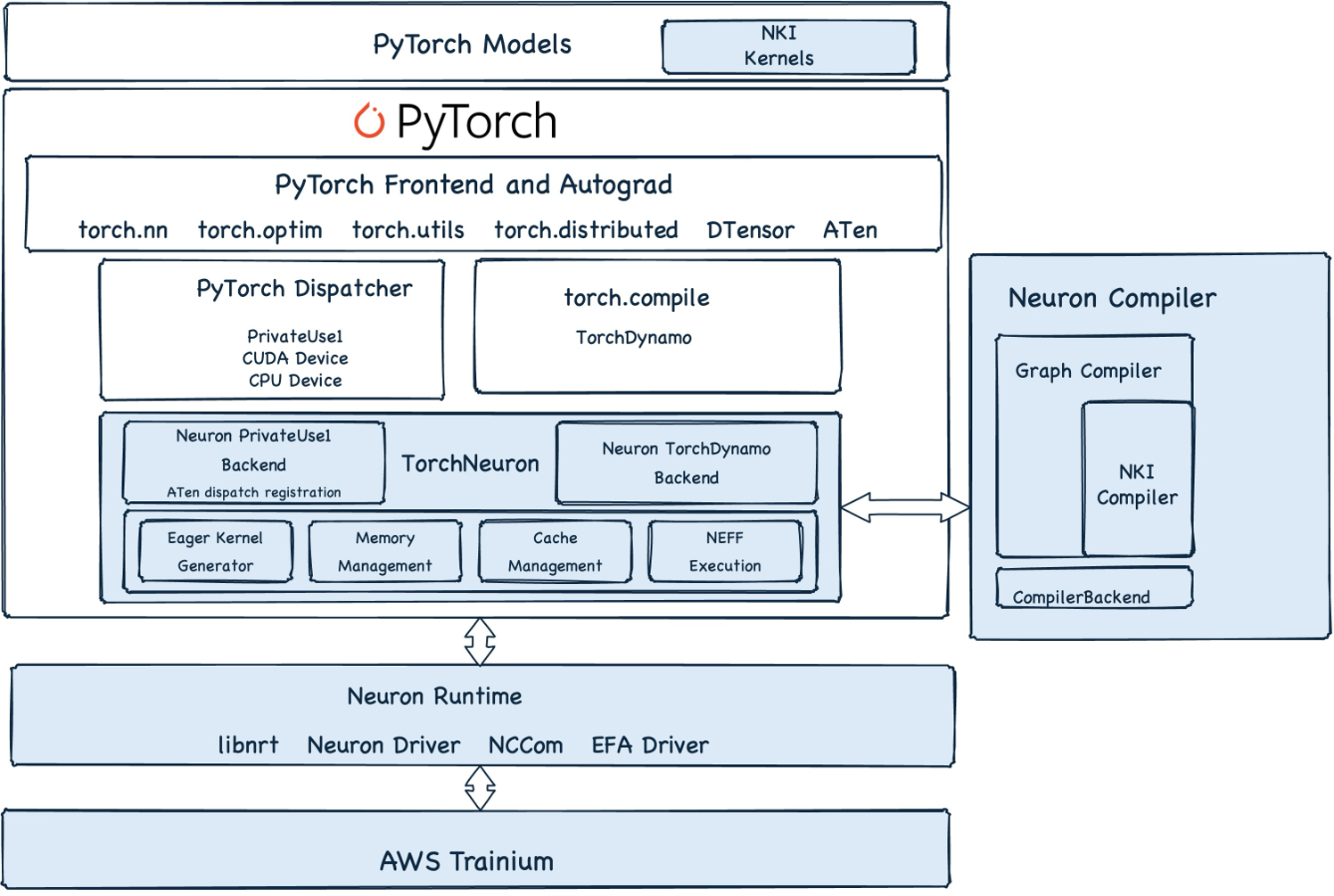_
_TorchNeuron 的高层架构图(_[_详情_](https://awsdocs-neuron.readthedocs-hosted.com/en/latest/frameworks/torch/pytorch-native-overview.html)_)。_
### Eager
Eager 模式会立即执行操作,因此 Python 控制流、打印和断点都能正常工作,无需编译或跟踪步骤。这是用于研究和调试的模式。Eager 模式会逐个分派操作。每个操作直接执行时都会编译自己的 Neuron 可执行文件格式(NEFF)文件,在设备上启动它,并通过 HBM 移动其中间结果。我们还引入了自适应 eager 模式(实验性),以降低启动开销,并提供更好的操作融合机会,在不修改代码的情况下接近编译图的性能,同时保留交互式体验。
### torch.compile
`torch.compile(model, backend="neuron")` 将模型捕获为图,由 Neuron 编译器进行优化,是用于稳定、高性能模型投入生产的模式。torch.compile 可用于优化整个模型或部分模型,并与 eager 模式无缝协作。原生支持 FlexAttention。TorchDynamo 将模型捕获为 FX 图,AOTAutograd 提前跟踪反向图,Neuron 后端通过 Torch-MLIR 将结果降为 StableHLO,Neuron 编译器生成在硬件上执行的 NEFF 文件。
Neuron 推理栈基于 TorchNeuron 中相同的 `torch.compile` 支持构建。vLLM Neuron 是 vLLM 的插件,用于服务 LLM;vLLM Omni Neuron 是 vLLM Omni 的插件,用于服务图像和视频生成的扩散模型。
### 算子与数据类型
广泛覆盖 aten 算子,涵盖文本、多模态与视觉语言、图像与视频生成和理解、状态空间模型以及世界模型中出现的算子。模型可以使用 BF16、FP32 和 FP16,以及整数和布尔类型,`torch.autocast` 和混合精度代码按原样运行。TorchAO 和 FP8 目前处于私有 Beta 阶段,将在下一版本中正式可用。
### 分布式 API
分布式推理和训练可以使用标准 PyTorch API,高级并行模块可按原样与你的模型组合:DDP、FSDP2、SimpleFSDP、张量并行和流水线并行,以及 FSDP2 与张量并行、ZeRO 等常见组合,这些对训练大型模型至关重要。支持 DTensor 和 DeviceMesh 来处理分片和多维进程组。支持集合通信 API(例如:`all_gather`、`reduce_scatter`、`all_reduce`)和 P2P API(`send`、`recv`)。集合通信在节点内通过 Trainium 专用的集合通信核心执行,在节点间通过 Elastic Fabric Adapter(EFA)执行,因此通信传输原生适配硬件,无需更改 PyTorch API。
### 流与事件
Torch 流和事件原生受支持。`torch_neuronx.Stream` 和 `torch_neuronx.Event` 将 PyTorch 的流语义映射到 Trainium 的硬件队列上。在同一个流内,数据移动和计算会自动保持顺序。不同的流之间没有隐式依赖关系,因此跨流时,你需要通过在生产者流上记录事件,并在消费者流上等待该事件,然后再使用结果,来显式地建立这种顺序。与设备无关的 `torch.Stream`、`torch.Event` 和 `torch.accelerator` 入口点会到达相同的实现,因此针对它们编写的代码无需修改即可运行。错误会在下一个同步点暴露,而不是在导致该错误的操作处暴露;TorchNeuron 会跟踪最早的异常,并在该同步点以原始上下文重新抛出它。在执行时,非默认流会多路复用到单个硬件队列上,因此它们会保留顺序、优先级和事件语义,但不会各自获得专用引擎;并且当主机集合通信被禁用时,在非默认流上发出的集合通信会保留其在该流执行顺序中的位置,但会在默认硬件队列上运行。
### Neuron 内核接口(NKI)
[Neuron 内核接口(NKI)](https://awsdocs-neuron.readthedocs-hosted.com/en/latest/nki/index.html)让研究人员和开发者能够为 eager 和 torch.compile 开发、优化并执行自定义算子。研究人员可以针对需要底层硬件控制的想法进行原型验证,包括新的模型架构。开发者可以通过在模型代码中直接调用性能关键的 NKI 内核来替代一系列标准 PyTorch 操作(ATen 操作),从而获得超越 Adaptive Eager 和 torch.compile 的更精细的性能控制。
TorchNeuron 还提供由 NKI 实现、针对 Trainium 优化的高性能算子,并以开源形式发布为 [NKI-lib](https://github.com/aws-neuron/nki-library/blob/main/README.md),覆盖稠密模型和 MoE 模型的主流 LLM 与多模态场景,例如 FlashAttention 和 MoE blockwise 内核,开发者可以使用它们来提升在 Trainium 上的性能。以下示例使用 PyTorch 推荐的 register\_autograd 风格定义并注册了一个自定义 NKI 算子:
```python
import torch
import nki
import nki.language as nl
from torch_neuronx import nki_op
# Declaring and implementing NKI kernels
# Note in NKI kernels, the output tensor should be defined as parameter to the kernel
@nki.jit
def sin_kernel(in_ptr0, out_ptr):
input_tile = nl.load(in_ptr0[0:128])
output_tile = nl.sin(input_tile)
nl.store(out_ptr[0:128], value=output_tile)
return out_ptr
# defining cos since it will be used in backward path of sin
@nki.jit
def cos_kernel(in_ptr0, out_ptr):
input_tile = nl.load(in_ptr0[0:128])
output_tile = nl.cos(input_tile)
nl.store(out_ptr[0:128], value=output_tile)
return out_ptr
# after this line, there is no NKI code, just native PyTorch, registering custom ops
@nki_op("mylib::pt_nki_sin", mutates_args={})
def pt_nki_sin(x: torch.Tensor) -> torch.Tensor:
out = torch.empty_like(x)
sin_kernel(x, out)
return out
@nki_op("mylib::pt_nki_cos", mutates_args={})
def pt_nki_cos(x: torch.Tensor) -> torch.Tensor:
out = torch.empty_like(x)
cos_kernel(x, out)
return out
def pt_nki_sin_backward(ctx, grad):
x, = ctx.saved_tensors
return grad * pt_nki_cos(x) # cos is derivative of sin
def pt_sin_setup_context(ctx, inputs, output):
x, = inputs
ctx.save_for_backward(x)
# Register backward pass and context function used during autograd for nki_sin
pt_nki_sin.register_autograd(pt_nki_sin_backward, setup_context=pt_sin_setup_context)
if __name__ == "__main__":
x = torch.randn(128, 1, device="neuron", requires_grad=True)
# Forward pass uses sin_kernel
y = pt_nki_sin(x)
# Backward pass, autograd calls uses nki_sin_backward() -> cos_kernel()
loss = y.sum()
loss.backward()
```
### 使用 TorchNeuron 进行性能分析
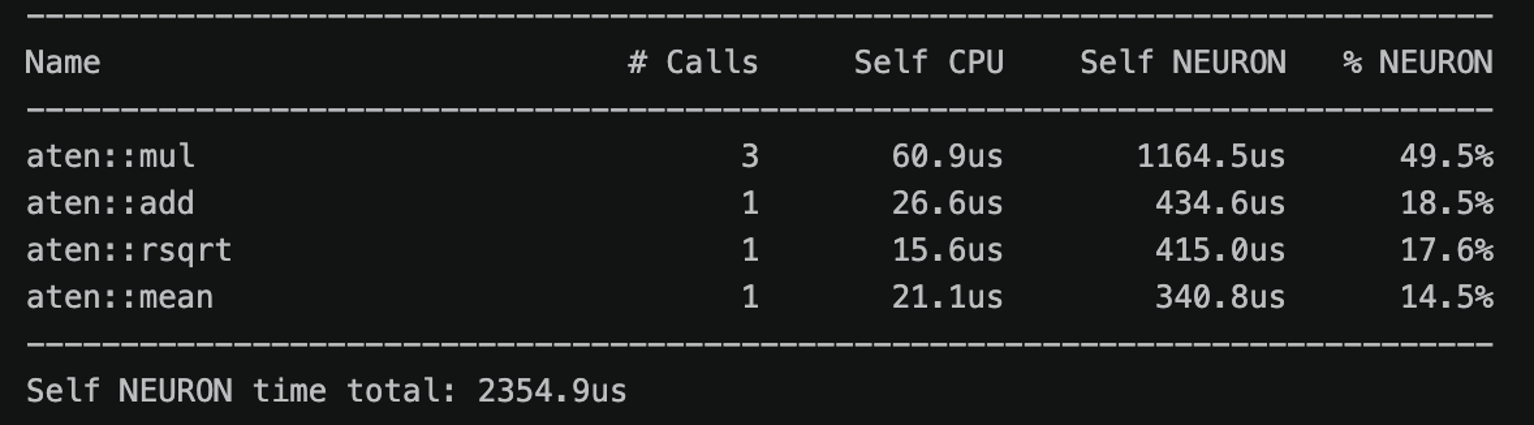
TorchNeuron 与标准 `torch.profiler.profile` API 集成,并扩展了一个 NeuronConfig 对象,用于控制 Neuron 特定的数据收集。这使用户能够捕获并关联来自框架级 CPU 操作(PyTorch 调度、Python 栈)以及 Neuron 运行时和 Trainium 活动的跟踪数据(由 NeuronConfig 控制),从而实现端到端性能分析。
捕获的性能分析数据可以在 Neuron Explorer UI 中可视化,用户可以跨框架、运行时和设备跟踪执行过程,从任意事件跳转到确切的源代码行(源代码查看器),通过调用层级浏览工作负载(层级查看器),并沿着依赖链查看每个停顿在等待什么(依赖链查看器)。
Neuron Explorer 还会输出一个 [Parquet 输出](https://awsdocs-neuron.readthedocs-hosted.com/en/latest/tools/neuron-explorer/profile-schema-reference.html),其中包含每个算子和每个引擎的指标,因此 UI 背后的同一份数据可以直接查询,或由代理用于自动化瓶颈分析。对于程序化访问,用户可以使用内置的 `torch.profiler` 工具。例如,`key_averages` 表让用户可以深入查看特定算子,并使用 `sort_by` 参数显示每个算子的设备侧开销,这对于识别热点很有用。
以下代码片段展示了一个示例([详情](https://awsdocs-neuron.readthedocs-hosted.com/en/latest/tools/neuron-explorer/how-to-profile-workload.html#pytorch-profiling)):
```python
import torch
from torch.profiler import profile, ProfilerActivity
from torch_neuronx.profiling import NeuronConfig, ProfileMode, NeuronProfiler
# Configure Neuron profiling and pass appropriate path as OUTPUT_DIR
nc = NeuronConfig(
modes=[ProfileMode.DEVICE, ProfileMode.RUNTIME],
profile_output_dir=OUTPUT_DIR,
capture_enabled_for_nc='0',
correlate_device_time=True,
)
# NeuronProfiler.export_trace() places the framework trace
# in the same directory as Neuron system traces
exporter = NeuronProfiler(nc)
device = torch.device('neuron')
x = torch.randn(4, 512, dtype=torch.bfloat16, device=device)
weight = torch.ones(512, dtype=torch.bfloat16, device=device)
def rms_norm_fn(t):
x_sq = t * t
mean_sq = x_sq.mean(dim=-1, keepdim=True)
rms = torch.rsqrt(mean_sq + 1e-6)
return t * rms * weight
# Profile your workload
with torch.profiler.profile(
activities=[ProfilerActivity.CPU, ProfilerActivity.PrivateUse1],
experimental_config=nc,
record_shapes=False,
on_trace_ready=exporter.export_trace,
schedule=torch.profiler.schedule(wait=2, warmup=1, active=1),
) as prof:
for step in range(4):
with torch.no_grad():
_ = rms_norm_fn(x)
torch.neuron.synchronize()
prof.step()
# Print the per-op summary, sorted by device time to surface hotspots
print(prof.key_averages().table(sort_by="self_privateuse1_time_total", row_limit=4))
```
__
_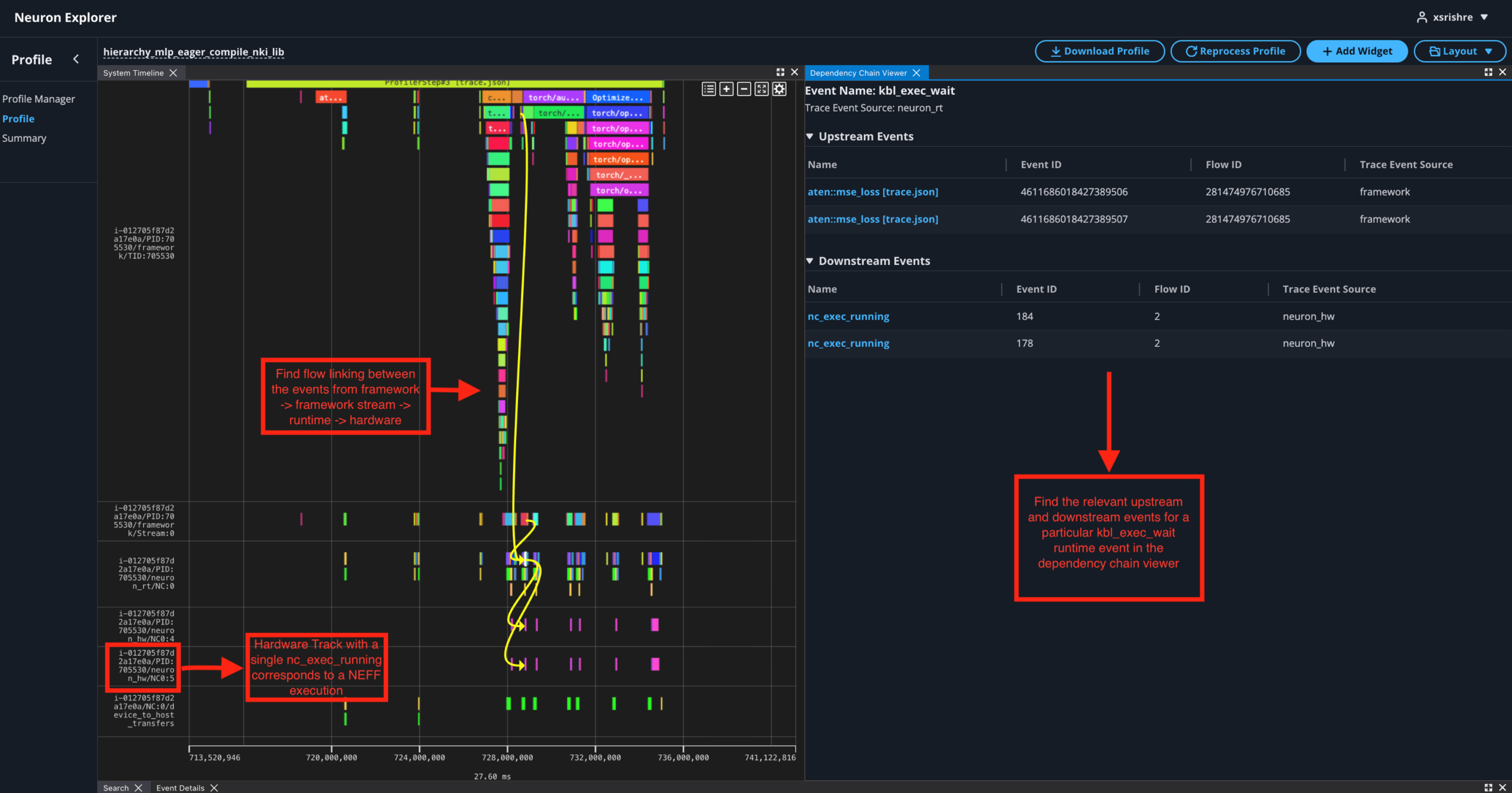_
_有关更多能力和功能,请参阅_ [_Neuron Explorer 文档_](https://awsdocs-neuron.readthedocs-hosted.com/en/latest/tools/neuron-explorer/index.html)_。_
## 基于 TorchNeuron 构建的客户与合作伙伴
TorchNeuron 已被初创公司、企业、机器学习行业合作伙伴和学术机构广泛采用:涵盖自动驾驶、机器人、视频生成、语音、电信、医疗健康和地理空间建模。以下是各团队当前构建成果的概览。
> _“Cartesia 正在构建能够像人类一样从世界中学习并与之交互的智能,起点是对话。我们在 Mamba 等状态空间架构上的开创性工作支撑了 Sonic(文本转语音)和 Ink(语音转文本),这些语音 AI 模型驱动着真正像人类一样的对话体验。真实对话同时需要三样东西:质量(自然度和准确度)、效率(大规模下的低延迟)和可控性。大多数解决方案只能提供其中一两个。我们从第一性原理出发设计研究和产品,以同时实现这三点,这意味着我们需要能够在不重写技术栈的情况下,从每一层榨取最大性能的基础设施。借助 AWS Trainium 上的 PyTorch 原生支持,我们以对 PyTorch 代码的最小改动运行了标准推理流水线。小而快的算子通过原生路径高效映射,因此我们无需为它们手写内核。这让我们团队能够专注于为被反复调用、决定端到端延迟的层编写高性能 NKI 内核。对于实时语音,每一毫秒的网络距离都至关重要。在 Trainium 上运行有助于将 Sonic 和 Ink 部署到全球客户附近。”_
>
> **_Arjun Desai,Cartesia 联合创始人_**
> _“语音正在成为 AI 的一等模态,Deepgram 每年为超过 200,000 名开发者和 1,400 家组织处理数千万亿的音频 token。为满足这一需求,我们需要高效扩展,同时持续交付更好的模型。在为期数月的合作中,AWS 生成式 AI 创新中心帮助我们将其模型移植到 AWS Trainium 上的 PyTorch 原生支持。在我们评估的基准测试中,Trainium 每美元处理的输入音频秒数比我们现有的 GPU 基线多约 60%,这有助于我们以更低价格向客户提供更好的模型。我们期待在解决方案中支持未来的 AWS AI 芯片。”_
>
> **_Adam Sypniewski,Deepgram CTO_**
> _“Hugging Face 是领先的 AI 构建者开放平台,通过 Transformers 和 Diffusers 等由 PyTorch 驱动的开源库,免费提供对超过 600 万个开放模型、数据集和应用的访问。此前,要利用 AWS Trainium 需要用 Neuron 专用软件和配置来适配 Hugging Face 模型;TorchNeuron 使 Trainium 成为 Transformers 和 Diffusers 的原生后端,因此开发者可以通过完全开源的栈使用熟悉的模型定义——这切实体现了我们对芯片中立性和兼容性的承诺。现在,在 AWS Trainium 上部署最先进的开放 LLM 以及最新的开放图像和视频生成模型比以往任何时候都更容易,TRL 支持微调和强化学习,Neuron 内核通过我们的库自动提供优化性能。”_
>
> **_Jeff Boudier,Hugging Face 产品副总裁_**
在这些客户之外,我们还一直在与众多合作伙伴合作,他们正在基于 TorchNeuron 进行构建,以增强 Trainium 生态系统。这些合作伙伴包括 Anyscale、Decart、Kernelize、Loka、Luminal、Makora、Modular、Nota AI、Radix、Wafer 和 Yasp。
## TorchNeuron 如何实现更广泛的兼容性
我们对原生 PyTorch 支持的目标之一,是让开发者能够利用 Trainium 的性能和成本优势,同时继续使用他们已经熟悉的模型、库和工作流。这有助于保护他们在 PyTorch 上的投资,包括其模型代码、推理和训练基础设施、调试实践,以及他们所依赖的社区项目。
运行 AI 工作负载的成本包括使其正常工作、优化其性能,以及随着模型和库的演进而维护它们所需的工程时间。我们希望开发者花更多时间试验架构和改进模型质量,减少将软件适配底层硬件的时间。他们应当能够从熟悉的模型或训练配方开始,将其适配到自己的工作负载,并在 Trainium 上运行,只需做极少的 Neuron 特定改动。
TorchNeuron 通过与更广泛的 PyTorch 兼容,为这一体验提供了基础。开发者可以使用 TorchTitan 等库——它汇集了 PyTorch 的分布式和编译能力以支持大规模训练——以及 Hugging Face Transformers,后者提供对社区模型实现、预训练检查点以及用于将模型适配到其应用的 API 的访问。
### TorchTitan 示例
[TorchTitan](https://github.com/pytorch/torchtitan) 是 PyTorch 用于快速实验和大规模训练的原生库。其模块化设计使自定义训练、测试新想法和扩展实验变得更加容易。TorchTitan 目前已在 Trainium 上训练。我们持续向上游贡献到主线 TorchTitan,`torchtitan-neuron` 会在这些改进合并之前提供给你,并在每项改进落地时与主线保持一致。Trainium 特定的产物也随 `torchtitan-neuron` 发布,并通过 TorchTitan 自身的扩展点注册;这些包括 NKI 内核、为 Trainium 调优的模型配置和训练配方,以及 Neuron Explorer 的性能分析集成。
```bash
# Install from source
git clone https://github.com/aws-neuron/torchtitan-neuron
cd torchtitan
pip install -r requirements.txt
# Download the llama3-8B tokenizer
python scripts/download_hf_assets.py --repo_id meta-llama/Llama-3.1-8B --assets tokenizer --hf_token=...
# Train Llama3-8B with Simple FSDP + torch.compile on a single trn2.48xlarge instance:
export NEURON_RT_NUM_CORES=64
torchrun --nnodes 1 --nproc_per_node $NEURON_RT_NUM_CORES \
--local-ranks-filter 0 --role rank --tee 3 \
--rdzv_backend c10d --rdzv_endpoint "localhost:0" \
-m torchtitan.train --module torchtitan_neuron.experiments.graph_trainer.llama3 --config simple_fsdp_llama3_8b \
--parallelism.tensor-parallel-degree 4 \
--parallelism.data-parallel-shard-degree -1 \
--training.global-batch-size 16 \
--training.local-batch-size 1 \
--compile.enable --compile.backend neuron
```
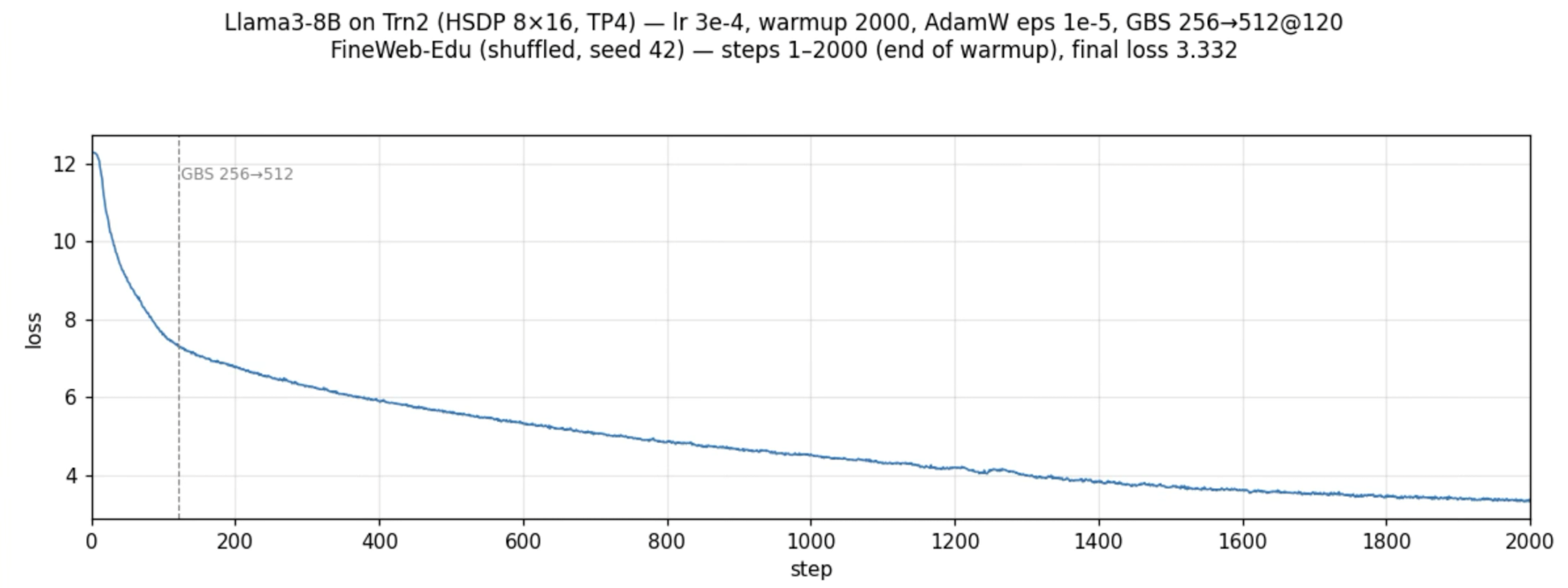
以下是使用 TorchTitan 在 8 台 trn2.48xlarge 上以张量并行(TP)和混合分片数据并行(HSDP)训练 Llama 3 8B 的示例损失曲线
### 
### Hugging Face Transformers v5
Transformers v5 为互操作性而构建:一个模型实现可在任何平台和任何硬件上运行,并可直接被下游训练和服务栈使用。
Trainium 是 Hugging Face 库上游支持的设备,包括 Transformers、Diffusers、trl 和 kernels。Transformers v5 支持文本和音频模型的训练与推理,Diffusers 支持图像和视频生成,trl 支持大型语言模型的强化学习,NKI 内核可通过 Hugging Face kernels 库获得。AWS 和 Hugging Face 为每个库添加了支持,因此现有的 Hugging Face 工作流可在 Trainium 上运行,无需设备特定代码。
- **训练。** Transformers v5 增强了完整预训练和微调的完备性,具有更好的初始化,并与并行和工具生态系统兼容——TorchTitan 用于扩展,Unsloth 和 TRL 用于后训练。
- **推理。** Transformers v5 在各模型实现之间标准化了注意力和内核。
- **Diffusion。** Diffusers 中的张量并行已在 Neuron 上游合并,因此图像和视频生成可通过 diffusers API 原样运行。
- **兼容性。** Transformers v5 是 TorchTitan、vLLM 和 SGLang 等运行时库的原生后端,将其模型覆盖范围扩展到 Hugging Face 上可用的 300 万个公开模型中的大多数。我们正在努力在 Neuron 上启用并验证这一集成,将这一扩展的模型支持带到 Trainium 实例。
#### 将模型加载到 Trainium 上
```python
from transformers import AutoModelForCausalLM
model = AutoModelForCausalLM.from_pretrained(
"Qwen/Qwen3-0.6B",
# Neuron hardware is automatically detected
device_map="neuron"
)
```
TorchNeuron 通过 PyTorch 的 PrivateUse1 扩展点注册 Trainium,从而将 Neuron 纳入 PyTorch 的设备枚举。device\_map=”auto” 无需配置即可找到它,device\_map=”neuron” 则显式指定它。无论哪种方式,权重都会加载到设备上用于训练或推理,脚本的其余部分保持不变。
## 测试方法与结果
我们的测试方法包括在 HuggingFace 和 TorchTitan 模型的广泛覆盖范围内验证 TorchNeuron,以及在 eager 和 torch.compile 两种模式下运行 PyTorch 上游测试套件。
### 模型覆盖
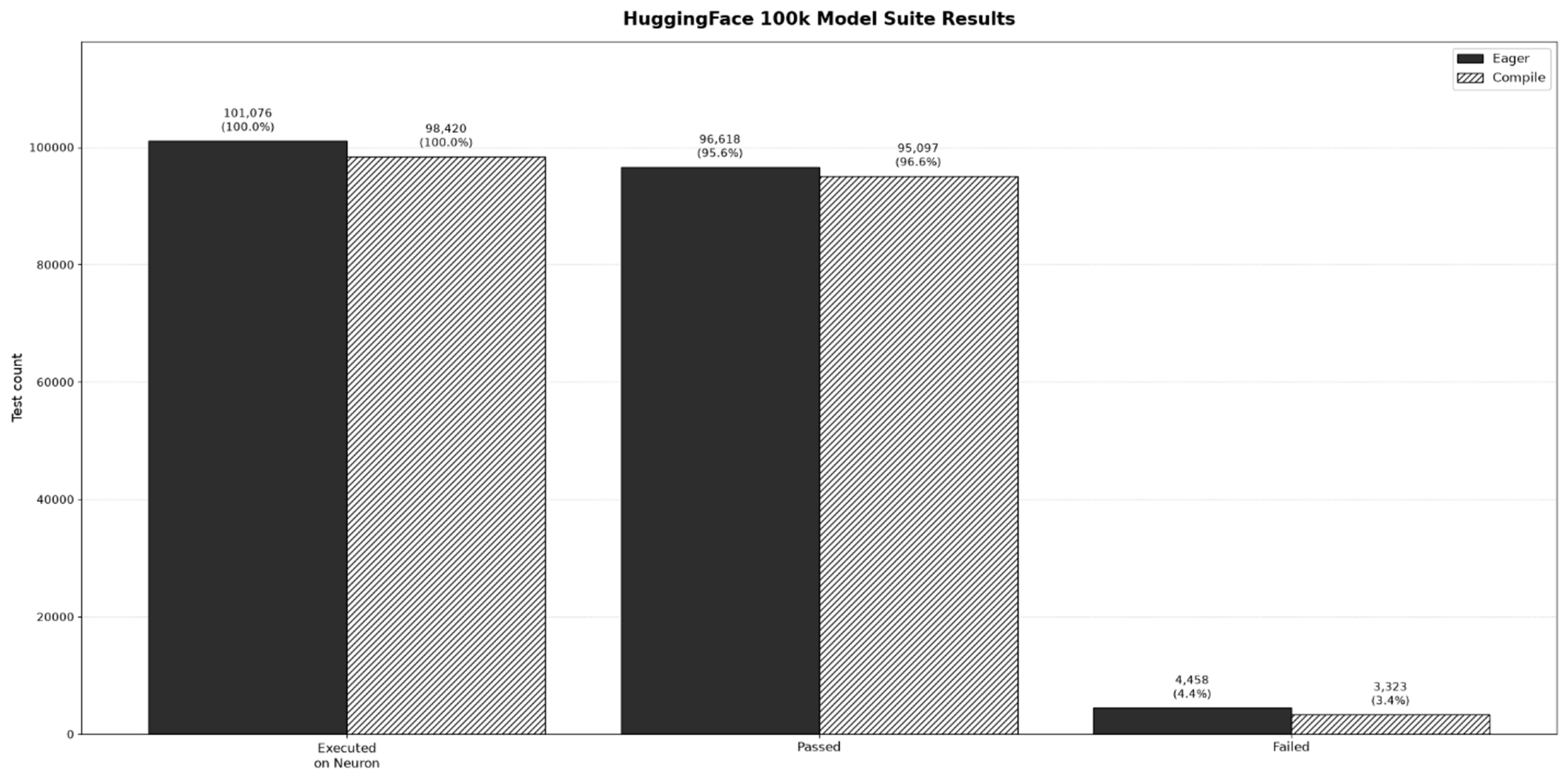
_盲扫(大规模广泛测试)。_ 我们利用 Hugging Face 模型宇宙对开源模型进行广泛扫描。我们持续运行 10 万个 Hugging Face 模型,覆盖 99.9% 的实际使用场景(基于下载量)。我们在 Trainium 上以缩减但具有代表性的配置运行每个模型,并记录发生的情况:是否加载、前向和反向传播是否运行、是否编译,以及哪些算子在该设备上执行、哪些回退到 CPU。
下图展示了截至 2026 年 9 月,在 eager 和 torch.compile 模式下运行 10 万个模型的结果。我们正在努力缩小剩余差距,目标是在未来版本中缩小大部分(如果不是全部)差距。
### 
### PyTorch 上游测试
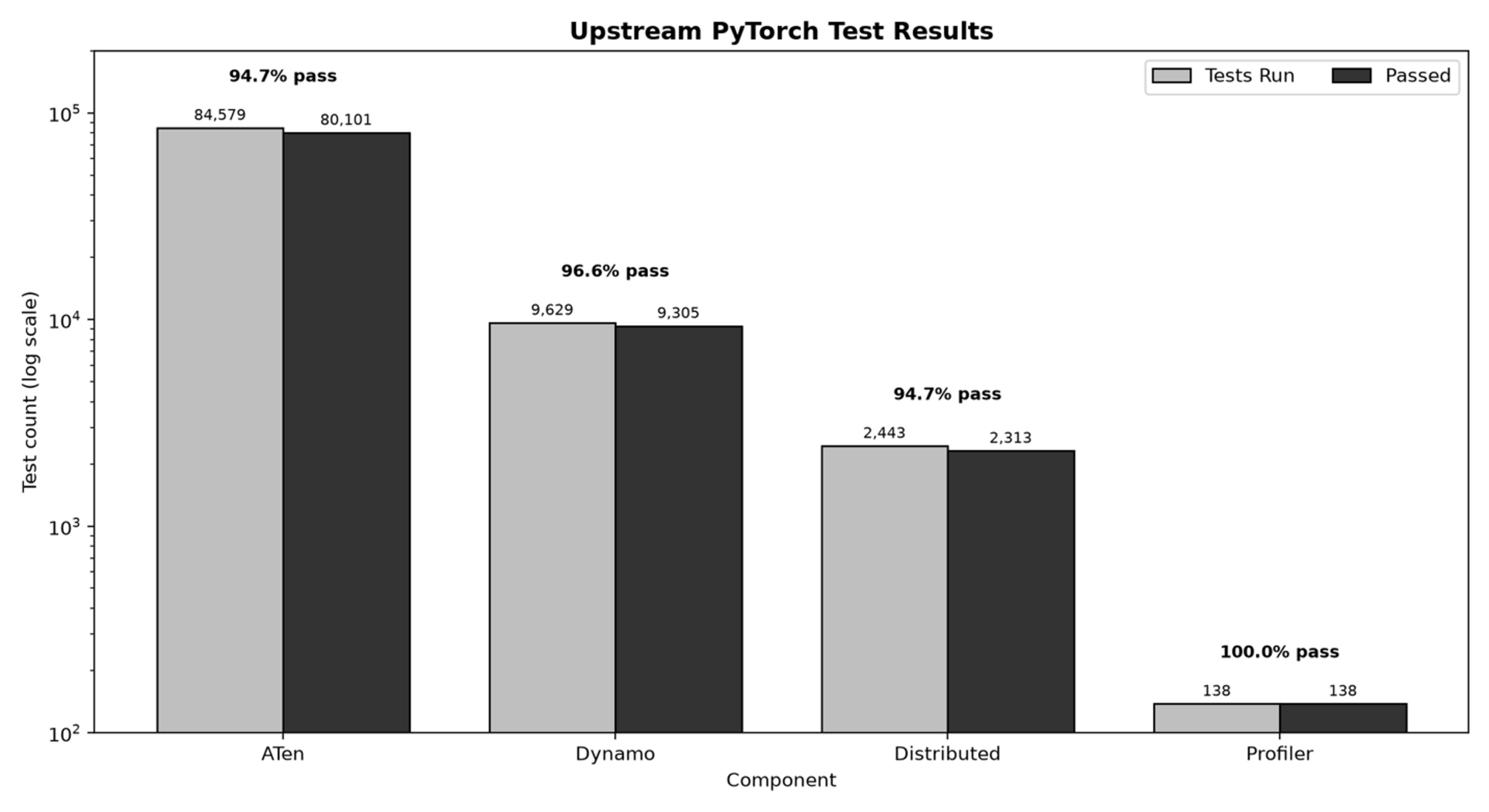
我们运行 PyTorch 上游测试套件:ATen、Dynamo、分布式和 profiler,并报告相对于已启用测试的通过率。2026 年 8 月的运行产生了约 15.4 万个测试结果,其中约 6.9 万个因有效原因被跳过:其中约 3 万个被 PyTorch 自身的资格检查跳过(例如仅 CUDA 和仅 CPU 测试),并非 Neuron 特有。其余约 3.9 万个是刻意跳过 Neuron 的,分为三组
- **目前尚无原生 Neuron lowering 的算子**(约 2.2 万个,是最大的一组;与上述算子覆盖相关,我们计划在后续版本中逐步缩小)——逐元素、归约、foreach、高级索引和高级线性代数算子的边缘情况,以及融合 LSTM/GRU 单元。
- **CUDA 特定测试(即上游资格检查未标记的)** —— CUDA graphs、NCCL 特定集合通信、CUDA 特定 Dynamo 路径测试因资格检查而被跳过。
- **TorchNeuron 在首个版本中明确选择不支持的功能,因为客户没有要求:** 复合算子合规性、稀疏张量和稀疏算子、NestedTensor、前向模式自动微分(JVP)、原生多头注意力中的任意注意力掩码(支持无掩码和因果)、逐通道量化、负/共轭视图位、torch.signal 窗口、双线性/双三次上采样,以及动态和符号形状。
作为这一过程的一部分,我们还通过提出多项 RFC 和 PR 来回馈 PyTorch,以提升测试质量并移除硬编码的 CUDA 假设([193439](https://github.com/pytorch/pytorch/pull/193439)、[193441](https://github.com/pytorch/pytorch/pull/193441)、[193442](https://github.com/pytorch/pytorch/pull/193442),完整 PR 列表见附录 A)。
## 
## 如何开始
从 2026 年 10 月 20 日起,TorchNeuron 将作为公开测试版提供。研究人员和开发者将能够从 AWS Neuron pip 仓库通过 pip install torch-neuronx 安装,[详情](https://awsdocs-neuron.readthedocs-hosted.com/en/latest/setup/pytorch/index.html)。
## 资源
以下资源将于 10 月 20 日上线:
- **TorchNeuron**:[https://github.com/aws-neuron/torch-neuronx](https://github.com/aws-neuron/torch-neuronx)
- **AWS Trainium**:[https://aws.amazon.com/machine-learning/trainium/](https://aws.amazon.com/machine-learning/trainium/)
- **AWS Neuron SDK**:[https://aws.amazon.com/machine-learning/neuron/](https://aws.amazon.com/machine-learning/neuron/)
- **Neuron 文档**:[https://awsdocs-neuron.readthedocs-hosted.com/](https://awsdocs-neuron.readthedocs-hosted.com/)
## 快速参考
有关入门、执行模式、分布式训练和开发路线图的更多指导,请参阅 Neuron 文档中的[常见问题(FAQ)](https://awsdocs-neuron.readthedocs-hosted.com/en/latest/frameworks/torch/pytorch-native-overview.html#pytorch_faqs)部分。
## 欢迎参加北美 PyTorch Conference
- 在 GitHub 上以 Apache 2.0 许可开源 TorchNeuron
- 发布可通过 pip 安装的软件包以供立即使用
- 举办关于在 Trainium 上原生运行 PyTorch 的技术深度探讨会议
- 举办现场演示
## 致谢
我们感谢 PyTorch 社区和 Meta 的 PyTorch 团队在 PyTorch 可扩展机制方面所做的工作,特别是 PrivateUse1 设备后端和 torch.accelerator API,它们使这一集成成为可能。我们也感谢 PyTorch 基金会在 CI/CD 基础设施方面的支持。
AWS 致力于通过为 PyTorch CI/CD 基础设施提供 Trainium 资源并贡献开源 PyTorch 项目来支持 PyTorch 生态系统。
特别感谢 Anthropic、Anyscale、Amazon AGI、Amazon Rufus、ByteDance、Cartesia、Clay Foundation、Databricks、Decart、Deepgram、Hugging Face、Karakuri、Lieber Institute for Brain Development、Meta、MIT、Neura Robotics、NinjaTech AI、Nota AI、Odyssey、PDT Partners、poolside、Qube Research and Technologies、RadixArk、Ricoh、Rivian、Salesforce、SemiAnalysis、UC Berkeley、Stanford、CMU、UCLA、Zyphra 以及许多其他机构,感谢他们在塑造 TorchNeuron 的设计和能力方面提供的反馈。
**贡献者**:Apoorv Gupta、Arash Jamalian、Rui Silva、Peter Sam Raj、Kunind Sahu、Kamran Khan、Shreya Srivastava、Charan Shettyhalli Guruswamy、Alex Hoffman、Abigail Fernandes、Sam Jin
## 附录:完整 PR 列表
- [https://github.com/pytorch/pytorch/pull/179063](https://github.com/pytorch/pytorch/pull/179063)
- [https://github.com/pytorch/pytorch/pull/179511](https://github.com/pytorch/pytorch/pull/179511)
- [https://github.com/pytorch/pytorch/pull/187736](https://github.com/pytorch/pytorch/pull/187736)
- [https://github.com/pytorch/pytorch/pull/188839](https://github.com/pytorch/pytorch/pull/188839)
- [https://github.com/pytorch/pytorch/pull/192365](https://github.com/pytorch/pytorch/pull/192365)
- [https://github.com/pytorch/pytorch/pull/192401](https://github.com/pytorch/pytorch/pull/192401)
- [https://github.com/pytorch/pytorch/pull/192404](https://github.com/pytorch/pytorch/pull/192404)
- [https://github.com/pytorch/pytorch/pull/193428](https://github.com/pytorch/pytorch/pull/193428)
- [https://github.com/pytorch/pytorch/pull/193430](https://github.com/pytorch/pytorch/pull/193430)
- [https://github.com/pytorch/pytorch/pull/193433](https://github.com/pytorch/pytorch/pull/193433)
- [https://github.com/pytorch/pytorch/pull/193436](https://github.com/pytorch/pytorch/pull/193436)
- [https://github.com/pytorch/pytorch/pull/193438](https://github.com/pytorch/pytorch/pull/193438)
- [https://github.com/pytorch/pytorch/pull/193439](https://github.com/pytorch/pytorch/pull/193439)
- [https://github.com/pytorch/pytorch/pull/193441](https://github.com/pytorch/pytorch/pull/193441)
- [https://github.com/pytorch/pytorch/pull/193442](https://github.com/pytorch/pytorch/pull/193442)
- [https://github.com/pytorch/pytorch/pull/193444](https://github.com/pytorch/pytorch/pull/193444)
- [https://github.com/pytorch/pytorch/pull/193445](https://github.com/pytorch/pytorch/pull/193445)
- [https://github.com/pytorch/pytorch/pull/193450](https://github.com/pytorch/pytorch/pull/193450)
- [https://github.com/pytorch/pytorch/pull/193456](https://github.com/pytorch/pytorch/pull/193456)
- [https://github.com/pytorch/pytorch/pull/193457](https://github.com/pytorch/pytorch/pull/193457)
- [https://github.com/pytorch/pytorch/pull/193686](https://github.com/pytorch/pytorch/pull/193686)
- [https://github.com/pytorch/torchtitan/pull/2382](https://github.com/pytorch/torchtitan/pull/2382)
- [https://github.com/pytorch/torchtitan/pull/2440](https://github.com/pytorch/torchtitan/pull/2440)
- [https://github.com/pytorch/torchtitan/pull/2445](https://github.com/pytorch/torchtitan/pull/2445)
- [https://github.com/pytorch/torchtitan/pull/2450](https://github.com/pytorch/torchtitan/pull/2450)
- [https://github.com/pytorch/torchtitan/pull/2668](https://github.com/pytorch/torchtitan/pull/2668)
文章 [Introducing TorchNeuron: Native PyTorch backend for AWS Trainium](https://pytorch.org/blog/introducing-torchneuron-native-pytorch-backend-for-aws-trainium/) 首次发表于 [PyTorch](https://pytorch.org/)。
## 正文 · 原文
Frontier models span language, video and audio, on architectures from dense and mixture-of-experts transformers to diffusion, state-space, world and structure-prediction models. PyTorch is where AI research happens, where the models are defined, and increasingly where production happens too. Researchers want to experiment and innovate, and customers want the performance AWS Trainium offers to enable them to achieve their performance and scale goals. The training and serving libraries are written against PyTorch’s own APIs, and new libraries and new versions ship continuously. Over the last several years, PyTorch made those APIs accelerator-agnostic, with official extension points for registering custom hardware.
Today, to address the growing demand from the developers and research community on Trainium, we are excited to share an even simpler approach to program the chip as a standard PyTorch device, ahead of its open source launch at PyTorch Conference North America on Oct. 20. AWS Trainium is a portfolio of AI chips designed from the ground up for next generation cloud scale AI training and inference. We are announcing **TorchNeuron**, an open source native PyTorch backend for Trainium, so the model code, the libraries, and the tools you already use run on Trainium. This integration builds directly on the accelerator-agnostic extension points, including the PrivateUse1 device backend and torch.accelerator APIs, created by the PyTorch community.
TorchNeuron supports eager execution for research and debugging including new adaptive eager mode with improved performance, torch.compile for production performance, and the [Neuron Kernel Interface (NKI)](https://awsdocs-neuron.readthedocs-hosted.com/en/latest/nki/index.html) for custom kernels, on Trainium2 and Trainium3. Also, with [Neuron Explorer](https://awsdocs-neuron.readthedocs-hosted.com/en/latest/tools/neuron-explorer/index.html), performance engineers use the same torch.profiler to trace execution from framework to hardware, linking every event back to its source line to pinpoint bottlenecks and optimize efficiently. TorchNeuron will be released as open source under Apache 2.0 at [github.com/aws-neuron/torch-neuronx](https://github.com/aws-neuron/torch-neuronx), going live as public Beta on Oct. 20.
> _“PyTorch’s vision is straightforward: developers should have a consistent experience across hardware platforms. Native support for AWS Trainium expands that choice, enabling researchers and engineers to experiment and iterate using the eager execution and distributed APIs they already know. Teams can take advantage of Trainium’s capabilities without reinventing their workflows or leaving the PyTorch ecosystem.” – Jana van Greunen, Director of PyTorch Engineering at Meta_
## Getting started: Easy device switching
Getting started is straightforward. Run your code on Trainium using the pointer: `.to('neuron')`.
```python
# Run a training loop on Trainium
model = MyModel().to('neuron') # the only change
optimizer = torch.optim.AdamW(model.parameters())
for batch in dataloader:
optimizer.zero_grad()
loss = criterion(model(batch), targets)
loss.backward()
optimizer.step()
```
Modern code written against torch.accelerator, PyTorch’s recommended device-agnostic API, runs unmodified. A compiled model needs the Neuron backend named, once with `torch.compiler.set_default_backend("neuron")`, after which `torch.compile(model)` takes it, or per call as `torch.compile(model, backend="neuron")`.
```python
# Run a compiled training loop on Trainium
torch.compiler.set_default_backend("neuron") # call once, before any compile
model = MyModel().to('neuron')
model.compile() # no backend argument
optimizer = torch.optim.AdamW(model.parameters())
for batch in dataloader:
optimizer.zero_grad()
loss = criterion(model(batch), targets)
loss.backward()
optimizer.step()
```
## Capabilities
TorchNeuron registers Trainium through PrivateUse1, PyTorch’s official extension point for custom hardware, so the standard APIs work as written: `torch.nn`, `torch.tensor`, `torch.autocast`, `torch.distributed`, and `torch.profiler` all operate on the `neuron` device. The two execution modes of PyTorch, eager and torch.compile work natively.
__
_High-level architecture diagram of TorchNeuron (_[_details_](https://awsdocs-neuron.readthedocs-hosted.com/en/latest/frameworks/torch/pytorch-native-overview.html)_)._
### Eager
Eager runs operations immediately, so Python control flow, prints, and breakpoints all work with no compile or trace step. This is the mode for research and debugging. Eager mode dispatches operations individually. Executed directly, each operation compiles its own Neuron Executable File Format (NEFF) file, launches it on device, and moves its intermediates through HBM. We are also introducing adaptive eager mode (experimental), to reduce the launch cost and provide better opportunities to fuse operations to approach performance of compiled graph without a code change, while retaining the interactive experience.
### torch.compile
`torch.compile(model, backend="neuron")` captures the model into a graph the Neuron compiler optimizes, and is the mode for stable, high-performance models moving to production. torch.compile can be used to optimize the whole or part of the model and works seamlessly with eager mode. FlexAttention is supported natively. TorchDynamo captures the model into an FX graph, AOTAutograd traces the backward graph ahead of time, the Neuron backend lowers the result, by way of Torch-MLIR, into StableHLO, and the Neuron compiler produces a NEFF file that executes on hardware.
The Neuron inference stacks are built on the same `torch.compile` support in TorchNeuron. vLLM Neuron is a plugin to vLLM and serves LLMs; vLLM Omni Neuron is a plugin to vLLM Omni and serves diffusion models for image and video generation.
### Ops and dtypes
Broad aten operator coverage for ops seen across text, multimodal and vision language, image and video generation and understanding, state space models, and world models. Models can use BF16, FP32, and FP16, with integer and boolean types, and `torch.autocast` and mixed precision code operate as written. TorchAO and FP8 are currently supported under private Beta and will be made generally available in the next release.
### Distributed APIs
Distributed inference and training can use the standard PyTorch APIs and the high-level parallelism modules compose with your model as written: DDP, FSDP2, SimpleFSDP, tensor parallelism, and pipeline parallelism, along with common compositions like FSDP2 with tensor parallelism, ZeRO that are essential for training large models. DTensor and DeviceMesh are supported to handle sharding and the multi-dimensional process groups. The collective APIs (example: `all_gather`, `reduce_scatter`, `all_reduce`) and the P2P APIs (`send`, `recv`) are supported. Collectives execute over Trainium’s dedicated collective cores intra-node and over the Elastic Fabric Adapter (EFA) inter-node, so the communication transport is native to the hardware with no change to PyTorch APIs.
### Streams and Events
Torch streams and events are supported natively. `torch_neuronx.Stream` and `torch_neuronx.Event` map PyTorch’s stream semantics onto Trainium’s hardware queues. Within a stream, data movement and computation stay in order automatically. Separate streams carry no implicit dependency on one another, so across streams you make that ordering explicit by recording an event on the producing stream and waiting for it on the consuming stream before using the result. The device-agnostic `torch.Stream`, `torch.Event`, and `torch.accelerator` entry points reach the same implementation, so code written against them runs unmodified. An error surfaces at the next synchronization point rather than at the operation that caused it; TorchNeuron tracks the earliest exception and re-raises it there with its original context. In execution, non-default streams multiplex onto a single hardware queue, so they keep ordering, priority, and event semantics but do not each get a dedicated engine; and when host collectives are disabled, a collective issued on a non-default stream keeps its place in that stream’s execution order but runs on the default hardware queue.
### Neuron Kernel Interface (NKI)
The [Neuron Kernel Interface (NKI)](https://awsdocs-neuron.readthedocs-hosted.com/en/latest/nki/index.html) lets researchers and developers develop, optimize, and execute custom operators for both eager and torch.compile. Researchers can prototype ideas that require low level hardware control, including new model architectures. Developers can obtain finer performance control beyond Adaptive Eager and torch.compile by calling performance critical NKI kernels directly in model code to replace sequences of standard PyTorch operations (ATen ops).
TorchNeuron also provides Trainium optimized, high-performance operators implemented with NKI and released open source as [NKI-lib](https://github.com/aws-neuron/nki-library/blob/main/README.md), covering mainstream LLM and multimodal scenarios for both dense and MoE models, such as FlashAttention and MoE blockwise kernels, which developers can use to improve performance on Trainium. The following example defines and registers a custom NKI operator using the PyTorch recommended register\_autograd style:
```python
import torch
import nki
import nki.language as nl
from torch_neuronx import nki_op
# Declaring and implementing NKI kernels
# Note in NKI kernels, the output tensor should be defined as parameter to the kernel
@nki.jit
def sin_kernel(in_ptr0, out_ptr):
input_tile = nl.load(in_ptr0[0:128])
output_tile = nl.sin(input_tile)
nl.store(out_ptr[0:128], value=output_tile)
return out_ptr
# defining cos since it will be used in backward path of sin
@nki.jit
def cos_kernel(in_ptr0, out_ptr):
input_tile = nl.load(in_ptr0[0:128])
output_tile = nl.cos(input_tile)
nl.store(out_ptr[0:128], value=output_tile)
return out_ptr
# after this line, there is no NKI code, just native PyTorch, registering custom ops
@nki_op("mylib::pt_nki_sin", mutates_args={})
def pt_nki_sin(x: torch.Tensor) -> torch.Tensor:
out = torch.empty_like(x)
sin_kernel(x, out)
return out
@nki_op("mylib::pt_nki_cos", mutates_args={})
def pt_nki_cos(x: torch.Tensor) -> torch.Tensor:
out = torch.empty_like(x)
cos_kernel(x, out)
return out
def pt_nki_sin_backward(ctx, grad):
x, = ctx.saved_tensors
return grad * pt_nki_cos(x) # cos is derivative of sin
def pt_sin_setup_context(ctx, inputs, output):
x, = inputs
ctx.save_for_backward(x)
# Register backward pass and context function used during autograd for nki_sin
pt_nki_sin.register_autograd(pt_nki_sin_backward, setup_context=pt_sin_setup_context)
if __name__ == "__main__":
x = torch.randn(128, 1, device="neuron", requires_grad=True)
# Forward pass uses sin_kernel
y = pt_nki_sin(x)
# Backward pass, autograd calls uses nki_sin_backward() -> cos_kernel()
loss = y.sum()
loss.backward()
```
### Profiling with TorchNeuron
TorchNeuron integrates with the standard `torch.profiler.profile` API extended with a NeuronConfig object that controls Neuron-specific data collection. This allows users to capture and correlate traces from framework-level CPU operations (PyTorch dispatch, Python stacks) as well as Neuron runtime and Trainium activity (controlled by NeuronConfig) enabling end to end performance analysis.
Profiles captured can be visualized in the Neuron Explorer UI, where users can trace execution across framework, runtime, and device, jump from any event to the exact source line (source code viewer), navigate the workload through its call hierarchy (hierarchy viewer), and follow dependency chains to see what each stall is waiting on (dependency chain viewer).
Neuron Explorer also emits a [Parquet output](https://awsdocs-neuron.readthedocs-hosted.com/en/latest/tools/neuron-explorer/profile-schema-reference.html) with per-op and per-engine metrics, so the same data behind the UI can be queried directly or consumed by agents for automated bottleneck analysis. For programmatic access, users can work with the built-in `torch.profiler` tools. For example, the `key_averages` table lets users drill down into specific ops and use the `sort_by` argument to surface the device-side cost of each op, which is useful for identifying hotspots.
Following code snippet shows an example ([details](https://awsdocs-neuron.readthedocs-hosted.com/en/latest/tools/neuron-explorer/how-to-profile-workload.html#pytorch-profiling)):
```python
import torch
from torch.profiler import profile, ProfilerActivity
from torch_neuronx.profiling import NeuronConfig, ProfileMode, NeuronProfiler
# Configure Neuron profiling and pass appropriate path as OUTPUT_DIR
nc = NeuronConfig(
modes=[ProfileMode.DEVICE, ProfileMode.RUNTIME],
profile_output_dir=OUTPUT_DIR,
capture_enabled_for_nc='0',
correlate_device_time=True,
)
# NeuronProfiler.export_trace() places the framework trace
# in the same directory as Neuron system traces
exporter = NeuronProfiler(nc)
device = torch.device('neuron')
x = torch.randn(4, 512, dtype=torch.bfloat16, device=device)
weight = torch.ones(512, dtype=torch.bfloat16, device=device)
def rms_norm_fn(t):
x_sq = t * t
mean_sq = x_sq.mean(dim=-1, keepdim=True)
rms = torch.rsqrt(mean_sq + 1e-6)
return t * rms * weight
# Profile your workload
with torch.profiler.profile(
activities=[ProfilerActivity.CPU, ProfilerActivity.PrivateUse1],
experimental_config=nc,
record_shapes=False,
on_trace_ready=exporter.export_trace,
schedule=torch.profiler.schedule(wait=2, warmup=1, active=1),
) as prof:
for step in range(4):
with torch.no_grad():
_ = rms_norm_fn(x)
torch.neuron.synchronize()
prof.step()
# Print the per-op summary, sorted by device time to surface hotspots
print(prof.key_averages().table(sort_by="self_privateuse1_time_total", row_limit=4))
```
__
__
_For additional capabilities and features refer to_ [_Neuron Explorer documentation_](https://awsdocs-neuron.readthedocs-hosted.com/en/latest/tools/neuron-explorer/index.html)_._
## Customers and partners building on TorchNeuron
TorchNeuron is already in use across startups, enterprises, ML industry partners, and academic institutions: spanning autonomous vehicles, robotics, video generation, speech, telecommunications, healthcare, and geospatial modeling. Below is a snapshot of what teams are building today.
> _“Cartesia is building intelligence that learns from and interacts with the world the way humans do, starting with conversation. Our pioneering work on state-space architectures like Mamba powers Sonic (text-to-speech) and Ink (speech-to-text), the voice AI models behind conversational experiences that feel truly human. Real conversation demands three things at once: quality (naturalness and accuracy), efficiency (low latency at scale), and steerability. Most solutions deliver one or two. We designed our research and products from first principles to deliver all three, which means we need infrastructure that lets us squeeze maximum performance out of every layer without rewriting our stack. With PyTorch native support on AWS Trainium, we ran our standard inference pipeline with minimal changes to our PyTorch code. Small, fast ops map efficiently through the native path, so we didn’t have to hand-write kernels for them. That lets our team concentrate on writing high-performance NKI kernels for the layers that are called repeatedly and drive end-to-end latency. For real-time voice, every millisecond of network distance matters. Running on Trainium gives helps to put Sonic and Ink close to our customers globally.”_
>
> **_Arjun Desai, Cofounder, Cartesia_**
> _“Voice is becoming a first-class modality for AI, and Deepgram processes quadrillions of audio tokens a year for more than 200,000 developers and 1,400 organizations. To meet that demand, we need to scale efficiently while continuing to ship better models. Over a multi-month engagement, the AWS Generative AI Innovation Center helped us port our model to PyTorch Native on AWS Trainium. In the benchmarks we evaluated, Trainium processes about 60% more input audio seconds per dollar than our existing GPU baselines, which helps us bring better models to customers at lower prices. We look forward to supporting future AWS AI chips in our solution.”_
>
> **_Adam Sypniewski, CTO, Deepgram_**
> _“Hugging Face is the leading open platform for AI builders, providing free access to over 6 million open models, datasets and applications through PyTorch-powered open-source libraries including Transformers and Diffusers. Until now, taking advantage of AWS Trainium required adapting Hugging Face models with Neuron-specific software and configuration; TorchNeuron makes Trainium a native backend for Transformers and Diffusers, so developers can use familiar model definitions through a fully open-source stack – a practical expression of our commitment to silicon neutrality and compatibility. It’s now easier than ever to deploy state-of-the-art open LLMs and the latest open image and video generation models on AWS Trainium, with TRL enabling fine-tuning and reinforcement learning and Neuron kernels delivering optimized performance automatically through our libraries.”_
>
> **_Jeff Boudier, VP Product, Hugging Face_**
Beyond these customers, we have been working with a number of partners who are building with TorchNeuron to enhance the Trainium ecosystem. These partners include Anyscale, Decart, Kernelize, Loka, Luminal, Makora, Modular, Nota AI, Radix, Wafer, and Yasp.
## How TorchNeuron Enables broader compatibility
One of our goals with native PyTorch support is to enable developers to leverage the performance and cost benefits of Trainium while continuing to use the models, libraries, and workflows they already know. This helps preserve their investment in PyTorch, including their model code, inference and training infrastructure, debugging practices, and the community projects they build upon.
The cost of running AI workloads includes the engineering time needed to get them working, optimize their performance, and maintain them as models and libraries evolve. We want developers to spend more time experimenting with architectures and improving model quality, and less time adapting their software to the underlying hardware. They should be able to start with a familiar model or training recipe, adapt it to their workload, and run it on Trainium with minimal changes specific to Neuron.
TorchNeuron provides the foundation for this experience through compatibility with the broader PyTorch. Developers can use libraries such as TorchTitan, which brings together PyTorch’s distributed and compilation capabilities for large-scale training, and Hugging Face Transformers, which provides access to community model implementations, pretrained checkpoints, and APIs for adapting models to their applications.
### TorchTitan Example
[TorchTitan](https://github.com/pytorch/torchtitan) is PyTorch’s native library for rapid experimentation and large-scale training. Its modular design makes it easier to customize training, test new ideas, and scale up experiments. TorchTitan trains on Trainium today. We continuously upstream into mainline TorchTitan, and `torchtitan-neuron` gives you those improvements before they merge, converging on mainline as each one lands. The Trainium-specific artifacts also ship in `torchtitan-neuron` and register through TorchTitan’s own extension points; those include NKI kernels, Trainium-tuned model configurations and training recipes, and profiling integrations for Neuron Explorer.
```bash
# Install from source
git clone https://github.com/aws-neuron/torchtitan-neuron
cd torchtitan
pip install -r requirements.txt
# Download the llama3-8B tokenizer
python scripts/download_hf_assets.py --repo_id meta-llama/Llama-3.1-8B --assets tokenizer --hf_token=...
# Train Llama3-8B with Simple FSDP + torch.compile on a single trn2.48xlarge instance:
export NEURON_RT_NUM_CORES=64
torchrun --nnodes 1 --nproc_per_node $NEURON_RT_NUM_CORES \
--local-ranks-filter 0 --role rank --tee 3 \
--rdzv_backend c10d --rdzv_endpoint "localhost:0" \
-m torchtitan.train --module torchtitan_neuron.experiments.graph_trainer.llama3 --config simple_fsdp_llama3_8b \
--parallelism.tensor-parallel-degree 4 \
--parallelism.data-parallel-shard-degree -1 \
--training.global-batch-size 16 \
--training.local-batch-size 1 \
--compile.enable --compile.backend neuron
```
Following is example loss curve of training Llama 3 8B on 8 x trn2.48xlarge with Tensor Parallel (TP) and Hybrid Sharded Data Parallel (HSDP) with TorchTitan
### 
### Hugging Face Transformers v5
Transformers v5 is built for interoperability: one model implementation that runs on any platform and any hardware, and that downstream training and serving stacks consume directly.
Trainium is a supported device upstream in the Hugging Face libraries, including Transformers, Diffusers, trl and kernels. Transformers v5 enables training and inference of text and audio models, Diffusers supports image and video generation, trl enables reinforcement learning of large language models, and NKI kernels are available through the Hugging Face kernels library. AWS and Hugging Face added the support to each library, so existing Hugging Face workflows run on Trainium with no device-specific code.
- **Training.** Transformers v5 strengthens full pre-training and fine-tuning readiness, with better initialization and compatibility with the parallelism and tooling ecosystem — TorchTitan for scale, Unsloth and TRL for post-training.
- **Inference.** Transformers v5 standardizes attention and kernels across model implementations.
- **Diffusion.** Tensor parallelism in Diffusers is merged upstream for Neuron, so image and video generation run through the diffusers APIs unchanged.
- **Compatibility.** Transformers v5 is a native backend of runtime libraries such as TorchTitan, vLLM and SGLang, extending their model breadth to most of the 3 million public models available on Hugging Face. We are working on enabling and validating this integration on Neuron, bringing this expanded model support to Trainium instances.
#### Loading a model onto Trainium
```python
from transformers import AutoModelForCausalLM
model = AutoModelForCausalLM.from_pretrained(
"Qwen/Qwen3-0.6B",
# Neuron hardware is automatically detected
device_map="neuron"
)
```
TorchNeuron registers Trainium through PyTorch’s PrivateUse1 extension point, which puts Neuron in PyTorch’s device enumeration. device\_map=”auto” finds it with no configuration, and device\_map=”neuron” names it explicitly. Either way the weights load onto the device for training or inference, and the rest of the script is unchanged.
## Testing methodology and results
Our testing methodology included verifying TorchNeuron on broad model coverage across HuggingFace and TorchTitan models, and PyTorch upstream test suite across both eager and torch.compile mode.
### Model coverage
_Blind Sweep (Broad testing at scale)._ We used the Hugging Face model universe to perform broad sweep across open source models. We continuously run 100k Hugging Face models that cover 99.9% of real-world usage (based on the download count). We ran each model on Trainium in a reduced but representative configuration and record what happens: does it load, does the forward and backward pass run, does it compile, and which operators executed on the device versus fell back to CPU.
The following graph shows the result of 100k model run across eager and torch.compile mode as of September, 2026. We are working on closing the remaining gaps, targeting closing most, if not all, in future releases.
### 
### PyTorch Upstream tests
We run the PyTorch upstream test suites: ATen, Dynamo, distributed, and profiler, and report the pass rate against the enabled tests. The August 2026 run produced about 154K test outcomes, of which roughly 69K were skipped with a valid reason: About 30K of those are skipped by PyTorch own eligibility checks (for example CUDA-only and CPU-only tests) and are not Neuron-specific. The remaining ~39K are deliberate Neuron skips, in three groups
- **Operators without a native Neuron lowering at this point** (~22K, the largest group; ties to operator coverage above that we plan to close in sequential releases) – corner cases for elementwise, reduction, foreach, advanced-indexing, and advanced-linalg operators, and fused LSTM/GRU cells.
- **CUDA-specific tests (i.e. the upstream eligibility check did not flag)** – CUDA graphs, NCCL-specific collectives, CUDA-specific Dynamo paths tests are skipped with eligibility check.
- **Features TorchNeuron explicitly chose not to support in the first release as customers didn’t request them:** composite-operator compliance, sparse tensors and sparse ops, NestedTensor, forward-mode autograd (JVP), arbitrary attention masks in native multi-head attention (no-mask and causal are supported), per-channel quantization, negative/conjugate view bits, torch.signal windows, bilinear/bicubic up sample, and dynamic and symbolic shapes.
As part of this process, we also contributed back to PyTorch by raising several RFCs and PRs to improve test quality and removing hard coded CUDA assumptions ([193439](https://github.com/pytorch/pytorch/pull/193439), [193441](https://github.com/pytorch/pytorch/pull/193441), [193442](https://github.com/pytorch/pytorch/pull/193442), see Appendix A for complete PR list).
## 
## How to get started
Starting Oct. 20, 2026, TorchNeuron will be available as a public beta. Researchers and developers will be able to install with pip install torch-neuronx from the AWS Neuron pip repo [details](https://awsdocs-neuron.readthedocs-hosted.com/en/latest/setup/pytorch/index.html).
## Resources
The following resources will go live on Oct. 20:
- **TorchNeuron**: [https://github.com/aws-neuron/torch-neuronx](https://github.com/aws-neuron/torch-neuronx)
- **AWS Trainium**: [https://aws.amazon.com/machine-learning/trainium/](https://aws.amazon.com/machine-learning/trainium/)
- **AWS Neuron SDK**: [https://aws.amazon.com/machine-learning/neuron/](https://aws.amazon.com/machine-learning/neuron/)
- **Neuron Documentation**: [https://awsdocs-neuron.readthedocs-hosted.com/](https://awsdocs-neuron.readthedocs-hosted.com/)
## Quick Reference
For further guidance on getting started, execution modes, distributed training, and development roadmap, see our [Frequently Asked Questions (FAQ)](https://awsdocs-neuron.readthedocs-hosted.com/en/latest/frameworks/torch/pytorch-native-overview.html#pytorch_faqs) section in the Neuron documentation.
## Join us at PyTorch Conference North America
- Open source TorchNeuron under Apache 2.0 on GitHub
- Release pip-installable packages for immediate use
- Present technical deep-dive sessions on native PyTorch on Trainium
- Host live demos
## Acknowledgments
We would like to thank the PyTorch community and the PyTorch team at Meta for their work on PyTorch’s extensibility mechanisms, particularly the PrivateUse1 device backend and torch.accelerator APIs that made this integration possible. We also thank the PyTorch Foundation for their support in CI/CD infrastructure.
AWS is committed to supporting the PyTorch ecosystem by providing Trainium resources for PyTorch CI/CD infrastructure and contributing to open source PyTorch projects.
Special thanks to Anthropic, Anyscale, Amazon AGI, Amazon Rufus, ByteDance, Cartesia, Clay Foundation, Databricks, Decart, Deepgram, Hugging Face, Karakuri, Lieber Institute for Brain Development, Meta, MIT, Neura Robotics, NinjaTech AI, Nota AI, Odyssey, PDT Partners, poolside, Qube Research and Technologies, RadixArk, Ricoh, Rivian, Salesforce, SemiAnalysis, UC Berkeley, Stanford, CMU, UCLA, Zyphra, and many others for their feedback in shaping TorchNeuron’s design and capabilities.
**Contributors**: Apoorv Gupta, Arash Jamalian, Rui Silva, Peter Sam Raj, Kunind Sahu, Kamran Khan, Shreya Srivastava, Charan Shettyhalli Guruswamy, Alex Hoffman, Abigail Fernandes, Sam Jin
## Appendix: Complete List of PRs
- [https://github.com/pytorch/pytorch/pull/179063](https://github.com/pytorch/pytorch/pull/179063)
- [https://github.com/pytorch/pytorch/pull/179511](https://github.com/pytorch/pytorch/pull/179511)
- [https://github.com/pytorch/pytorch/pull/187736](https://github.com/pytorch/pytorch/pull/187736)
- [https://github.com/pytorch/pytorch/pull/188839](https://github.com/pytorch/pytorch/pull/188839)
- [https://github.com/pytorch/pytorch/pull/192365](https://github.com/pytorch/pytorch/pull/192365)
- [https://github.com/pytorch/pytorch/pull/192401](https://github.com/pytorch/pytorch/pull/192401)
- [https://github.com/pytorch/pytorch/pull/192404](https://github.com/pytorch/pytorch/pull/192404)
- [https://github.com/pytorch/pytorch/pull/193428](https://github.com/pytorch/pytorch/pull/193428)
- [https://github.com/pytorch/pytorch/pull/193430](https://github.com/pytorch/pytorch/pull/193430)
- [https://github.com/pytorch/pytorch/pull/193433](https://github.com/pytorch/pytorch/pull/193433)
- [https://github.com/pytorch/pytorch/pull/193436](https://github.com/pytorch/pytorch/pull/193436)
- [https://github.com/pytorch/pytorch/pull/193438](https://github.com/pytorch/pytorch/pull/193438)
- [https://github.com/pytorch/pytorch/pull/193439](https://github.com/pytorch/pytorch/pull/193439)
- [https://github.com/pytorch/pytorch/pull/193441](https://github.com/pytorch/pytorch/pull/193441)
- [https://github.com/pytorch/pytorch/pull/193442](https://github.com/pytorch/pytorch/pull/193442)
- [https://github.com/pytorch/pytorch/pull/193444](https://github.com/pytorch/pytorch/pull/193444)
- [https://github.com/pytorch/pytorch/pull/193445](https://github.com/pytorch/pytorch/pull/193445)
- [https://github.com/pytorch/pytorch/pull/193450](https://github.com/pytorch/pytorch/pull/193450)
- [https://github.com/pytorch/pytorch/pull/193456](https://github.com/pytorch/pytorch/pull/193456)
- [https://github.com/pytorch/pytorch/pull/193457](https://github.com/pytorch/pytorch/pull/193457)
- [https://github.com/pytorch/pytorch/pull/193686](https://github.com/pytorch/pytorch/pull/193686)
- [https://github.com/pytorch/torchtitan/pull/2382](https://github.com/pytorch/torchtitan/pull/2382)
- [https://github.com/pytorch/torchtitan/pull/2440](https://github.com/pytorch/torchtitan/pull/2440)
- [https://github.com/pytorch/torchtitan/pull/2445](https://github.com/pytorch/torchtitan/pull/2445)
- [https://github.com/pytorch/torchtitan/pull/2450](https://github.com/pytorch/torchtitan/pull/2450)
- [https://github.com/pytorch/torchtitan/pull/2668](https://github.com/pytorch/torchtitan/pull/2668)
The post [Introducing TorchNeuron: Native PyTorch backend for AWS Trainium](https://pytorch.org/blog/introducing-torchneuron-native-pytorch-backend-for-aws-trainium/) appeared first on [PyTorch](https://pytorch.org/).