# Ed Zitron 长文解析 Anthropic S-1:称其把散户当作退出流动性
> 原标题:Exit Liquidity
- 来源:Ed Zitron 长文 / Where’s Your Ed At
- 发布时间:2026-10-28T17:51:00.000Z
- AIHOT:https://aihot.news/items/x2h1bp5shee6v508nw7pjtvas
- 原文:https://www.wheresyoured.at/exit-liquidity/
## 摘要
Ed Zitron 撰文批评 Anthropic 的 S-1 招股书,指其仅披露 Q2 盈利数据、省略 Q3 现金状况和付款明细,是在公司基本面变化前误导投资者。
## 推荐理由
作者基于 Anthropic S-1 逐项拆解其逾 4300 亿美元不可撤销算力承诺与收入结构风险,可用于对照招股书原文核实。
## 正文 · 中文译文
我打算暂停一周的付费内容,因为这周家里有事占去了我大量时间,不过下周五(11/6)我会带着一篇重磅内容回归。
在此期间,我正在进行为期一周的促销活动——新订阅用户可享受每年70美元订阅费_终身_九折优惠([点击这里!](https://edzitronswheresyouredatghostio.outpost.pub/public/promo-subscription/8xT65k4Lb3?ref=wheresyoured.at))。这是支持我工作的绝佳方式,而且你能以低于几乎所有竞品简报的价格获得极其丰富的价值。
过去几个月里,我发表了关于AI债务世界的[两](https://www.wheresyoured.at/premium-the-haters-guide-to-ai-debt-part-1/)[部分](https://www.wheresyoured.at/premium-the-haters-guide-to-ai-debt-part-2/)指南、一篇关于[生成式AI对全球经济(可疑)影响](https://www.wheresyoured.at/premium-how-has-ai-changed-the-economy/)的分析、对AI基础设施领域最大参与者的深度分析,比如NVIDIA([上](https://www.wheresyoured.at/the-haters-guide-to-nvidia/)篇和[下](https://www.wheresyoured.at/premium-the-haters-guide-to-nvidia-part-2/)篇)和Oracle([上](https://www.wheresyoured.at/haters-guide-oracle/)篇和[下](https://www.wheresyoured.at/premium-the-haters-guide-to-oracle-part-2/)篇)、[OpenAI最终将如何杀死Oracle](https://www.wheresyoured.at/how-openai-kills-oracle/),以及[风险投资如何杀死自己](https://www.wheresyoured.at/premium-venture-capital-is-killing-itself/)。
如果你想联系我——尤其是如果你掌握关于Anthropic、OpenAI、Blackstone或AI泡沫中任何其他公司的劲爆信息——请通过Signal联系我,号码是ezitron.76。你也可以在你的Bloomberg Terminal上通过IB找到我。
* * *
[上周](https://www.wheresyoured.at/ai-had-better-work-out/),我在简报开头引用了Apollo首席经济学家Torsten Slok的一句话,请原谅,[我不得不再引用一次](https://www.apollo.com/wealth/insights-news/insights/daily-spark/no-signs-of-ai-payoff-outside-the-tech-sector?ref=wheresyoured.at),重点是他_本人_强调的:
> **尽管人工智能领域投资巨大、炒作广泛,但这项技术除科技行业外,并未给美国企业带来任何财务回报。**Mag 7的每员工收入在上升,但标普493持平,见下图一。Mag 7的利润率在上升,但标普493持平,见下图二。而且仍没有迹象表明AI在推动生产率增长,见下图三。由于对利润没有影响,美国主流企业正在收缩,并开始将token支出视为拖累利润率的成本中心,而非增长来源。
我在下面附上了前两张图表,因为它们很重要,而且,嗯,极具杀伤力。
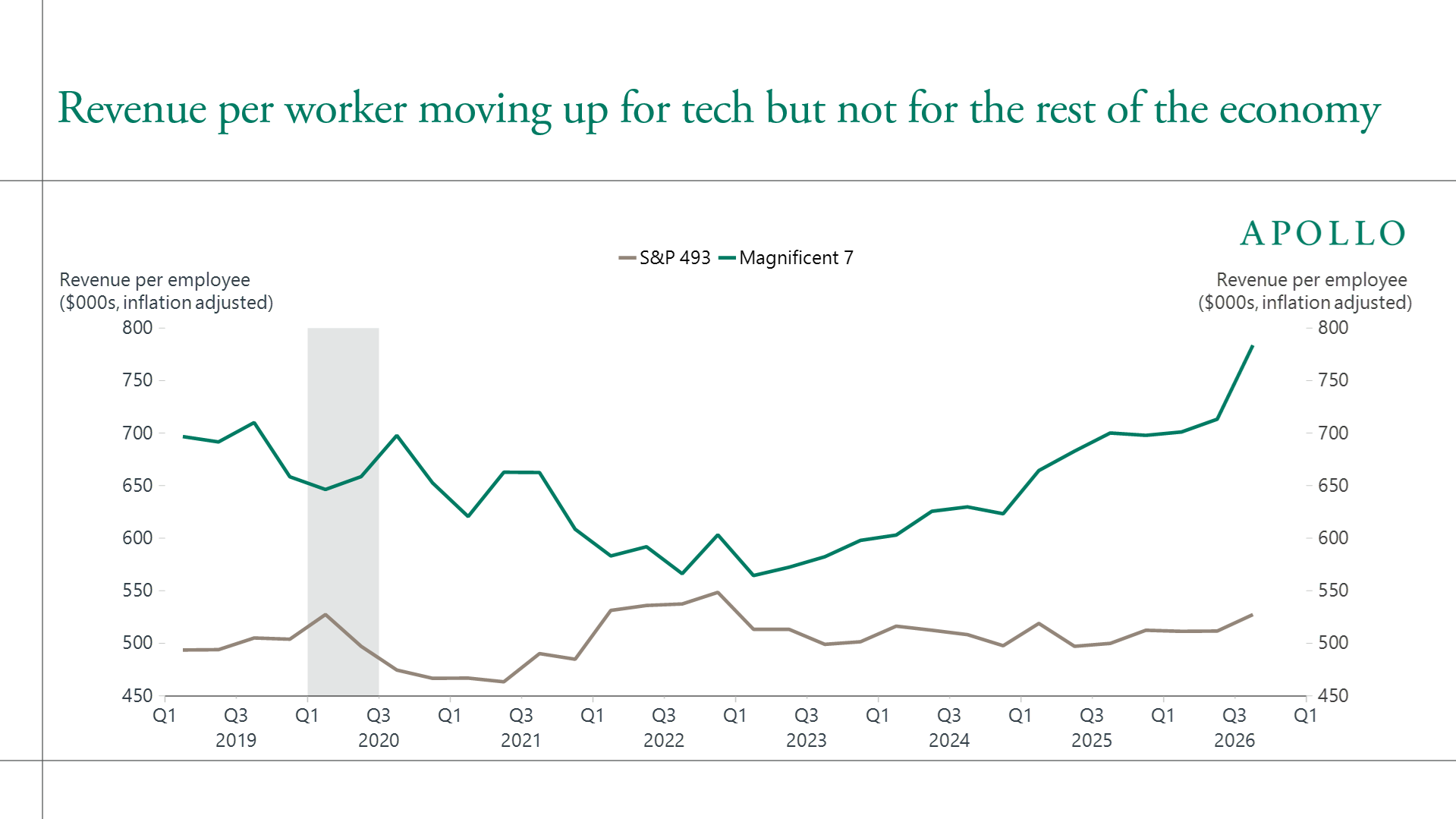
从大局来看,AI的整个卖点在于它是一种_增强器_或_岗位替代器_,我的意思是它能让_你当前的资源更高效和/或更具生产力_,或者_让你能够替代上述资源_,这里的“资源”指的是现金、人员、软件或其他你用来经营业务的东西。
我之所以用这么费雪牌(Fisher Price)式的说法,是因为AI泡沫是通过刻意回避你用来衡量企业健康状况的术语而被吹大的。泡沫已经四年了,AI至少理论上应该对商业世界_做点什么_——某种_可衡量的_事情,尤其是几乎所有人都在谈论要在各处部署它、一直使用它。
然而自AI泡沫开始以来,标普500的利润率似乎变得_更糟_了,ChatGPT在2022年11月的发布似乎对那些不叫Google、Amazon、Meta、Microsoft或NVIDIA的公司_屁用没有_,而Tesla和Apple与我们理解的AI泡沫关系甚微。
AI 吹捧者和不满者花了将近四年的时间,试图让所有人去谈论任何可以想象到的统计数据,_唯独_不谈那些真正重要的数据,主要是因为这些数据无一例外都长_这样_:
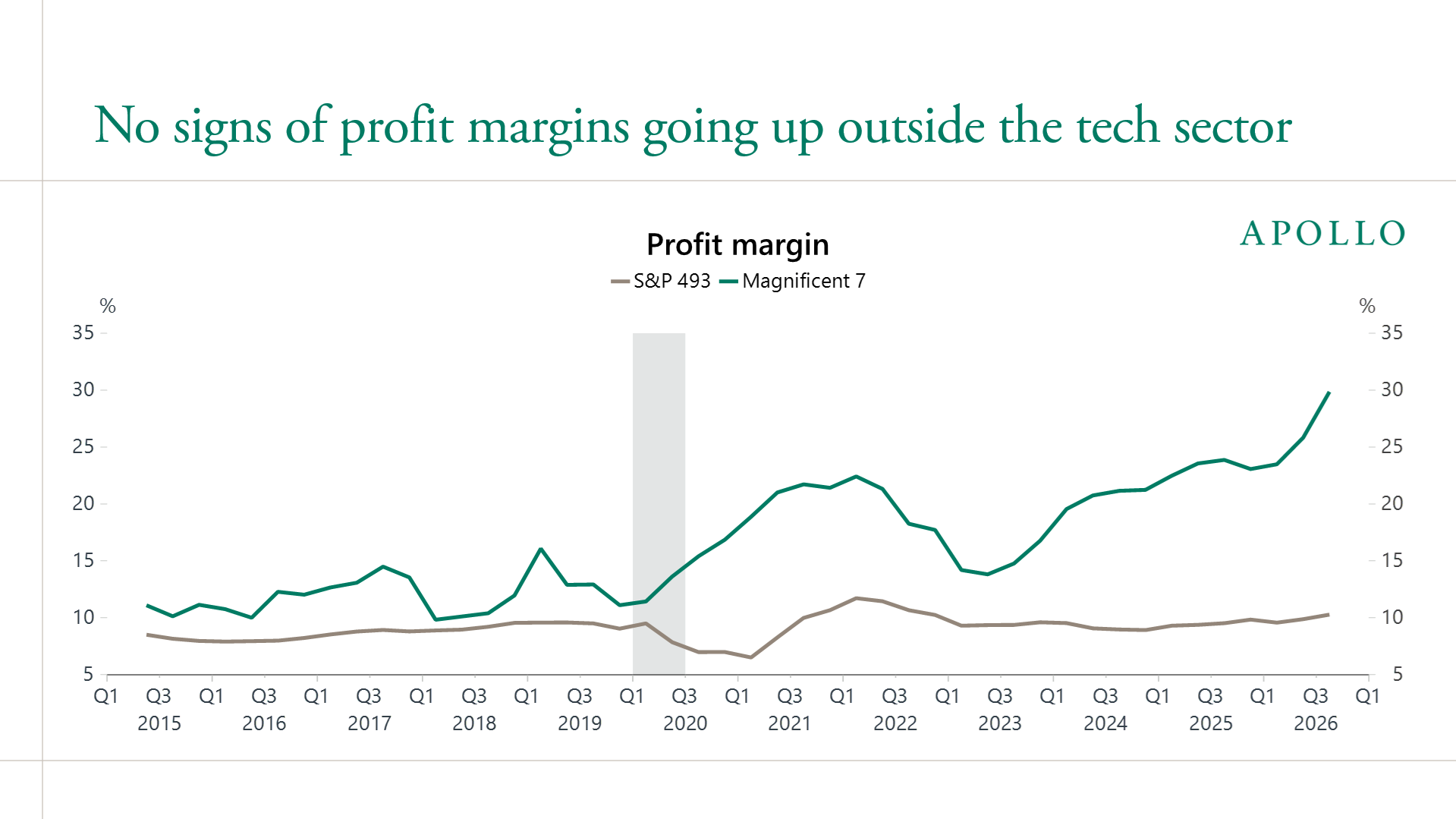
他们将要给出的反驳是“各组织尚未将 AI 完全安装到其工作流程中”之类的商业说辞,与其说是_移动球门柱_,不如说是_不断改变游戏规则,以至于我们都搞不清自己到底在玩什么。_它并没有让公司赚更多的钱、获得更多利润,也没有以现代科学可以衡量的方式改善它们。
而且,[根据 Slok 上周的说法](https://www.apollo.com/wealth/insights-news/insights/daily-spark/slowing-token-spend-shows-compute-demand-is-not-unlimited?ref=wheresyoured.at),它甚至没有提高超大规模云服务商的 ROIC(投入资本回报率),而这还是在 [Meta 宣布计划通过持续股权销售筹集近 1000 亿美元](https://www.reuters.com/legal/transactional/meta-launches-35-billion-stock-offering-fund-ai-expansion-2026-10-26/?ref=wheresyoured.at)之前:
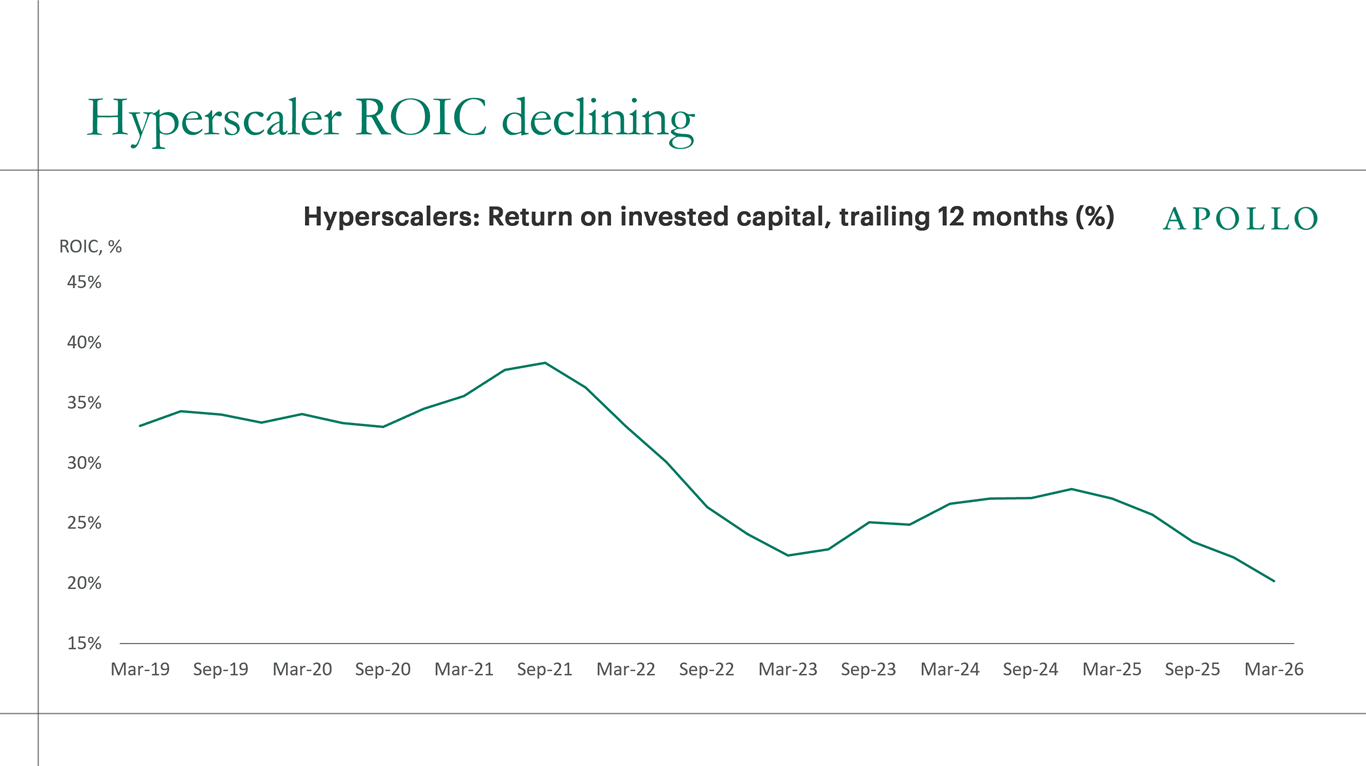
看来 AI 似乎并没有在标普 500 指数成分股中带来收入或利润率的增长,除了那七家巨头之外——而它们以超过一万亿美元的资本支出为代价,换来的却是投入资本回报率逐季_下降_。
然而,每一家构建任何与 AI 相关产品的公司都会告诉你,它正在_改变一切_,而且_你今天就必须加入_,即使产品并不像他们说的那样真正有效,即使并没有真正 tangible 的证据表明这是一笔好投资,即使很明显运营这些服务的公司有着极其可疑的经济账。
而这是因为整个行业在推销时,对终端客户或投资者怀有真切的蔑视。
我还应该补充,包括硅谷历史上最大的 IPO。
## 这是 Anthropic 最好看的样子,而其 IPO 时机是刻意为之
[引用经济学家 Paul Kedrosky 在 Prof G Markets 播客上的话](https://x.com/ProfGMarkets/status/2115143250331714026?s=20&ref=wheresyoured.at):“……这份 \[S-1\] 从当前业务结构的角度来看已经好得不能再好了。而现在你要经历这个拐点,这会让它变得资本密集得多。”
我要说得更狠一点,因为我认为 Anthropic 正在以 IPO 史上前所未见的规模故意误导投资者。任何人对现金流或对“盈利能力”的宽松定义可能抱有的兴奋都无关紧要,因为 Anthropic 按其自己的承认及其令人难以置信的义务来看,已经是一家与今年第二季度时完全不同的公司。
## Anthropic 的 S-1——以及 2026 年第二季度——讲述的是一家与即将上市的那家公司截然不同的公司,其拥有超过 4300 亿美元不可撤销的义务
所以,正如你可能已经读到的,[Anthropic 终于在本周早些时候发布了其 S-1](https://www.sec.gov/Archives/edgar/data/2130357/000162828026067168/anthropicpbc-sx1.htm?ref=wheresyoured.at#ib6a29c037bd3429bad7f20ec2033b471_14324),这是一份 300 多页的庞然大物,包含各种风险因素和披露信息,同时也小心翼翼地避开了可能有助于全面分析它的内容,特别是[略去了任何与其第三季度数据相关的内容](https://www.cnbc.com/2026/10/15/anthropics-third-quarter-revenue-hits-16point8-billion-ipo.html?ref=wheresyoured.at),而这些数据是在其投资者日期间披露的。
> **旁注**:看起来 Anthropic 正在将其财年与日历年对齐。若果真如此,其第三季度应已于 9 月 30 日结束。
>
> 如果我们以对待上市公司的同等标准来要求 Anthropic,那么它未披露最新数据这件事_本身_并没有什么可疑之处(请耐心听我说)。美国证券交易委员会(SEC)给予上市公司在每个财季结束后 45 天的时间来发布业绩。
>
> 话虽如此,如果我们以大型上市公司设定的同等标准来要求 Anthropic(请记住,它的目标估值是 1.5 万亿美元,不过据报道,投资者已被告知其目标[已下调至可能低至 1.4 万亿美元](https://www.bloomberg.com/news/articles/2026-10-28/anthropic-said-to-pick-jpmorgan-to-lead-ipo-s-us-retail-offering?accessToken=eyJhbGciOiJIUzI1NiIsInR5cCI6IkpXVCJ9.eyJzb3VyY2UiOiJTdWJzY3JpYmVyR2lmdGVkQXJ0aWNsZSIsImlhdCI6MTc5MzE0Nzk3NCwiZXhwIjoxNzkzNzUyNzc0LCJhcnRpY2xlSWQiOiJUTktXQllSS1YyVEUwMCIsImJjb25uZWN0SWQiOiJGRTc3RjhBRkFFRDY0ODc4OTZGOTQ5RUIxOThCNDk2MyJ9.WUiKaxfvkHdwq13b6edFj1mKZB50XeN-fc-qmA5M1yM&ref=wheresyoured.at)),那就有点说不过去了。这种规模的公司能够(也确实会)在财季结束后几周内公布经审计的数据。例如,SpaceX 于 10 月 20 日公布了第三季度业绩,Meta 则[在一天后](https://investor.atmeta.com/investor-news/press-release-details/2026/Meta-Reports-Third-Quarter-2026-Results/default.aspx?ref=wheresyoured.at)跟进。
>
> 这两家公司规模更大、业务更多元,因而也复杂得多。所以,很难忽视或合理化这一明显的疏漏。
尽管有种种喧嚣和盲目乐观的自我安慰,绝大多数数字其实早已为人所知,而许多新数字让情况变得难上加难。
## 我们早已知道 Anthropic 的第二季度数字——而这份 S-1 所描述的公司已不复存在
这意味着我们掌握的最新季度——2026 年第二季度——是“盈利”的([正如我在 5 月所讨论的](https://www.wheresyoured.at/anthropics-profitability-swindle/)),原因是 SpaceX 在该季度三个月中的两个月给予了折扣:
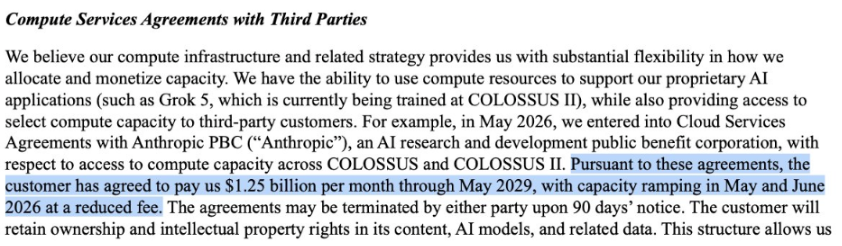
因此,Anthropic 的盈利季度——具体来说是 9.74 亿美元的利润——在很大程度上是由很可能永远不会再发生的事件造成的。
> **旁注:**我还应补充一点,当你使用 Anthropic 自己的“[每单位算力收入](https://www.cnbc.com/2026/10/15/anthropics-third-quarter-revenue-hits-16point8-billion-ipo.html?ref=wheresyoured.at)”数字时,就能看出这是一个异常值。2026 年第二季度,每 1 美元算力支出带来 2 美元收入,高于 2026 年第一季度的 1.39 美元。这一数字在第三季度降至 1.70 美元。我认为这是个愚蠢的指标,因为它并不能真正说明业务的多少情况,但即便基于 Amodei 经济学,这个季度也像是例外而非常态。
事实上,未来几个季度将发生_截然相反_的情况,因为无论公司表现如何,Anthropic 庞大的不可取消负担都将开始拖累其资产负债表。
你看,这是一份_择机而发_的 S-1,因为 Anthropic 的大部分大型算力合同都是在 2026 年第二季度或前后才启动的,其中与亚马逊和谷歌签订的 2245 亿美元不可取消协议分别于 4 月和 5 月开始。
- “……2026 年 3 月,我们与谷歌签订了一项协议,该协议随后在 2026 年 5 月至 8 月间被修订,根据该协议,我们承诺在 2026 年 4 月至 2033 年 7 月间至少支出约 1145 亿美元,无论实际使用量如何。”
- “……2026 年 4 月,我们与亚马逊签订了一项协议,根据该协议,我们承诺在 2026 年 5 月至 2036 年 4 月间总计至少支出 1100 亿美元,无论实际使用量如何。”
就 SpaceX 而言,算力账单比我们想象的要大得多,从[此前报道的每月 12.5 亿美元](https://www.wsj.com/livecoverage/stock-market-today-dow-sp-500-nasdaq-05-20-2026/card/anthropic-rents-1-25-billion-of-spacex-data-center-capacity-each-month-uNS0TiOKvaa8wo4GhxII?eafs_enabled=false&ref=wheresyoured.at),到 2026 年 12 月已增至每月 31 亿美元,约合每年 372 亿美元。
- “根据 SpaceXAI 协议,我们同意在延伸至 2029 年的期限内合计支出最高 1205 亿美元,其中包括在全部容量交付后(我们预计为 2026 年 12 月)每月合计约 31 亿美元,容量爬坡期间则收取不同费用。”
就微软而言,Anthropic 将从 2026 年 11 月起开始向其付款。
- “……2025 年 11 月,我们与微软签订了一项协议,该协议随后于 2026 年 2 月和 10 月修订,据此我们承诺在 2026 年 11 月至 2033 年 5 月期间合计支出至少 449 亿美元,无论实际使用量如何。”
这大约是 2694 亿美元不可取消的算力承诺,其中大部分尚未体现在 Anthropic 的实际账面上。
还有另一条耐人寻味的附注:
- “公司还签订了某些短期性质的协议,此类合同项下最低不可取消付款约为 210 亿美元。”
这些是和谁签的?谁知道呢!没必要告诉我们这些是什么、何时摊销、合同条款如何,或者任何其他信息。朋友之间,210 亿美元算什么?
总之,还有博通,它为谷歌制造 TPU 芯片,并与 Anthropic 签有 1612 亿美元不可取消的租赁协议,唯一的出路就是彻底违约。Anthropic 指出,“一部分”芯片“已于 2026 年开始上线……更多容量预计将从 2027 年开始上线。”
> **旁注:**你会注意到我没有提到 Anthropic 对 Nscale 或 Lambda 的义务,这是因为尽管它们“价值数百亿美元”,但在我看来都不太真实。Anthropic 签署这些交易是为了帮助推动这些新型云厂商的 IPO,相关容量目前并不存在,而建设这些容量将需要从一个[如果你相信埃隆·马斯克的话](https://www.cnbc.com/2026/10/26/neocloud-stocks-today-coreweave-nebius-iren-elon-musk.html?ref=wheresyoured.at)已经停止放贷的市场借款。
## Anthropic 对真正重要的数字留白,聚焦于一个并不能代表一家增长放缓、义务飙升的公司未来的季度
换句话说,Anthropic 的数字讲述的是一家与真正将要上市的公司完全不同的公司的故事,并且严重依赖一个算力成本打折、协议尚未完全生效的季度,而这些协议无论其收入增长如何都将拖累公司。
而且,由于这是一份_草稿_,且 Anthropic 知道自己_并不真的必须提供这些信息_,其合同义务的明细被留成了……完全空白!
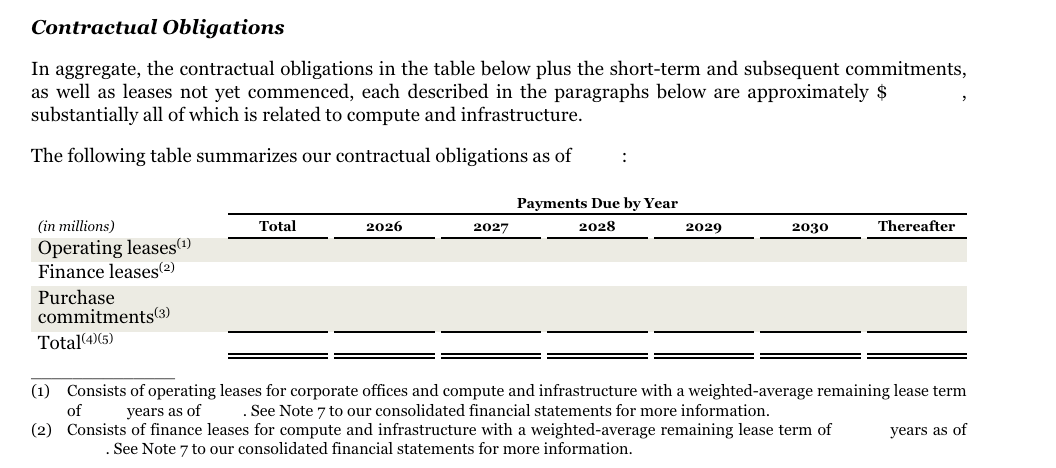
这份 S-1 文件中的空白似乎是专门设计来模糊任何试图弄清其未来_任何_情况的能力。
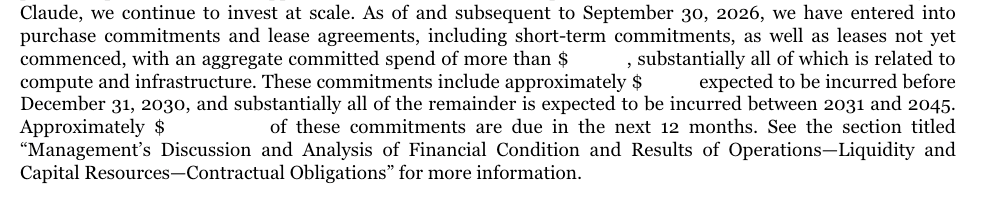
尽管提交了_三百多页的信息_,Anthropic 却选择省略:
- 其第三季度收入。
- The amount of payments due on a yearly basis.
- 这将使我们能够精确建模它在 2030 年前需要多少资金。
- The amount of payments due in the next 12 months — arguably the most important number to disclose.
- 这将使我们能够将其当前烧钱速度与未来成本进行比较。
- Its cash position as of September 30, 2026 (the end of Q3).
- 这将使我们能够看到它在_2026 年 6 月 30 日之后实际手头有多少钱,而这对一场感恩节前进行的 IPO 来说似乎相当重要。_
- 我还想象,鉴于其向 SpaceX、Google、Amazon 及其他交易对手的付款增加,其现金状况自那时起已经发生了变化。
- 任何关于 IPO 定价或募集资金用途的内容,除了最笼统的表述之外。
- 它的运行率,在第 194 页留了空白。
我会对 Anthropic 宽容一些——这是一份_草稿_文件,因此它_有可能_在实际 IPO 之前补上这些数字,但尽管如此,_这是极其有价值的信息_,因为据[路透社报道](https://www.reuters.com/business/finance/investors-temper-anthropic-ipo-valuation-expectations-over-revenue-growth-2026-10-15/?ref=wheresyoured.at),其营收增长在第三季度环比放缓至(仍然非常高的)45%,从 115 亿美元增长到 168 亿美元。根据 TickerTrends,[就连被曲解的“运行率”指标也显示,情况已经开始放缓](https://x.com/tickerplus/status/2110497393078600053/photo/1?ref=wheresyoured.at):
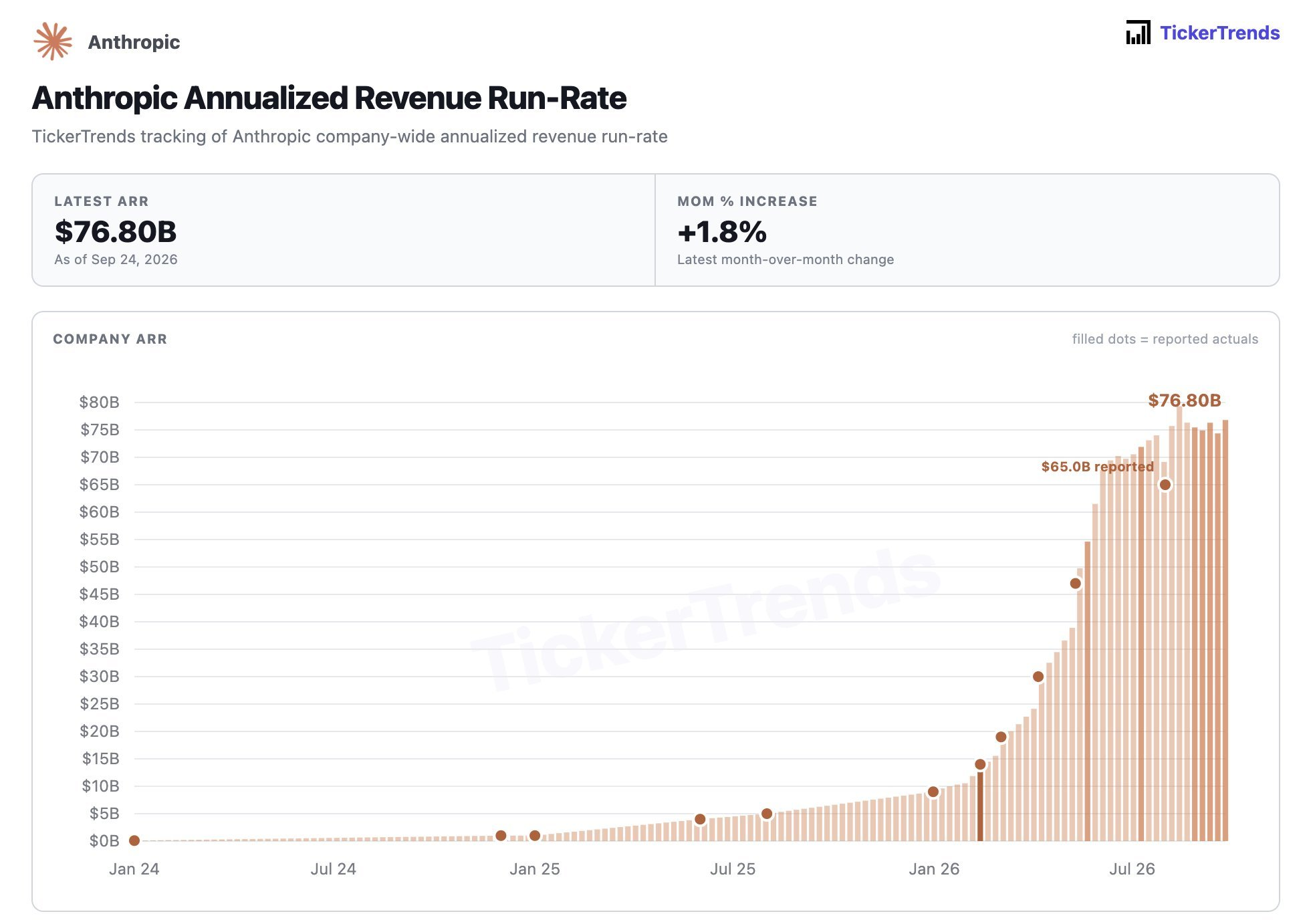
token-maxxing 的时代——[当时 Meta 等公司激励员工尽可能多地消耗 token](https://www.wsj.com/cio-journal/why-some-companies-say-ai-tokenmaxxing-is-key-to-survival-e699a128?eafs_enabled=false&ref=wheresyoured.at),[结果在成本飙升后又收手](https://www.wheresyoured.at/ai-doesnt-have-roi/)——在 2026 年第二或第三季度的某个时候结束了,这就是为什么 Anthropic 如此急于把这家公司推出去,最好是在你对其最新季度或持续支出可能有多高了解太多之前。
尽管如此,Anthropic 有一个盈利的季度,这证明它的业务比 OpenAI 更高效,即使这种效率来自合同上的花招。它_省略了第三季度——一个我们已经知道的月份——_这一事实表明情况已不再如此,尤其是因为我读到的每篇文章都说它“按调整后口径”盈利,这意味着剔除了股权激励(2026 年第二季度为 12.61 亿美元,环比增长 36.5%)。
同样有趣——也令人沮丧!——的是,截至_2026 年 6 月 30 日_,Anthropic 拥有约 1120 亿美元现金及现金等价物,这让我们几乎无法了解其_当前_财务状况,也无法知道是否必须支付任何预付款。怎么了,Anthropic?是怕告诉我们一些关于你流动性的情况吗?
尽管如此,其中大部分——1104 亿美元——来自两轮融资,其中一轮的规模比报道的更大:
- [Anthropic 在 2 月宣布完成了 300 亿美元的 G 轮融资](https://www.anthropic.com/news/anthropic-raises-30-billion-series-g-funding-380-billion-post-money-valuation?ref=wheresyoured.at),但在两轮融资(G-1 和 G-2)中,于 2026 年 1 月至 5 月间筹集了 452 亿美元。
- [Anthropic 在 5 月宣布完成了 650 亿美元的 H 轮融资](https://www.anthropic.com/news/series-h?ref=wheresyoured.at),与 S-1 上的 652 亿美元相符。
我承认 Anthropic 的现金状况让我感到意外,尤其是考虑到其算力支出似乎_大幅_低于我(和其他人)的预期……_这使得缺乏任何付款时间表更加令人沮丧。_
我能想到两个原因,而且两者可以同时成立!
1. Anthropic 足够聪明,意识到 IPO 后融资会很困难,于是选择在其炒作最盛时大举吸金,约 650 亿美元在其估值最高点流入,而无需经历公开市场按市价发行那种麻烦。
2. Anthropic 清楚,它正在签署的合同——例如与 [Google、Broadcom](https://www.anthropic.com/news/google-broadcom-partnership-compute?ref=wheresyoured.at) 和 [Amazon](https://www.anthropic.com/news/anthropic-amazon-compute?ref=wheresyoured.at) 的大规模交易(两项交易均于 4 月签署,早于其 H 轮融资完成,该轮融资包含来自 Amazon 和 Google 的投资)——将要求从 2026 年下半年开始进行_巨额_预付款,因此它在资金收紧之前就采取了行动来充实自身资本。
无论如何,这份 S-1 中所描述的 Anthropic 并不是真正进入市场的那个 Anthropic。
事实上,Anthropic 正是就此向投资者发出警告,并专门用一个风险因素来阐述这一点,其标题恰如其分(强调为原文所加):**_我们正处于收入增长的早期阶段,近几个时期我们经历了快速增长,而我们的历史增长率并不预示未来业绩,也不代表我们有能力维持或预测未来的收入增长。_**
> 我们预计我们的收入不会继续以可比的速度增长,我们也无法向您保证它将继续增长。我们近期的增长可能反映了早期采用阶段的动态、AI 市场的初生状态,以及可能无法长期持续的快速初始客户扩张,并且随着我们收入基数的增加、市场的成熟以及下文所述其他因素的作用,它可能会显著下降,且下降速度比我们预期的更快。我们预计我们的收入增长率将随时间推移而下降。此外,由于 AI 行业非常初生,我们过去难以准确预测我们的收入,未来也可能难以做到。
它还列举了若干可能减缓增长的因素,包括[对模型的需求放缓或转变](https://x.com/tickerplus/status/2110497393078600053?s=20&ref=wheresyoured.at)、能否获得足够的算力或高效地调配算力、模型的故障或性能局限(包括意外行为)、日益激烈的竞争、安全风险,以及我个人最喜欢的……
> _我们的模型、平台和应用的用户及付费客户数量增长不足,或未能提升现有客户对我们模型、平台和应用的销售额_
考虑到 Anthropic 2026 年上半年 48% 的收入来自通过 Amazon 和 Google 销售其模型,“客户”一词可能有多重含义。
在讨论运行率时还包含这样一条引人注目的说明:
> 我们近期的运行率收入增长也部分得益于快速的初始客户采用和扩张,这往往是早期采用阶段和 AI 市场初生状态的典型特征,可能无法持续;我们预计我们的运行率收入增长率将随时间推移而下降,并且随着我们收入基数的增加、市场的成熟以及其他因素的作用,它可能会显著下降,且下降速度比我们预期的更快。
>
> 此外,我们的运行率收入已经包含、并且我们预计将继续包含来自客户的金额,而这些客户后来被我们认定在使用我们的模型、平台和应用时违反了我们的使用政策或商业条款。
这引出了另一个问题……
## Anthropic 存在客户集中度问题:_2026 年迄今收入_的 5-7%(16.5 亿美元至 23.1 亿美元)来自利用其输入来训练自身模型的竞争对手
在第 145 页,Anthropic 披露其 5% 至 7% 的收入似乎来自蒸馏攻击,即其他模型提供商利用其模型或账户来训练自己的模型:
> 此外,我们的收入已经包含、并且预计将继续包含来自客户的金额,而这些客户我们随后认定其使用我们的模型、平台和应用程序违反了我们的使用政策或商业条款。我们认为这一动态在我们行业中很常见。由于检测、调查和执法需要时间,我们在相关服务提供时即确认来自此类客户的收入,然后再限制或终止其访问权限。根据我们的检测和审查流程,我们估计,在截至2026年9月30日的九个月中,来自此类客户的收入约占我们收入的5%至7%。
当我们考虑到Anthropic迄今为止的收入——包括2026年第三季度报告的168亿美元——约为330.8亿美元时,这意味着其收入中多达23.1亿美元(7%)来自_其他公司对其模型进行蒸馏_。Anthropic预计来自其“商业模式”这一部分的收入占比将会下降,并补充说这将对“收入和收入增长产生不确定的不利影响”。
其五大客户还占其截至2026年第三季度末收入的25%_——**你知道的,就是它没有纳入的那个季度!**_——Anthropic还补充说,“其许多顶级客户不受长期合同约束,或者合同到期日临近,能够随时以任何理由减少或在某些情况下停止支出。”
虽然尚不清楚这些大客户是谁,但它们无疑包括Meta和微软,[据报道这两家公司都在减少对该平台的使用](https://finance.yahoo.com/technology/ai/articles/meta-microsoft-scale-back-internal-185842649.html?ref=wheresyoured.at),[微软AI首席执行官Mustafa Suleyman曾在6月表示,他希望彻底消除这笔支出](https://thenextweb.com/news/microsofts-ai-chief-says-the-company-wants-to-eliminate-what-it-pays-anthropic?ref=wheresyoured.at)。
然后是其余部分——以及这三个要点,我看到多家媒体试图将其描述为对公司的利好。
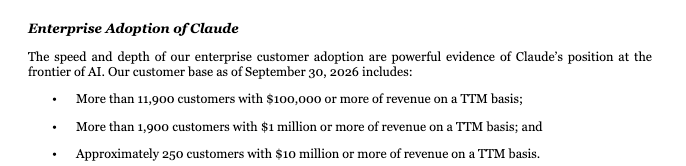
让我们来推演一下。
- 那么,假设其收入中有11.9亿美元来自11,900名用户(假设每人支付10万美元——尽管区间在0.1万至100万美元之间。为了论证起见,我在这里采用最低可能的数字)。
- 再次,让我们进一步假设其收入中另有19亿美元来自1,900名客户(同样假设他们支出的是该区间内的最低金额,即100万美元)。
- 最后,让我们设想有25亿美元来自250名客户(同样假设他们都恰好支出了1000万美元)
- 这样我们得到45.9亿美元。
这些数字基于TTM(滚动十二个月)口径,即报告期结束前的十二个月——也就是6月底。如果我们算一下,Anthropic在该期间的收入为197.08亿美元(其中2025年下半年带来34.22亿美元),这意味着,在我们最慷慨的(因而必然是错误的)假设下,该期间近四分之一的收入来自一个相对较小的鲸鱼客户群体。
如果我们把这些假设变得不那么慷慨,哪怕只是略微调整,那么收入集中度就会变得更加惨淡。如果最低可能的估计错了50%,那么Anthropic近三分之一的收入来自那一小群鲸鱼客户。如果最低可能金额是真实数字的一半,那么反过来,该期间Anthropic略低于一半的收入来自同一小群客户。
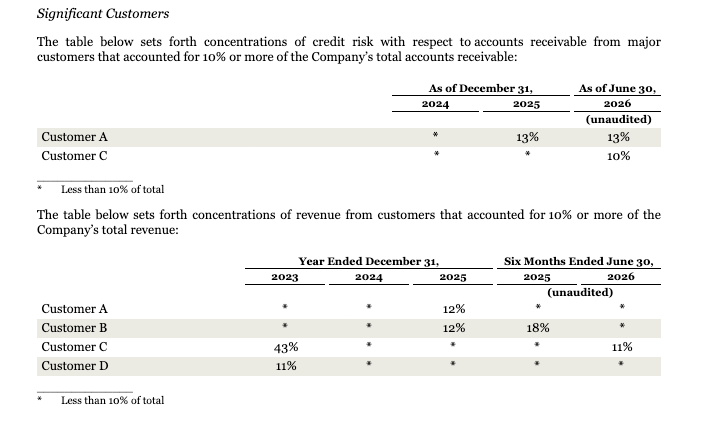
再说一次,最慷慨的估计也_必然_只是真实数字的一小部分,尤其是因为仅两家客户就占了 Anthropic 2026 年上半年应收账款的 23%。上述推算假设每头“鲸鱼”都在各自区间内统一按最低可能金额消费——这不现实,但足以说明问题。
然后还有另一个问题:**这些所谓“多元化”客户中很大一部分,实际上是不盈利且不可持续的 AI 初创公司。**
## Anthropic 和 OpenAI 的企业收入中,有 80% 都依赖风投支持的初创公司——而 Anthropic 曾用折扣在短期内推高收入
Anthropic 还悄悄提到了我认为是其第二大生存风险(仅次于其算力协议):
> ……我们的客户,尤其是早期和高增长公司,可能依赖风险投资或其他外部融资来为其运营提供资金,如果此类融资延迟、减少或无法获得,或者其获取资本的成本变得更高,他们可能会减少或停止向我们支出。
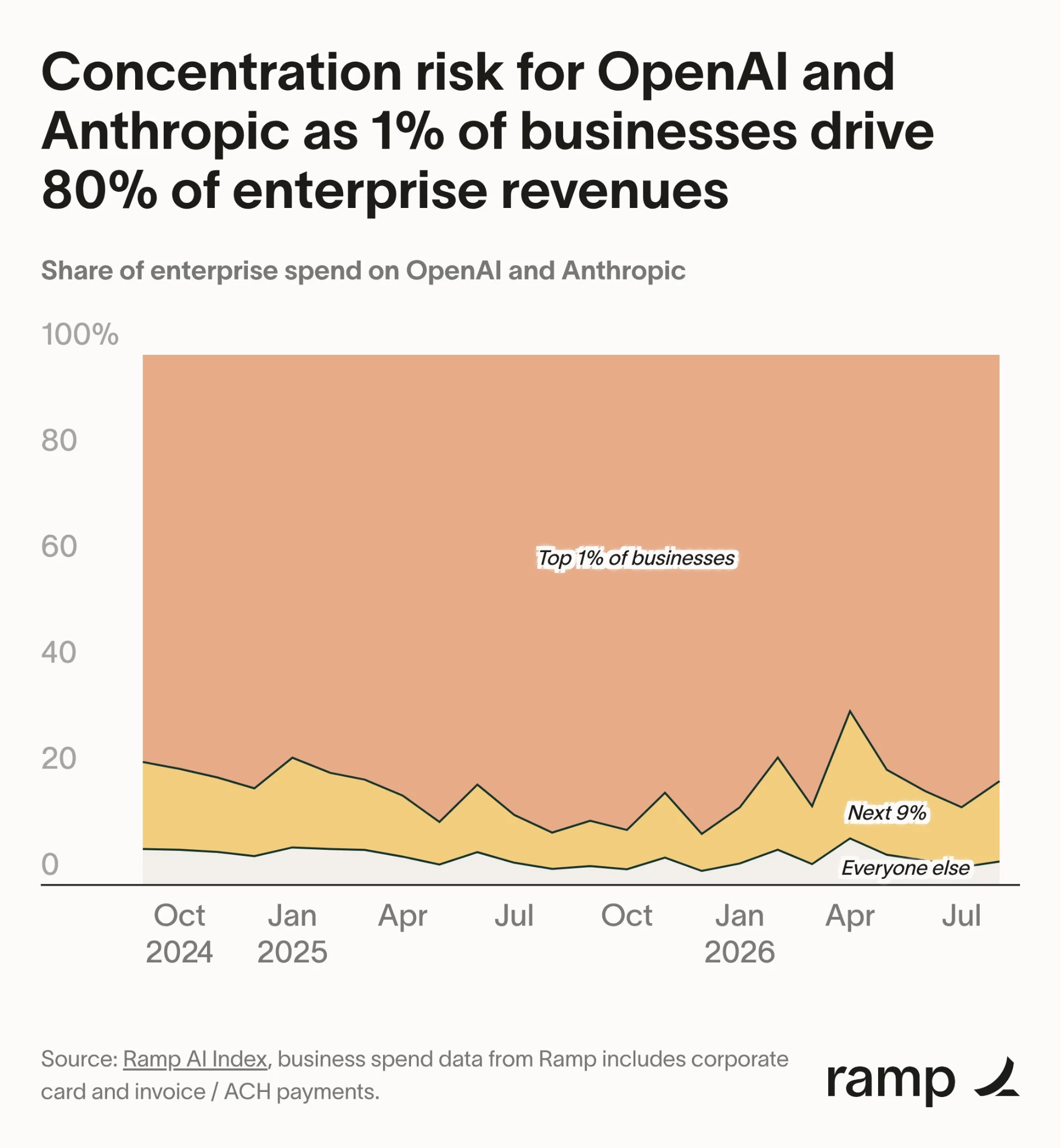
[正如我之前讨论过的](https://www.wheresyoured.at/annualized-enron-rate/#ai-startups-are-the-dirty-little-secret-of-the-bubble-%E2%80%94-raising-billions-of-dollars-to-make-millions-of-dollars-making-up-around-80-of-openai-and-anthropic%E2%80%99s-revenues-by-spending-5x-of-sales-on-ai-tokens),根据 Ramp 的数据,OpenAI 和 Anthropic 企业收入的 80%——也就是它们收入的绝大部分——来自 1% 的客户,其中绝大多数是风投支持的初创公司;[正如我也讨论过的](https://www.wheresyoured.at/annualized-enron-rate/#ai-startups-are-the-dirty-little-secret-of-the-bubble-%E2%80%94-raising-billions-of-dollars-to-make-millions-of-dollars-making-up-around-80-of-openai-and-anthropic%E2%80%99s-revenues-by-spending-5x-of-sales-on-ai-tokens:~:text=For%20example%2C%20SemiAnalysis,when%20using%20Anthropic%E2%80%99s%20models.),这些公司让客户每产生 1 美元订阅收入就烧掉 3 到 10 美元。
根据我上一期通讯:
> 例如,[SemiAnalysis 做了一项深入研究](https://newsletter.semianalysis.com/p/anthropic-subscriptions-offer-5x?ref=wheresyoured.at),考察了市面上各种不同 AI 订阅服务能烧掉多少 token,发现按 Cognition 的价格,每月 20 美元可烧掉 83 到 118 美元,每月 200 美元可烧掉 1,264 到 1,331 美元;而在 Cursor 上使用 Anthropic 的模型时,每月 20 美元的计划降至 46 美元,每月 200 美元的计划降至 507 美元。
这意味着两家公司收入的很大一部分都依赖于其客户能够持续融资,这也是为什么[像 Harvey 这样的公司](https://www.wheresyoured.at/annualized-enron-rate/#ai-startups-are-the-dirty-little-secret-of-the-bubble-%E2%80%94-raising-billions-of-dollars-to-make-millions-of-dollars-making-up-around-80-of-openai-and-anthropic%E2%80%99s-revenues-by-spending-5x-of-sales-on-ai-tokens:~:text=and%20OpenAI%E2%80%99s%20Revenues-,Let%E2%80%99s%20take%20Harvey,-%E2%80%94%20which%20raised)每隔几个月就必须筹集数亿美元来跟上成本。
而且很明显,Anthropic 曾提供临时折扣,以便在 IPO 前推高收入,随后又停止这些折扣,除非初创公司承诺通过我称之为_有点残酷_的手段在平台上花更多钱:
[据 The Information 报道](https://www.theinformation.com/articles/anthropic-openai-fighting-enterprise-spending?rc=kz8jh3&ref=wheresyoured.at),2026 年 9 月:
> 虽然 Anthropic 和其头号竞争对手 OpenAI 都会向承诺每年在其产品上花费数百万美元的客户提供折扣,但据三家同时从两家公司购买 AI 的软件公司的经理称,Anthropic 采取了不同寻常的做法:一旦客户达到合同中的使用上限,就终止其折扣。这些人士说,达到上限的客户必须谈判新协议,否则就要面对更高的价格。
>
> “你一达到上限,Anthropic 的销售团队就会打电话和发邮件说,‘嘿,我们注意到你达到上限了——如果我们今天通过新协议解决这个问题,你就可以避免超量费用,’”其中一位人士说。“否则你就只能自己想办法了。”
Anthropic 介于黑帮和毒贩之间,它以为客户会直接屈服,并(错误地)以为 OpenAI 不会在成本上竞争:
[据 The Information 上周报道](https://www.theinformation.com/articles/anthropics-margin-openais-opportunity?rc=kz8jh3&ref=wheresyoured.at):
> 据一位知情人士透露,编程应用 Replit 近几个月将其大部分 AI 支出从 Anthropic 转向了 OpenAI,原因是 OpenAI 在一份年价值超过 1 亿美元的合同中,以超过 30% 的折扣提供了其模型价格。这位人士说,这家初创公司原本计划继续与 Anthropic 合作,但 Anthropic 不愿延长此前给予 Replit 的折扣,除非该初创公司承诺更高的支出水平。(Replit 已公开讨论过转向 OpenAI,但未披露其获得的折扣或合同规模。)
“近几个月”,是吗?[Replit 几周前曾提到](https://techcrunch.com/2026/10/17/replit-is-no-longer-working-with-anthropic-ceo-says/?ref=wheresyoured.at)它已不再与 Anthropic 合作,这让我不禁怀疑,这种下滑的影响是否会在比如 2026 年第四季度——你知道,_也就是它上市后的那个季度_——才体现出来。
Anthropic 正在玩一场危险的游戏:它要么选择疏远一些最大的客户,要么通过要求他们保证最低代币支出,耗尽他们仅剩的风险资本。
而我想 Anthropic 这么做的原因是,它意识到自己的算力承诺已经超出了自身能力。
## Anthropic 的算力成本增速现已超过收入增速
热心的读者在阅读[有关 Anthropic 2026 年第三季度数据的报道](https://www.cnbc.com/2026/10/15/anthropics-third-quarter-revenue-hits-16point8-billion-ipo.html?ref=wheresyoured.at)时会注意到,它夸耀自己“每在算力上花费 1 美元就能产生 1.70 美元收入”,这算下来就是约 98.8 亿美元的算力支出对应 168 亿美元的收入。
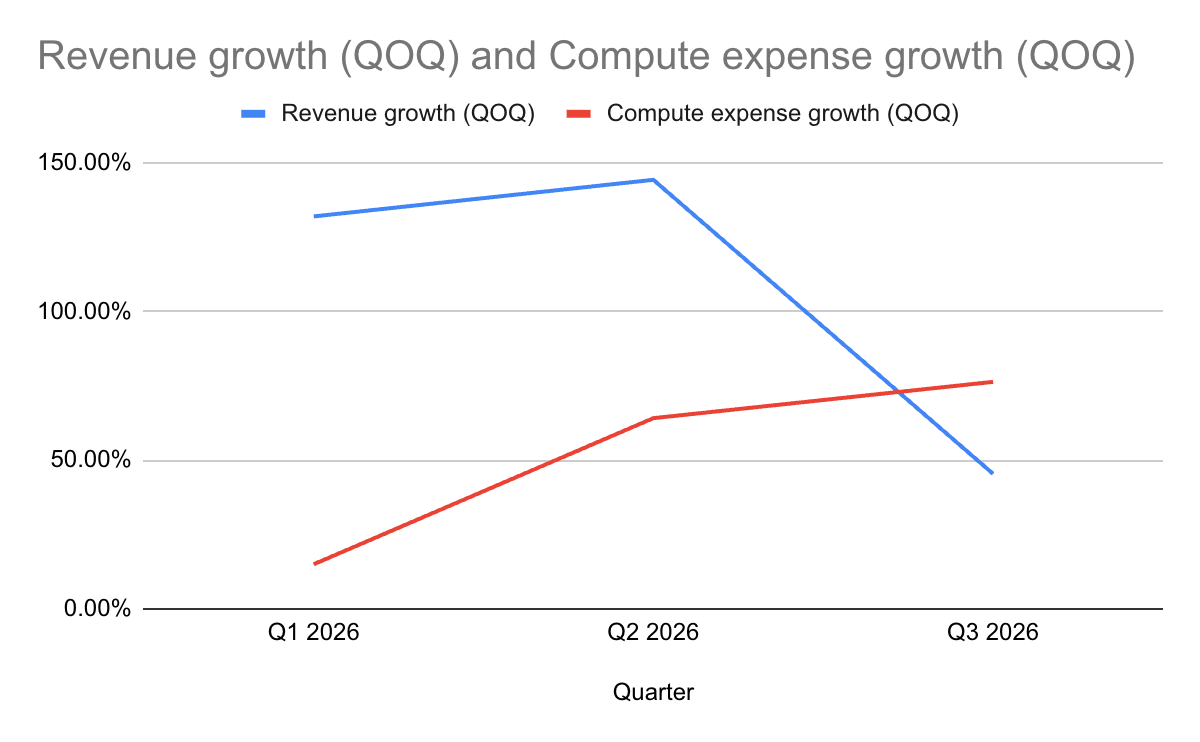
这很可能是 Anthropic 没有公布第三季度数据的主要原因之一——因为 2026 年第三季度正是其算力支出环比增速超过收入增速的季度:收入增长了(依然亮眼的)45%(从 115 亿美元增至 168 亿美元),但算力成本增长了 76.3%(从 55 亿美元增至 98.8 亿美元)。
同样有趣的是,Anthropic 又搬出了那个“每单位算力对应一美元收入”的说法,尤其是考虑到该数字环比_下降_了,从 2 美元(2026 年第二季度)降至 1.70 美元。我想它以为没人会费心花两分钟琢磨这件事。
无论如何,虽然我们对 Anthropic 2026 年第三季度之后的情况知之甚少,但我们_确实_知道,它在未来几年有_数千亿美元的算力成本到期_,而且这些成本将大幅增加:
- 如果我们假设 SpaceX 能如约交付其算力,这意味着 Anthropic 仅与 Elon Musk 合作就**每年花费 372 亿美元**。
- Broadcom’s deal is $161.2 billion “excluding interest” for multiple five-year-long leases, though it’s unclear when the capacity will come online. **Nevertheless, that’s at least $5 billion next year, if not more like $10 billion, growing to as much as $30 billion a year.**
- [首批 210 亿美元的五年期债券目前正在筹备中,若不进行再融资,将导致每季度约 10 亿美元的本金偿付](https://www.bloomberg.com/news/articles/2026-10-27/banks-eye-21-billion-of-bonds-for-broadcom-chip-financing-deal?accessToken=eyJhbGciOiJIUzI1NiIsInR5cCI6IkpXVCJ9.eyJzb3VyY2UiOiJTdWJzY3JpYmVyR2lmdGVkQXJ0aWNsZSIsImlhdCI6MTc5MzE1MDc1NSwiZXhwIjoxNzkzNzU1NTU1LCJhcnRpY2xlSWQiOiJUTktHQ05UOTZPU0cwMCIsImJjb25uZWN0SWQiOiJGRTc3RjhBRkFFRDY0ODc4OTZGOTQ5RUIxOThCNDk2MyJ9.J8TF9mBGaczamaBTlwwNj3favrjvpnUqPe5pTVOLMIo&ref=wheresyoured.at)。
- Anthropic 与 Microsoft 的协议于 11 月启动,要求其在 2033 年 7 月前支出 449 亿美元,即每年约**68 亿美元。**
- Anthropic 与 Amazon 的 1100 亿美元协议于 2026 年 5 月启动,持续到 2036 年,**折算下来每年约 110 亿美元。**
- Google 的 1145 亿美元协议从 2026 年 4 月持续到 2033 年 7 月,**折算下来每年约 156 亿美元。**
此外,在第 170 页底部,披露其与 Google 的 TPU 租赁协议之后,还有这样一条耐人寻味的注释:
> 此外,我们还承诺从包括 Google 在内的 TPU 供应商处额外采购 TPU 算力,交付时间为 2028 年至 2031 年。此类额外算力的付款义务取决于所提供的容量、部署方式、定价机制以及某些部署条件的满足情况。我们估计此类额外算力的未来付款总额约为 1250 亿美元至 1500 亿美元,这些金额未包含在上文的合同承诺表中。
所以没错,不过是又多了 1250 亿或 1500 亿美元的承诺而已。没什么大不了的!别担心。
就不可撤销承诺而言,这合计约为每年 756 亿美元的算力承诺,而且每笔交易都带有“至少”这一关键措辞。Anthropic 不提供确切明细,这基本上是对每一位参与此次 IPO 投资的投资者的侮辱。
然而,如果我们(唉)将 Anthropic 2026 年第三季度的算力支出年化,这意味着 Anthropic 很可能恰恰在其放缓之际,需要将其芯片租赁支出_翻倍_。
## Anthropic 明确表示,其 S-1 中所描述的公司并非你所投资的那家公司
Anthropic 明确告诉我们,你眼前看到的这家公司并不是最终真正上市的那家公司。这不是我的个人观点,而是对 S-1 的客观解读。
在其 S-1 中,Anthropic 告诉你“……历史增长率并不预示未来业绩,也不预示我们维持或预测未来收入增长的能力”(第 16 页),并特别指出“……截至 2026 年 6 月 30 日的六个月业绩不一定预示截至 2026 年 12 月 31 日止全年或任何其他期间的预期业绩”(第 22 页)。它在第 62 页再次提醒我们,它“……不预期\[其\]收入将继续以可比速度增长”,它“无法向你保证它将持续增长”,并且“近期增长可能反映早期采用阶段的动态、AI 市场的初期阶段以及可能无法长期持续的快速初始客户扩张,并可能大幅下降。”
在第 64 页,它告诉你 Anthropic“……预计\[其\]成本将随时间增加,\[其\]亏损将持续,因为我们预计将投入大量资源来发展业务并作为上市公司运营。”
在第 67 页,Anthropic 明确表示,其年化收入增长是由“早期采用阶段常见的扩张”所驱动,并且“可能比其预期更快下降”:
在第 133 页,Anthropic 表示,随着算力上线,其利润率将恶化:
> _随着未来期间大量增量算力上线,相关费用将在该算力最终支撑的全部收入之前确认,我们预计这些期间的营业利润率和调整后营业利润率可能受到压缩。_
……而这还没有计入短期算力成本(第 134 页)。
> _此外,我们的大部分算力是通过多年期承诺合同采购的,通常会在算力可用前12至18个月进行采购。当客户需求或研究需求超出这一长期容量时,我们会采购短期算力,而短期算力的单位算力成本通常更高。我们预计短期内短期算力的使用将会增加,进而压缩我们的营业利润率和调整后营业利润率。_
在第161页,Anthropic明确表示,其“为构建算力和基础设施而不断加大的投入需要大量资本支出,并正在改变\[其\]业务的现金流状况,而且其算力支付的底层经济结构也将发生变化,包括更大的预付款和‘巨额’资本支出:
> 我们为构建算力和基础设施而不断加大的投入需要大量资本支出,并正在改变我们业务的现金流状况。通过我们的CSP安排购买的算力通常在算力可供我们使用时才付款,而我们预计越来越多的算力和基础设施投资将以资本支出和其他承诺的形式出现,包括租赁义务,这些都需要在相关算力投入运营之前很久就进行大额预付款。我们预计随着我们扩大建设规模,资本支出将大幅增加,并且我们预计这些投资将在可预见的未来导致经营活动和投资活动产生大量净现金流出。无论我们的财务表现是否改善,这些活动产生的净现金流出都可能增加。
换句话说,2026年第二季度的Anthropic——这家所谓的“盈利的”、轻算力公司让支持者们激动不已——只是一个被特意选定的时间切片,目的是让人们形成一种印象,以为这是一家与他们实际将要投资的公司截然不同的企业。
用Anthropic自己的话来说,它注定——未来的增长会更慢、利润率会更差、成本会更高,而只公布_第二季度_的数据,就是在对投资者群体进行一场真正令人反感的诱饵调包,而这个群体还被一个无法察觉自己何时被欺骗的媒体生态系统所鼓舞。
更令人反感的是,[Anthropic仅在几周前就向投资者分享了部分第三季度数据](https://www.cnbc.com/2026/10/15/anthropics-third-quarter-revenue-hits-16point8-billion-ipo.html?ref=wheresyoured.at)!它显然掌握这些数据,而且考虑到其_其他_2026年数据未经审计,我认为除了“我们不想让投资者拿它们与第二季度比较”之外,没有任何理由不至少公布其现金状况和运营费用。
是否存在一个真正具有经济可行性的Anthropic版本?鉴于其收入如此依赖风险投资,这不太可能。由于其绝大多数收入来自风险投资支持的初创公司,我们有理由质疑_对AI整体而言_是否存在根本性需求——而支持者们可能会回应说“这只是早期阶段”,但我认为,当你已经做出近5000亿美元的承诺,并[声称拥有30万亿美元的总可寻址市场](https://www.reuters.com/business/media-telecom/anthropic-expected-tell-investors-it-sees-over-30-trillion-potential-revenue-wsj-2026-08-25/?ref=wheresyoured.at)时,这种说法简直可笑至极。
## Anthropic——以及整个AI行业——把你视为退出流动性
你可以随意做任何心理体操——“哦,它大可以停止训练然后实现盈利”——但真正重要的只有 Anthropic 实际在做的事,那就是做出 4300 亿美元不可撤销的承诺,并明确表示其经济状况会变得更糟。
Anthropic 最大的客户也在明确地打造竞争对手,和/或积极讨论弃用其服务。拥有 Cursor 的 SpaceX 有 [Grok](https://x.ai/news/grok-4-5?ref=wheresyoured.at),并且[刚刚举债 400 亿美元购买更多 GPU 来训练它](https://www.cnbc.com/2026/10/26/spacex-closes-40-billion-debt-deal-for-ai-chips-elon-musk-.html?ref=wheresyoured.at)(并可能为此将 Anthropic 踢出其基础设施),Meta 有 Muse,而且[Meta 和微软都明确讨论过弃用 Anthropic](https://finance.yahoo.com/technology/ai/articles/meta-microsoft-reportedly-trim-anthropic-230612967.html?ref=wheresyoured.at)。
然后是来自开源 LLM 的威胁,它们天然对 Anthropic 最大的客户有吸引力。虽然对于一家 AI 初创公司来说,在用户要求使用 Anthropic 和 OpenAI 最新模型的情况下,花费数千万或数亿美元训练自己的模型可能并不现实,但任何真正对 AI 感兴趣的大型成熟企业都会在基于众多开源选项之一(比如 [Meta 的开放权重 Muse 模型](https://research.meta.ai/blog/muse-spark-open?ref=wheresyoured.at)_)训练自己的模型上看到大得多的价值——并且拥有执行这一计划的资源。_
我还应该明确一点,[正如我两周前在付费通讯中所讨论的](https://www.wheresyoured.at/premium-venture-capital-is-killing-itself/),这次 IPO 的唯一目的就是把 Anthropic 甩给公开市场。
在 [1.4 万亿至 1.75 万亿美元估值](https://www.bloomberg.com/news/articles/2026-10-28/anthropic-said-to-pick-jpmorgan-to-lead-ipo-s-us-retail-offering?accessToken=eyJhbGciOiJIUzI1NiIsInR5cCI6IkpXVCJ9.eyJzb3VyY2UiOiJTdWJzY3JpYmVyR2lmdGVkQXJ0aWNsZSIsImlhdCI6MTc5MzE0Nzk3NCwiZXhwIjoxNzkzNzUyNzc0LCJhcnRpY2xlSWQiOiJUTktXQllSS1YyVEUwMCIsImJjb25uZWN0SWQiOiJGRTc3RjhBRkFFRDY0ODc4OTZGOTQ5RUIxOThCNDk2MyJ9.WUiKaxfvkHdwq13b6edFj1mKZB50XeN-fc-qmA5M1yM&ref=wheresyoured.at)下,Anthropic 早已远远越过了还能像投资亚马逊(以 4.38 亿美元上市)、微软(约 7.77 亿美元)、谷歌(230 亿美元)或 Meta(1040 亿美元)那样有增长空间的地步。
> **旁注**:如果 Anthropic 以 1.4 万亿美元上市,对于那些在公司目标纸面估值为 9600 亿美元时投资的人来说,无疑会是一个巨大的失望。
作为参照,截至我写这句话时,Meta 的市值约为 1.6 万亿美元,而这还是一家在社交媒体上拥有有效垄断地位的公司。Anthropic 究竟凭什么支撑如此高的估值?而如果它真的上市了——鉴于所有人都如此无脑,遗憾的是它可能真会上市——它又如何维持这一估值?
无论如何,证明这就是在甩卖股票所需的全部证据,来自 Anthropic 的锁定期安排:它允许非创始人内部人士在上市首日抛售 10% 的股份,并在 Anthropic 2026 财年业绩公布后的第二个交易日抛售总计 45% 的股份。
在上市约 180 天后——或者更早,如果它在此前公布了 2027 年第一季度业绩——Anthropic 的非创始人内部人士可以卖出_全部_股份,创始人可以卖出 29% 的股份。在其 2027 年第三季度业绩公布后的第二个交易日(或最终 IPO 招股书日期后 365 天,以先到者为准),**_所有人都可以卖出一切_**,前提是他们的协议不禁止这样做。
那些受180天锁定期约束的持有者(这实际上并不意味着他们必须等待180天)被允许在招股说明书提交后27天出售6%的股份,48天后再出售6%,而在其2026财年财报发布后的第二个完整交易日,最多可出售38.5%的股份。财报发布69天后,这一比例跃升至86%。
虽然其中_部分_内容相当标准,但内部人士和股东退出这家公司的速度之快令人瞩目,其设计目的就是让内部人士利用散户投资者,将他们在这样一家已被抽干任何机会或价值的公司中的早期押注金融化。
引用《蜘蛛侠:平行宇宙》中彼得·B·帕克的话,[_别看嘴,看手_](https://www.youtube.com/shorts/BVWRakUKW9s?ref=wheresyoured.at)_。_
如果CoreWeave相信它真的能增长到实现其1000亿美元营收积压订单——这无疑会将其股价送上月球——[它的三位联合创始人就不会自2025年3月上市以来出售33亿美元的股份](https://www.bloomberg.com/news/articles/2026-10-15/coreweave-founders-shield-fortunes-with-3-3-billion-stock-sales?ref=wheresyoured.at)。如果前甲骨文CEO Safra Catz相信甲骨文真的能从与OpenAI为期五年、价值3000亿美元的交易中有所收获,[她就不会在2025年第二季度出售18亿美元的股份](http://finance.yahoo.com/news/oracles-safra-catz-quietly-tops-171715233.html?ref=wheresyoured.at) ,更不用说在[交易](https://www.wsj.com/business/openai-oracle-sign-300-billion-computing-deal-among-biggest-in-history-ff27c8fe?ref=wheresyoured.at)宣布两周后[辞去CEO职务](https://www.ft.com/content/8f55152c-f9ef-4a81-8bc1-37a6a5a93dce?syn-25a6b1a6=1&ref=wheresyoured.at)。同样的情况也适用于[NVIDIA CEO黄仁勋](https://www.bloomberg.com/news/articles/2025-10-31/nvidia-ceo-jensen-huang-completes-1-billion-share-sale?ref=wheresyoured.at),他在2025年10月前通过一项于2025年3月启动的计划出售了10亿美元的股份——那个月DeepSeek因开源威胁让市场陷入恐慌——以及董事会成员Mark Stevens,他在[2026年第二季度出售了9.46亿美元的股份](https://www.bloomberg.com/news/features/2026-10-07/nvidia-s-stevens-jeff-bezos-among-top-q3-insider-stock-sellers?ref=wheresyoured.at)。
[引用彭博社2026年7月的报道](https://www.bloomberg.com/news/articles/2026-07-17/us-corporate-insiders-are-selling-stocks-at-a-near-record-pace?ref=wheresyoured.at),美国高管正以20多年来第二快的速度出售股份,仅次于2021年的盛况。与此同时,据彭博社数据,企业回购仅为69亿美元,略高于七年低点67亿美元。
换句话说,当科技和AI界的每个人都在告诉你_现在就买,抢占先机_时,他们的实际_行动_却表明他们不愿留下来看看接下来会发生什么。
你开始看到的大规模、仓促的AI债务交易也是如此。据报道,博通的陈福阳([据《华尔街日报》](http://wsj.com/finance/broadcom-ceo-intervened-to-seal-63-billion-anthropic-debt-deal-c807754f?eafs_enabled=false&ref=wheresyoured.at))“周末与银行高管进行了11小时的谈判”,以敲定他们在一笔630亿美元芯片交易中400亿美元的出资,该交易让Anthropic从该公司回租TPU,换言之,_就是让银行家们从博通购买630亿美元的TPU。_
虽然陈福阳不得不为该交易支付高得无法确定的利率,但他的紧迫感告诉我,他非常清楚这场派对正在收场,他需要尽可能多地从系统中套现。同样的情况也适用于[马斯克及其400亿美元芯片交易](https://www.bloomberg.com/news/articles/2026-10-26/spacex-agrees-to-40-billion-chip-financing-deal-with-apollo?ref=wheresyoured.at)(据彭博社报道,该交易预计在年底前完成),[Semafor报道](https://www.semafor.com/article/10/26/2026/ai-fears-add-a-200-basis-point-premium-to-spacexs-debt?ref=wheresyoured.at)称,部分债务的利率可能高达8.75%。
这是一个只有在确信资金即将耗尽时才会接受的糟糕利率。
[据《华盛顿邮报》报道](https://archive.ph/Fz582?ref=wheresyoured.at#selection-551.0-570.0),AI行业已经在闭门承认这一点:
> 如何概括当下 AI 公司之间的情绪?投资公司 Raymond James Investment Management 的首席市场策略师 Matt Orton 谈到 AI 公司的圈钱行为时说:“能拿就拿。”“每个人都会需要更多。”
[据 MarketWatch 报道](http://marketwatch.com/story/ai-debt-trouble-could-help-feds-warsh-get-his-way-with-fewer-rate-hikes-b3dc4525?ref=wheresyoured.at),RBC 固定收益主管 Andrzej Skiba 认为,“融资市场即将——或接近——\[对 AI 投资关上大门\]。”
然而,在所有这些试图吸收全球流动性的奇怪尝试中,最糟糕的——除了 Anthropic 的 IPO,我认为那是对散户投资者赤裸裸的欺诈——是 [Meta 975 亿美元的按市价股票抛售](https://www.reuters.com/legal/transactional/meta-launches-35-billion-stock-offering-fund-ai-expansion-2026-10-26/?ref=wheresyoured.at):一家几乎没有或根本没有 AI 战略的公司稀释股东权益,并欺骗散户,声称这是在为其“未来主义 AI”融资,依据是 [其 Muse 助手短暂却正在崩塌的增长](https://hntrbrk.com/breaking-news/muse-tickertrends?ref=wheresyoured.at)。
975 亿美元这个数字可与 Anthropic 希望在 IPO 中筹集的 500 亿至 1000 亿美元相匹敌,而在这两种情况下,投资者最终都将为两家公司背锅,而这两家公司几乎拿不出切实证据证明它们能兑现其离谱的承诺。
而最终,其他所有人都要承受后果。
## 我们身处泡沫之中,持续越久,情况越糟
[各组织正在质疑投资回报率](https://www.wheresyoured.at/ai-doesnt-have-roi/)。Apollo 的首席经济学家表示没有回报。[数据中心建不起来](https://www.wheresyoured.at/wherere-all-the-ai-chips/),并且需要无止境的高息债务来为其提供资金。
最大的两家公司——OpenAI 和 Anthropic——背负着超过 1.3 万亿美元的债务,其中许多不可取消,它们正寻求在大部分债务生效之前让公司上市,诱骗散户投资者相信自己的处境好得多,而就在这之后,铁砧就会砸到他们头上。
Anthropic 对其增长轨迹如此自信,以至于在其 S-1 中省略了 2026 年第三季度的大部分数据,只报告了第二季度——此时超过 4300 亿美元的不可取消算力承诺即将开始生效,其增长也将开始放缓。
纳斯达克 100 指数中有 46.5% 由 NVIDIA、AMD 和 Broadcom 等 AI 芯片制造商,Google、Amazon、Meta 和 Microsoft 等超大规模云服务商,存储公司 Micron,以及负债累累的“新云”CoreWeave 构成。这些股票的价值与一个非常简单的理念挂钩——即 AI 将永久增长,每年为硬件和软件公司创造数万亿美元的新收入。据 Gartner 称,数据中心所有者[到 2030 年将需要创造 8.5 万亿美元的新 AI 收入,才能证明其计划支出合理](https://finance.yahoo.com/technology/ai/articles/ai-boom-nearly-5-trillion-153607724.html?ref=wheresyoured.at),而他们至少还差 5 万亿美元。
美国全部家庭财富中有超过 37% 被绑在一个充满泡沫的美国股市上,而如果你试图指出这一点,你往往会被说成是怀疑论者、愤世嫉俗者,或是对大局一无所知。
更糟的是,养老金和保险基金正越来越多地被用于为这一建设提供资金,[据 Jen Harris 在《纽约时报》撰文](https://www.nytimes.com/2026/10/25/opinion/ai-bubble-financial-crisis-lehman.html?eafs_enabled=false&ref=wheresyoured.at):
> 以年金为例,退休人员往往依赖这类产品。由于许多美国人依赖此类保险产品,一旦保险公司破产,其保单通常由州政府担保。眼下,Apollo 等私人信贷机构正通过动用 Athene 等公司账上的资金,为部分债务热潮提供融资——Athene 是 Apollo 控制的、规模达 4700 亿美元的保险公司。如果 A.I. 热潮转坏、Athene 倒闭,Apollo 清楚州政府(也就是纳税人)将为它欠保单持有人的大部分款项兜底。(Athene 的披露不透明,难以得知其资产中有多少投在数据中心。)
>
> 如今,私人资本支持的公司拥有整个美国人寿保险行业近 20% 的份额,资产规模接近 1.5 万亿美元。
这里存在非常、非常严重的问题,无论是正在发生的事件,还是那些协同一致、攻击任何提出异议者的做法。
总有一天资金会耗尽——OpenAI 和 Anthropic 那些风投支持的客户背后的基金、A.I. 数据中心背后的债务,以及投资者容忍连续多个季度出现十一位数资本支出的意愿——而一旦耗尽,我一直所说的这一切就会成为共识。
而且说实话,某种程度上这已经发生了——只是规模还不足以阻止 Anthropic 把散户投资者当作退出流动性。
* * *
如果你喜欢这篇文章,应该订阅我的付费通讯。目前我正在做为期一周的促销——新订阅者可享受每年 70 美元订阅费_终身_九折([点击这里!](https://edzitronswheresyouredatghostio.outpost.pub/public/promo-subscription/8xT65k4Lb3?ref=wheresyoured.at))。这是支持我工作的绝佳方式,而且你能以低于几乎所有竞品通讯的价格获得极其丰富的价值。
如果你想联系我——尤其是如果你掌握关于 Anthropic、OpenAI 或 A.I. 泡沫中任何其他公司的劲爆信息——请在 Signal 上通过 ezitron.76 找我。我也在 The Terminal 的 IB 上。
## 正文 · 原文
I’m taking a week off of premium as I’ve had a family situation that has absorbed a lot of my time this week, but I’ll be back with a barnburner next Friday (11/6).
In the interim, I’m running a week-long sale — 10% off of the $70-a-year subscription _for life_ ([click here!](https://edzitronswheresyouredatghostio.outpost.pub/public/promo-subscription/8xT65k4Lb3?ref=wheresyoured.at)) — for new subscribers. It’s a great way to support my work, and you get an absolute ton of value at a lower price than basically every competing newsletter.
Over the past few months, I’ve published a [ two](https://www.wheresyoured.at/premium-the-haters-guide-to-ai-debt-part-1/) [ part](https://www.wheresyoured.at/premium-the-haters-guide-to-ai-debt-part-2/) guide to the world of AI debt, an analysis of [ the (dubious) impact of generative AI on the global economy](https://www.wheresyoured.at/premium-how-has-ai-changed-the-economy/), deep analyses of the biggest players in the AI infrastructure space like NVIDIA (part [ one](https://www.wheresyoured.at/the-haters-guide-to-nvidia/) and [ two](https://www.wheresyoured.at/premium-the-haters-guide-to-nvidia-part-2/)) and Oracle (part [ one](https://www.wheresyoured.at/haters-guide-oracle/) and [ two](https://www.wheresyoured.at/premium-the-haters-guide-to-oracle-part-2/)), how [ OpenAI will eventually kill Oracle](https://www.wheresyoured.at/how-openai-kills-oracle/), and [ how venture capital is killing itself](https://www.wheresyoured.at/premium-venture-capital-is-killing-itself/).
If you want to get in touch — and especially if you have any juicy information about Anthropic, OpenAI, Blackstone or any other companies in the AI bubble — hit me up on Signal at ezitron.76. I’m also on IB on your Bloomberg Terminal.
* * *
[Last week](https://www.wheresyoured.at/ai-had-better-work-out/), I opened my newsletter with a quote from Apollo Chief Economist Torsten Slok, and forgive me, [I’m going to have to do so again](https://www.apollo.com/wealth/insights-news/insights/daily-spark/no-signs-of-ai-payoff-outside-the-tech-sector?ref=wheresyoured.at), emphases _his_:
> **Despite massive investments and widespread hype around artificial intelligence, the technology has delivered zero financial payoff to corporate America outside of tech.** Revenue per worker is rising for the Mag 7 but is flat for the S&P 493, see the first chart below. Profit margins are rising for the Mag 7 but are flat for the S&P 493, see the second chart below. And there are still no signs of AI boosting productivity growth, see the third chart below. With no impact on the bottom line, mainstream corporate America is pulling back and starting to view token spending not as a source of growth but as a cost center that weighs on margins.
I’ve included the first two charts below, because they’re important and, well, damning.

In the grand scheme of things, the whole sales pitch for AI is that it’s an _enhancer_ or a _job replacer,_ by which I mean it makes _your current resources more efficient and/or productive_ or _allows you to replace said resources,_ with “resources” meaning cash, people, software, or other things that you use to run your business.
The reason I’m speaking in such Fisher Price-esque terms is that the AI bubble has been inflated by intentionally escaping the terminology that you’d use to measure the health of a business. Four years into the bubble, AI should, at least in theory, be doing _something_ to the world of business — something _measurable_, especially given that just about everybody is talking about installing it everywhere and using it all the time.
Yet profit margins appear to have gotten _worse_ across the S&P 500 since the beginning of the AI bubble, with ChatGPT’s November 2022 launch appearing to do _sweet fuck all_ for anybody not called Google, Amazon, Meta, Microsoft, or NVIDIA, with Tesla and Apple having very little to do with the AI bubble as we understand it.
AI boosters and malcontents have spent the best part of four years trying to get everybody to talk about any imaginable statistic _other_ than the ones that matter, mostly because they universally look like _this_:

The counterpoint they’re going to give is that “organizations have yet to fully install AI in their workflows” or some such business, not so much _moving the goalposts_ but _constantly changing the rules of the game to the point that it’s unclear what it is we’re playing._ It isn’t making companies more money, more profits, or improving them in a manner that can be measured by modern science.
And, [per Slok last week](https://www.apollo.com/wealth/insights-news/insights/daily-spark/slowing-token-spend-shows-compute-demand-is-not-unlimited?ref=wheresyoured.at), it isn’t even improving the ROIC (return on invested capital) for hyperscalers, and that was before [Meta announced its plans to raise nearly $100 billion through ongoing equity sales](https://www.reuters.com/legal/transactional/meta-launches-35-billion-stock-offering-fund-ai-expansion-2026-10-26/?ref=wheresyoured.at):

It appears that AI does not appear to be increasing revenue or margin growth across the S&P 500, other than in the magnificent seven, who in return for over a trillion dollars of capital expenditures have seen their return on invested capital _drop_ on a quarterly basis.
Yet every single company building anything AI related will tell you that it’s _changing everything_ and that _you have to get on board today_, even if the product doesn’t really work the way they say it does, even if there isn’t really tangible evidence that it’s a good investment, and even if it’s clear the companies running the services have deeply questionable economics.
And that’s because this entire industry is sold with a genuine contempt for the end customer or investor.
Including, I should add, the biggest IPO in Silicon Valley history.
## This Is The Best Anthropic Will Ever Look, And Its IPO Timing Is Intentional
[To quote economist Paul Kedrosky on the Prof G Markets podcast](https://x.com/ProfGMarkets/status/2115143250331714026?s=20&ref=wheresyoured.at), “...this \[S-1\] is as good as it looks from the standpoint of the business as currently structured. And now you go through this inflection that makes it much more capex intensive."
I’m going to be a little more brutal, as I believe that Anthropic is intentionally misleading investors at a scale unseen in the history of IPOs. Whatever excitement anyone might have about cashflows or the stretched definition of “profitability” is irrelevant, as Anthropic is, by its own admission and its unbelievable obligations, a completely different company to the one it was in the second quarter of this year.
## Anthropic’s S-1 — And Q2 2026 — Tells The Story Of A Very Different Company To The One That Will Go Public, With Over $430 Billion In Non-Cancellable Obligations
So, as you’ve likely read, [Anthropic finally dropped its S-1 earlier in the week](https://www.sec.gov/Archives/edgar/data/2130357/000162828026067168/anthropicpbc-sx1.htm?ref=wheresyoured.at#ib6a29c037bd3429bad7f20ec2033b471_14324), a 300+ page megalith of different risk factors and disclosures that also carefully avoided including things that might have been useful to fully analyze it, specifically [leaving out anything to do with its third quarter numbers](https://www.cnbc.com/2026/10/15/anthropics-third-quarter-revenue-hits-16point8-billion-ipo.html?ref=wheresyoured.at) that were disclosed during its investor day.
> **Sidenote**: It seems as though Anthropic’s aligning its financial year with the calendar year. In that case, its third quarter would have ended on September 30.
>
> If we hold Anthropic to the same expectations as publicly-traded companies, there’s nothing _inherently_ dodgy (bear with me) with it failing to disclose its latest figures. The SEC gives public companies 45 days to publish their results after the close of each fiscal quarter.
>
> That said, if we hold Anthropic to the same expectations set by large publicly-traded companies (bear in mind it’s targeting a $1.5 trillion valuation, though investors have reportedly told investors that their target has [shifted to potentially as low as $1.4 trillion](https://www.bloomberg.com/news/articles/2026-10-28/anthropic-said-to-pick-jpmorgan-to-lead-ipo-s-us-retail-offering?accessToken=eyJhbGciOiJIUzI1NiIsInR5cCI6IkpXVCJ9.eyJzb3VyY2UiOiJTdWJzY3JpYmVyR2lmdGVkQXJ0aWNsZSIsImlhdCI6MTc5MzE0Nzk3NCwiZXhwIjoxNzkzNzUyNzc0LCJhcnRpY2xlSWQiOiJUTktXQllSS1YyVEUwMCIsImJjb25uZWN0SWQiOiJGRTc3RjhBRkFFRDY0ODc4OTZGOTQ5RUIxOThCNDk2MyJ9.WUiKaxfvkHdwq13b6edFj1mKZB50XeN-fc-qmA5M1yM&ref=wheresyoured.at)), it’s a bit lousy. Companies of this size can (and do) publish their audited numbers within a few weeks of the close of their fiscal quarters. SpaceX, for example, published its Q3 results on October 20, with Meta following [one day later](https://investor.atmeta.com/investor-news/press-release-details/2026/Meta-Reports-Third-Quarter-2026-Results/default.aspx?ref=wheresyoured.at).
>
> Both of these companies are larger, more diversified, and therefore considerably more complex. And so, it’s hard to ignore or rationalize away this glaring omission.
And despite all the hubbub and booster-cope, the vast majority of the numbers were already known, and many of the new ones make things much, much harder to stomach.
## We Already Knew Anthropic’s Q2 Numbers — And The Company This S-1 Describes No Longer Exists
This means that the latest quarter we have — Q2 2026 — is “profitable” ([as I discussed back in May](https://www.wheresyoured.at/anthropics-profitability-swindle/)) due to the discounts given to it by SpaceX for two out of the three months of the quarter:

Hence Anthropic’s profitable quarter — a $974 million profit, to be specific — which was largely a result of events that will likely never be repeated.
> **Sidenote:** I should also add that you can see this is an anomaly when you use Anthropic’s own “[dollar of revenue per compute](https://www.cnbc.com/2026/10/15/anthropics-third-quarter-revenue-hits-16point8-billion-ipo.html?ref=wheresyoured.at)” number. For Q2 2026, it brought in $2 of revenue per $1 of compute spend, up from $1.39 in Q1 2026. This number dropped to $1.70 in Q3. I think it’s a stupid number as it doesn’t really say very much about the business, but even based on Amodeiconomics, this quarter feels like the exception rather than the rule.
In fact, the literal _opposite_ is going to take place over the next few quarters, as Anthropic’s massive non-cancellable burdens start weighing on its balance sheet regardless of how well the company does.
You see, this was an _opportunistically-timed_ S-1, as the vast majority of Anthropic’s big compute contracts only got started in or around Q2 2026, with $224.5 billion in non-cancellable agreements with Amazon and Google starting in April and May.
- “...In March 2026, we entered into an agreement with Google, which was subsequently amended between May and August 2026, and pursuant to which we committed to spend at least approximately $114.5 billion between April 2026 and July 2033, regardless of actual usage.”
- “...In April 2026, we entered into an agreement with Amazon, pursuant to which we committed to spend an aggregate of at least $110.0 billion between May 2026 and April 2036, regardless of actual usage.”
In SpaceX’s case, the compute bill is much, much larger than we thought, going from the [$1.25 billion a month that had previously been reported](https://www.wsj.com/livecoverage/stock-market-today-dow-sp-500-nasdaq-05-20-2026/card/anthropic-rents-1-25-billion-of-spacex-data-center-capacity-each-month-uNS0TiOKvaa8wo4GhxII?eafs_enabled=false&ref=wheresyoured.at) to, as of December 2026, $3.1 billion a month, or around $37.2 billion a year.
- “Under the SpaceXAI Arrangements, we agreed to spend an aggregate of up to $120.5 billion over terms extending into 2029, consisting of approximately $3.1 billion in the aggregate per month once all capacity has been delivered, which we expect in December 2026, with different fees during capacity ramping periods.”
In Microsoft’s case, Anthropic is due to start paying it as of November 2026.
- “...in November 2025, we entered into an agreement with Microsoft, which was subsequently amended in February and October 2026, pursuant to which we committed to spend an aggregate of at least $44.9 billion between November 2026 and May 2033, regardless of actual usage.”
That’s around $269.4 billion in non-cancellable compute commitments, the majority of which are yet to be realized on Anthropic’s actual books.
There’s also another curious note:
- “The Company also entered into certain agreements that are short term in nature with minimum non-cancelable payments under such contracts of approximately $21 billion.”
Who are those with? Who knows! No need to tell us what those are, when they might amortize, the terms of those contracts, or really anything at all. What’s $21 billion between friends?
Anyway, there’s also Broadcom, which builds Google’s TPU chips and has $161.2 billion in non-cancellable leases with Anthropic, with the only out being an outright default. While Anthropic notes that “a portion of” the chips “began to come online in 2026…additional capacity \[is\] expected to come online starting in 2027.”
> **Sidenote:** You’ll notice I haven’t brought up Anthropic’s obligations with Nscale or Lambda, and that’s because neither of them feel very real to me despite being “worth tens of billions of dollars.” Anthropic signed those deals to help boost the neoclouds’ IPOs, the capacity doesn’t currently exist, and building it will require debt from a market that, [if you believe Elon Musk](https://www.cnbc.com/2026/10/26/neocloud-stocks-today-coreweave-nebius-iren-elon-musk.html?ref=wheresyoured.at), has stopped lending money.
## Anthropic Left The Numbers That Matter Blank, Focusing On A Quarter That Doesn’t Represent The Future Of A Company With Slowing Growth And Skyrocketing Obligations
In other words, Anthropic’s numbers tell the story of a completely different company to the one that will actually go public, and lean heavily on a quarter with discounted compute costs and yet-to-fully-commence agreements that will weigh on the company regardless of its revenue growth.
And because this is a _draft_ and Anthropic knows it _doesn’t really have to give this information_, the breakdown of its contractual obligations is left…completely blank!

The gaps in this S-1 filing are seemingly custom-built to obfuscate any ability to try and work out _anything_ about its future.

Despite filing _more than three hundred pages of information_, Anthropic chose to leave out:
- Its Q3 revenues.
- The amount of payments due on a yearly basis.
- This would allow us to model out exactly how much money it needs through 2030.
- The amount of payments due in the next 12 months — arguably the most important number to disclose.
- This would allow us to compare its current burn with its future costs.
- Its cash position as of September 30, 2026 (the end of Q3).
- This would allow us to see how much money it _actually had on hand past June 30 2026, which feels pretty material for an IPO happening before Thanksgiving._
- I also imagine its cash position changed since then given its increased payments to SpaceX, Google, Amazon and other counterparties.
- Anything about IPO pricing or the use of proceeds outside of the most general statements.
- Its run-rate, which it leaves blank on page 194.
I’ll give Anthropic some leniency — this is a _draft_ filing, and thus it’s _possible_ that it adds these numbers before the actual IPO, but nevertheless, _this is extremely valuable information_ given that its revenue growth, [per Reuters](https://www.reuters.com/business/finance/investors-temper-anthropic-ipo-valuation-expectations-over-revenue-growth-2026-10-15/?ref=wheresyoured.at), slowed to (a still very high) 45% quarter-over-quarter in Q3, growing from $11.5 billion to $16.8 billion. Per TickerTrends, [even the bastardized “run rate” metric shows that things have begun to slow down](https://x.com/tickerplus/status/2110497393078600053/photo/1?ref=wheresyoured.at):

The era of token-maxxing — [when companies like Meta incentivized their employees to burn as many tokens as possible](https://www.wsj.com/cio-journal/why-some-companies-say-ai-tokenmaxxing-is-key-to-survival-e699a128?eafs_enabled=false&ref=wheresyoured.at), [only to pull back after costs skyrocketed](https://www.wheresyoured.at/ai-doesnt-have-roi/) — ended somewhere in Q2 or Q3 2026, which is why Anthropic is so keen to push this company out the door, ideally before you learn too much about its latest quarter or how much its ongoing expenses might be.
Nevertheless, Anthropic had a profitable quarter, which proves that it has a more efficient business than OpenAI, even if said efficiency came from contractual shenanigans. The fact that it _left out Q3 — a month we already know about —_ suggests that this is no longer the case, especially given that every article I read has it being profitable “on an adjusted basis,” which means removing stock based compensation (which was $1.261 billion in Q2 2026, and had grown by 36.5% quarter-over-quarter).
What’s also interesting — and frustrating! — is that, as of _June 30 ,2026,_ Anthropic had around $112 billion in cash and cash equivalents, giving us little insight into its _current_ financial position or whether any prepayments have had to go out the door. What’s wrong, Anthropic? Afraid you might tell us something about your liquidity?
Nevertheless, the majority of it — $110.4 billion — came from two funding rounds, one of which was larger than reported:
- [Anthropic announced in February that it had raised a $30 billion Series G](https://www.anthropic.com/news/anthropic-raises-30-billion-series-g-funding-380-billion-post-money-valuation?ref=wheresyoured.at), but between two rounds (G-1 and G-2) raised $45.2 billion between January and May 2026.
- [Anthropic announced in May that it had raised a $65 billion Series H](https://www.anthropic.com/news/series-h?ref=wheresyoured.at), matching up with the $65.2 billion on the S-1.
I’ll admit that Anthropic’s cash position surprised me, especially given what appears to be a _drastically_ lower compute spend than I (and others) had expected…_which makes the lack of any payment schedule all the more frustrating._
There’re two reasons I can imagine, and both can be true at once!
1. Anthropic was smart enough to realize that post-IPO fundraising would be difficult, and chose to fill its boots at the height of its hype, with $65 billion or so coming in at the height of its valuation without any of the messiness of a public at-the-market offering.
2. Anthropic knew that the contracts it was signing — its massive deals with [Google, Broadcom](https://www.anthropic.com/news/google-broadcom-partnership-compute?ref=wheresyoured.at) and [Amazon](https://www.anthropic.com/news/anthropic-amazon-compute?ref=wheresyoured.at) (both signed in April, before the close of its Series H which included investments from both Amazon and Google), for example — would require _massive_ prepayments starting in the latter half of 2026, and took action to capitalize itself before purse strings tightened.
Either way, the Anthropic described in this S-1 isn’t really the one that’s hitting the market.
In fact, Anthropic warns investors of exactly that, and has an entire risk factor dedicated to it aptly titled (emphasis theirs) **_We are at an early stage of our revenue growth, we have experienced rapid growth in recent periods, and our historical growth rates are not indicative of future performance or our ability to sustain or forecast future revenue growth._**
> We do not expect our revenue will continue to grow at comparable rates, and we cannot assure you that it will continue to grow at all. Our recent growth may reflect early-stage adoption dynamics, the nascency of the AI market, and rapid initial customer expansion that may not be sustainable over time, and it may decline significantly and more rapidly than we anticipate, as our revenue base increases, as the market matures, and as a result of the other factors described below. We expect our revenue growth rate to decline over time. In addition, because the AI industry is very nascent, we have struggled to accurately forecast our revenue in the past and may struggle to do so in the future.
It also names a number of factors that could slow growth, including [a slowing or shifting demand for models](https://x.com/tickerplus/status/2110497393078600053?s=20&ref=wheresyoured.at), an ability to secure sufficient compute or to direct it efficiently, failures or performance limitations on models (including unexpected behavior), increasing competition, safety risks, and my personal favourite…
> _insufficient growth in the number of users and paying customers of our models, platform, and applications or the failure to increase sales of our models, platform, and applications to existing customers_
“Customers” could mean many things, given that 48% of Anthropic’s first half 2026 revenues came from selling its models through Amazon and Google.
There’s also this fascinating note included in discussion of run-rates:
> Our recent Run-Rate Revenue growth has also been driven in part by rapid initial customer adoption and expansion often characteristic of an early-adoption period and the nascency of the AI market that may not be sustainable, and we expect our Run-Rate Revenue growth rate to decline over time, and it may decline significantly and more rapidly than we anticipate, as our revenue base increases, as the market matures, and as a result of other factors.
>
> In addition, our Run-Rate Revenue has included, and we expect will continue to include, amounts from customers that we subsequently determine are using our models, platform, and applications in violation of our usage policy or commercial terms.
Which leads me to another problem…
## Anthropic Has A Customer Concentration Problem, With 5-7% Of _2026 Revenues To Date_ ($1.65 Billion to $2.31 billion) Coming From Competitors Using Its Inputs To Train Their Models
On page 145, Anthropic reveals that 5% to 7% of its revenues came from what appear to be distillation attacks, meaning other model providers using its models or accounts to train theirs:
> In addition, our revenue has included, and we expect will continue to include, amounts from customers that we subsequently determine are using our models, platform, and applications in violation of our usage policy or commercial terms. We believe this dynamic is common in our industry. Because detection, investigation, and enforcement take time, we recognize revenue from such customers when the related services are provided, before restricting or terminating their access. Based on our detection and review process, we estimate that revenue from such customers represented approximately 5% to 7% of our revenue for the nine months ended September 30, 2026.
When we factor in that Anthropic’s revenue to date — including the $16.8 billion reported for Q3 2026 — is around $33.08 billion, that means that as much as $2.31 billion of its revenues (7%) has come from _other companies distilling its models_. Anthropic expects the percentage of revenue from this part of its “business model” to decline, adding that it will have “an uncertain adverse effect on revenue and revenue growth.”
Its five largest customers also accounted for 25% of its revenues _through the end of Q3 2026 — **you know, the one it didn’t include!**_ — with Anthropic adding that “many of its top customers are not subject to long-term contracts or have contracts with near-term expiration dates and are able to reduce or in some cases cease spending at any time for any reason.”
While it’s unclear who these large customers are, they undoubtedly include Meta and Microsoft, [both of whom are reported to reduce their use of the platform](https://finance.yahoo.com/technology/ai/articles/meta-microsoft-scale-back-internal-185842649.html?ref=wheresyoured.at), with [Microsoft AI CEO Mustafa Suleyman saying back in June that he wanted to eliminate the spend entirely](https://thenextweb.com/news/microsofts-ai-chief-says-the-company-wants-to-eliminate-what-it-pays-anthropic?ref=wheresyoured.at).
Then there’s the rest of them — and these three bullet points that I’ve seen multiple media outlets attempt to frame as a positive for the company.

Let’s play around with this.
- So, let’s suppose that $1.19bn of its revenue came from 11,900 users (assuming each paid $100,000 — although the spread was between $0.1 and $1m. I’m going with the lowest possible number here, for the sake of argument).
- Again, let’s suppose further $1.9bn of its revenue comes from 1,900 customers (assuming, again they’re spending the least amount of money in that range, namely $1m).
- Finally, let’s imagine that $2.5bn came from 250 customers (assuming, again, they all spent exactly $10m)
- That gives us $4.59 billion.
These figures are on a TTM (trailing twelve month) basis, meaning the previous twelve months before the end of the reporting period — namely, the end of June. If we do the math, Anthropic had revenues of $19.708bn over the period (with H2 2025 bringing in $3,422bn), meaning that, in our most generous (and therefore guaranteed to be wrong) nearly one-quarter of its revenue from that period came from a relatively small group of whales.
If we make those assumptions less generous, even marginally so, then the revenue concentration becomes a lot more bleak. If the lowest possible estimate is wrong by 50%, then nearly one-third of Anthropic’s revenue comes from that small group of whales. If the lowest-possible amount is half the real number, then, in turn, just under half of Anthropic’s revenues from that period came from the same small group.
Again, the most generous estimate is _guaranteed_ to be a fraction of the real number, not least because two customers alone accounted for 23% of Anthropic’s accounts receivable in H1 2026. The above exercise assumed that each whale uniformly spent the least amount possible in their respective bracket — an unrealistic proposition, but one that illustrated a point.

And then there’s the other problem: **a large share of these supposed “diverse” customers are, in fact, unprofitable and unsustainable AI startups.**
## Both Anthropic and OpenAI Are Dependent On Venture-Backed Startups For 80% Of Their Enterprise Revenues — And Anthropic Used Discounts To Pump Revenues In The Short Term
Anthropic also quietly mentions what I believe is its second-largest — behind its compute agreements — existential risk:
> …our customers, particularly early-stage and high-growth companies, may depend on venture capital or other external financing to fund their operations, and may reduce or cease spending with us if such funding is delayed, reduced, or unavailable or if their access to capital becomes more costly.
[As I’ve discussed previously](https://www.wheresyoured.at/annualized-enron-rate/#ai-startups-are-the-dirty-little-secret-of-the-bubble-%E2%80%94-raising-billions-of-dollars-to-make-millions-of-dollars-making-up-around-80-of-openai-and-anthropic%E2%80%99s-revenues-by-spending-5x-of-sales-on-ai-tokens), per Ramp, 80% of OpenAI and Anthropic’s enterprise revenues — the vast majority of what they make — come from 1% of their customers, with the vast majority of those being venture-backed startups that [as I’ve also discussed](https://www.wheresyoured.at/annualized-enron-rate/#ai-startups-are-the-dirty-little-secret-of-the-bubble-%E2%80%94-raising-billions-of-dollars-to-make-millions-of-dollars-making-up-around-80-of-openai-and-anthropic%E2%80%99s-revenues-by-spending-5x-of-sales-on-ai-tokens:~:text=For%20example%2C%20SemiAnalysis,when%20using%20Anthropic%E2%80%99s%20models.) allow their customers to burn anywhere from $3 to $10 for every dollar of subscription revenue.

Per my last newsletter:
> For example, [ SemiAnalysis did a deep study](https://newsletter.semianalysis.com/p/anthropic-subscriptions-offer-5x?ref=wheresyoured.at) into the amount of tokens you could burn on the various different AI subscriptions out there, finding that you could burn anywhere from $83 to $118 a month for $20 and from $1,264 to $1,331 a month for $200 on Cognition, dropping to $46 on a $20-a-month plan and $507 for $200-a-month on Cursor when using Anthropic’s models.
This means that a large chunk of both companies’ revenues are dependent on their customers being able to continually raise capital, which is why [companies like Harvey](https://www.wheresyoured.at/annualized-enron-rate/#ai-startups-are-the-dirty-little-secret-of-the-bubble-%E2%80%94-raising-billions-of-dollars-to-make-millions-of-dollars-making-up-around-80-of-openai-and-anthropic%E2%80%99s-revenues-by-spending-5x-of-sales-on-ai-tokens:~:text=and%20OpenAI%E2%80%99s%20Revenues-,Let%E2%80%99s%20take%20Harvey,-%E2%80%94%20which%20raised) have to raise hundreds of millions of dollars every few months to keep up with their costs.
And it’s clear that Anthropic offered temporary discounts to pump its revenues through IPO, only to discontinue them unless the startup committed to spending more on the platform through tactics I’d describe as _a little brutal:_
[Per The Information](https://www.theinformation.com/articles/anthropic-openai-fighting-enterprise-spending?rc=kz8jh3&ref=wheresyoured.at), on September 2026:
> While both Anthropic and archrival OpenAI provide discounts to customers that commit to spending millions of dollars a year on their products, Anthropic has taken the unusual step of ending customers’ discounts once they hit the usage limits in their contracts, according to managers from three software firms that buy AI from both companies. Customers that reach the cap must negotiate a new agreement or face higher prices, these people said.
>
> “The second you hit the cap, you get phone calls and emails from Anthropic sales teams, saying ‘Hey, we noticed you hit your cap—if we address this today with a new agreement, you can avoid overages,’” one of these people said. “Otherwise you’re on your own.”
Somewhere between a mobster and a drug-pusher, Anthropic assumed its customers would simply capitulate, assuming (incorrectly) that OpenAI wouldn’t compete on cost:
[Per The Information](https://www.theinformation.com/articles/anthropics-margin-openais-opportunity?rc=kz8jh3&ref=wheresyoured.at) last week:
> Replit, a coding app, in recent months switched the majority of its AI spending to OpenAI from Anthropic after OpenAI offered a discount of more than 30% on its model prices as part of a contract worth more than $100 million annually, according to a person familiar with the situation. The startup had planned to stick with Anthropic, but Anthropic wouldn’t extend a discount it had previously provided to Replit unless the startup committed to a higher spending level, this person said. (Replit has publicly discussed shifting toward OpenAI but hasn’t disclosed the discount it is receiving nor the size of the contract.)
“In recent months,” eh? [Replit had mentioned a few weeks ago](https://techcrunch.com/2026/10/17/replit-is-no-longer-working-with-anthropic-ceo-says/?ref=wheresyoured.at) that it was no longer working with Anthropic, which makes me wonder if the effect of the dropoff will be realized in, say, Q4 2026, you know_, the quarter after it goes public._
Anthropic is playing a dangerous game where it either chooses to alienate some of its largest customers or drain them of what remains of their venture capital by demanding they guarantee a minimum spend on tokens.
And I imagine the reason Anthropic is doing so is that it realizes it’s bitten off more than it can chew with its compute commitments.
## Anthropic’s Compute Costs Are Now Growing Faster Than Its Revenues
Eager beavers reading [stories about Anthropic’s Q3 2026 numbers](https://www.cnbc.com/2026/10/15/anthropics-third-quarter-revenue-hits-16point8-billion-ipo.html?ref=wheresyoured.at) will note that it boasts about generating “$1.70 in revenue for every dollar spent on computing power,” which works out to approximately $9.88 billion in compute spend for $16.8 billion in revenue.
This is likely one of the main reasons that Anthropic didn’t include its Q3 numbers — because Q3 2026 is when its compute spend grew faster than its revenues on a quarter-over-quarter basis, where revenues grew a (still impressive) 45% (from $11.5bn to $16.8bn), but compute costs grew 76.3% (from $5.5bn to $9.88bn).

It’s also interesting that Anthropic fell back on that “dollar of revenue per compute” figure, especially considering that said number _declined_ from $2 (Q2 2026) to $1.70 quarter-over-quarter. I imagine it assumed nobody would bother to think about it for two minutes.
In any case, while we don’t know much about Anthropic past Q3 2026, we _do_ know that it has _hundreds of billions of compute costs due in the next few years,_ and that they’re going to increase dramatically:
- If we assume that SpaceX makes good on delivering its compute, that means that Anthropic will be **spending $37.2 billion a year** just with Elon Musk.
- Broadcom’s deal is $161.2 billion “excluding interest” for multiple five-year-long leases, though it’s unclear when the capacity will come online. **Nevertheless, that’s at least $5 billion next year, if not more like $10 billion, growing to as much as $30 billion a year.**
- The [first $21 billion tranche of five-year bonds is currently in the works, and without refinancing, will result in around $1bn in quarterly principal repayments](https://www.bloomberg.com/news/articles/2026-10-27/banks-eye-21-billion-of-bonds-for-broadcom-chip-financing-deal?accessToken=eyJhbGciOiJIUzI1NiIsInR5cCI6IkpXVCJ9.eyJzb3VyY2UiOiJTdWJzY3JpYmVyR2lmdGVkQXJ0aWNsZSIsImlhdCI6MTc5MzE1MDc1NSwiZXhwIjoxNzkzNzU1NTU1LCJhcnRpY2xlSWQiOiJUTktHQ05UOTZPU0cwMCIsImJjb25uZWN0SWQiOiJGRTc3RjhBRkFFRDY0ODc4OTZGOTQ5RUIxOThCNDk2MyJ9.J8TF9mBGaczamaBTlwwNj3favrjvpnUqPe5pTVOLMIo&ref=wheresyoured.at).
- Anthropic’s Microsoft deal kicks off in November, requiring it to spend $44.9 billion through July 2033, or around **$6.8 billion a year.**
- Anthropic’s $110 billion Amazon deal kicked off in May 2026 and goes through 2036, **working out to about $11 billion a year.**
- Google’s $114.5 billion deal, which runs from April 2026 through July 2033, **works out to about $15.6 billion a year.**
Then there’s this curious note at the bottom of page 170 following its disclosure of its deal with Google to rent TPUs:
> In addition, we also committed to procure additional TPU compute from TPU providers, including Google, to be delivered between 2028 and 2031. The payment obligations for such additional compute are determined by the capacity made available, the manner in which it is deployed, the pricing mechanics, and the satisfaction of certain deployment conditions. We estimate the aggregate future payments for such additional compute to be approximately $125.0 billion to $150.0 billion, which are not included in the contractual commitments table above.
So yeah, just another $125 billion or $150 billion in commitments. No big deal! Don’t worry about it.
As far as its non-cancellable commitments go, this all works out to around $75.6 billion in annual compute commitments, with each deal having the crucial phrase “at least.” The fact that Anthropic doesn’t include the exact breakdowns is an insult to basically every investor putting money in this IPO.
Yet if we (sigh) annualize Anthropic’s Q3 2026 compute spend, this means that Anthropic is likely on the hook to nearly _double_ how much it’s spending on chip rentals at precisely the moment it’s slowing down.
## Anthropic Is Saying In No Uncertain Terms That The Company In Its S-1 Is Not The One You’re Investing In
Anthropic is telling us in no uncertain terms that the company you see before you is not the one that will actually go public. This is not my personal opinion, but an objective explanation of the S-1.
In its S-1, Anthropic is telling you that “...historical growth rates are not indicative of future performance or our ability to sustain or forecast future revenue growth” (page 16), and specifically that “...results for the six months ended June 30, 2026 are not necessarily indicative of the results that may be expected for the full year ending December 31, 2026 or any other period” (page 22). It reminds us again on page 62 that it does “...not expect \[its\] revenue will continue to grow at comparable rates,” that it can “not assure you that it will continue to grow at all,” and that "recent growth may reflect early-stage adoption dynamics, the nascency of the AI market, and rapid initial customer expansion that may not be sustainable over time, and may decline significantly.”
On page 64, it tells you that Anthropic “...expects \[its\] costs will increase over time and \[its\] losses will continue as we expect to invest significant resources towards growing our business and operating as a public company.”
On page 67, Anthropic explicitly states that its run-rate revenue growth was driven by “expansion often characteristic of early adoption periods” and “may decline more rapidly than it anticipates”:
On page 133, Anthropic says that its margins will get worse as compute comes online:
> _As significant incremental compute is brought online in future periods, the associated expense will be recognized in advance of the full revenue that the compute will ultimately support, and we expect operating margin and Adjusted Operating Margin may compress in those periods._
…and that’s before factoring in short term compute costs (page 134).
> _In addition, the majority of our compute is contracted under multi-year commitments that we typically procure 12 to 18 months in advance of availability. When customer demand or research needs exceed this long-term capacity, we procure short-term compute, which typically carries a higher cost per unit of compute. We expect our use of short-term compute to increase in the near term and to in turn compress our operating margin and Adjusted Operating Margin as a result._
On page 161, Anthropic explicitly states that its “increasing efforts to build out our compute and infrastructure require substantial capital expenditures and are changing the cash flow profile of \[its\] business, and that the underlying economics of its compute payments are set to change, including larger prepayments and “substantial” capex:
> Our increasing efforts to build out our compute and infrastructure require substantial capital expenditures and are changing the cash flow profile of our business. Whereas the compute purchased through our CSP arrangements is generally paid as the compute becomes available to us, we expect an increasing portion of our compute and infrastructure investment to take the form of capital expenditures and other commitments, including lease obligations, that require significant upfront payments well in advance of the related compute becoming operational. We expect our capital expenditures to increase significantly as we expand our build-out, and we expect these investments to result in significant net cash used in operating and investing activities for the foreseeable future. Our net cash used in these activities may increase regardless of whether our financial performance improves.
In other words, the Anthropic of Q2 2026 — the so-called “profitable,” compute-light firm that’s got boosters hot under the collar — is a moment in time specifically chosen so that people come away with a vision of a very, very different company to the one they’d be investing in.
Anthropic is guaranteed — in its own words! — to have slower growth, worse margins and higher costs going forward, and by putting out _just_ the Q2 numbers, it’s engaged in a truly offensive bait-and-switch with an investor class buoyed by a media ecosystem incapable of seeing when it’s being duped.
What makes this all the more offensive is that [Anthropic shared some of its Q3 numbers with investors only a couple of weeks ago](https://www.cnbc.com/2026/10/15/anthropics-third-quarter-revenue-hits-16point8-billion-ipo.html?ref=wheresyoured.at)! It clearly has them, and considering its _other_ 2026 numbers are unaudited, I see no excuse to not include at least its cash position and operating expenses outside of “we don’t want investors to compare them to Q2.”
Is there a version of Anthropic that could be truly economically viable? It’s unlikely given that so much of its revenue is dependent on venture capital. With the vast majority of its revenue coming from venture backed startups, it’s reasonable to question whether there’s fundamental demand _for AI writ large_ — and while boosters may respond that “it’s just the early days,” I think that’s fucking laughable when you’ve made nearly half a trillion in commitments and [are claiming a total addressable market of $30 trillion](https://www.reuters.com/business/media-telecom/anthropic-expected-tell-investors-it-sees-over-30-trillion-potential-revenue-wsj-2026-08-25/?ref=wheresyoured.at).
## Anthropic — And The Greater AI Industry — Sees You As Exit Liquidity
You can do whatever mental gymnastics you want — “oh, it could just stop training and be profitable” — but all that matters is what Anthropic is actually doing, which is making $430 billion in non-cancellable commitments and explicitly stating that its economics will get worse.
Anthropic’s largest customers are also explicitly building competitors and/or actively discussing dropping their services. SpaceX (which owns Cursor) has [Grok](https://x.ai/news/grok-4-5?ref=wheresyoured.at) and [ just took on $40 billion in debt to buy more GPUs to train it](https://www.cnbc.com/2026/10/26/spacex-closes-40-billion-debt-deal-for-ai-chips-elon-musk-.html?ref=wheresyoured.at) (and will potentially kick Anthropic off of its infrastructure to do so), Meta has Muse, and [both Meta and Microsoft have explicitly discussed dropping their Anthropic use](https://finance.yahoo.com/technology/ai/articles/meta-microsoft-reportedly-trim-anthropic-230612967.html?ref=wheresyoured.at).
Then there’s the threat from open source LLMs, which appeal naturally to Anthropic’s largest customers. While it might be impractical for an AI startup to spend tens or hundreds of millions training its own models when its users demand access to the latest from Anthropic and OpenAI, a large, established business with any real interest in AI would see far more value in — and have the resources to execute on — training their own off of one of the many open source options, like [Meta’s open weight Muse model](https://research.meta.ai/blog/muse-spark-open?ref=wheresyoured.at)_._
I should also be clear, [as I discussed two weeks ago in my premium newsletter](https://www.wheresyoured.at/premium-venture-capital-is-killing-itself/), that the only objective of this IPO is to dump Anthropic onto the public markets.
At a $[1.4 trillion to $1.75 trillion valuation](https://www.bloomberg.com/news/articles/2026-10-28/anthropic-said-to-pick-jpmorgan-to-lead-ipo-s-us-retail-offering?accessToken=eyJhbGciOiJIUzI1NiIsInR5cCI6IkpXVCJ9.eyJzb3VyY2UiOiJTdWJzY3JpYmVyR2lmdGVkQXJ0aWNsZSIsImlhdCI6MTc5MzE0Nzk3NCwiZXhwIjoxNzkzNzUyNzc0LCJhcnRpY2xlSWQiOiJUTktXQllSS1YyVEUwMCIsImJjb25uZWN0SWQiOiJGRTc3RjhBRkFFRDY0ODc4OTZGOTQ5RUIxOThCNDk2MyJ9.WUiKaxfvkHdwq13b6edFj1mKZB50XeN-fc-qmA5M1yM&ref=wheresyoured.at), Anthropic is long past the point at which there’s really any room for this to grow like, say, investing in Amazon (which went public at $438 million), Microsoft ($777 million or so), Google ($23 billion), or Meta ($104 billion).
> **Sidenote**: Should Anthropic debut at $1.4 trillion, it would no doubt be a massive disappointment for those that invested when the company was targeting a paper valuation of $960 billion.
For some context, Meta’s current market capitalization as of writing this sentence is about $1.6 trillion, and that’s for a company with an effective monopoly on social media. How, exactly, does Anthropic warrant such a high valuation? And if it actually lists — which it sadly might, given how brainless everybody is — how does it retain that valuation?
In any case, all the proof you need that this is about dumping shares comes from Anthropic’s lock-up schedule, which allows non-founder insiders to dump 10% of their shares on the first day of trading, and a total of 45% of their shares the second trading day after Anthropic’s Fiscal Year 2026 earnings results.
Approximately 180 days — or earlier, if it reports its Q1 2027 earnings before then — after it goes public, Anthropic’s non-founder insiders can sell _all_ of their shares, and founders can sell 29% of their shares. On the second trading day after its Q3 2027 earnings (or 365 days after its final IPO prospectus date, whichever happens first), **_everyone can sell everything_**, assuming their agreements don’t preclude them from doing so.
Those holders subject to a 180 day lockup period (which does not actually mean they have to wait 180 days) are allowed to sell 6% of their shares 27 days after the prospectus is filed, 6% more after 48 days, and by the second full trading day after its Fiscal Year 2026 earnings, can sell up to 38.5% of them. 69 days after those earnings, that jumps to 86%.
While _some_ of this is fairly standard, the sheer speed at which insiders and shareholders can exit this company is remarkable, purpose-built to allow insiders to use retail investors to financialize their early bets in a company that’s been drained of any opportunity or value.
To quote Peter B. Parker in _Spiderman: Into The Spiderverse_, [_don’t watch the mouth, watch the hands_](https://www.youtube.com/shorts/BVWRakUKW9s?ref=wheresyoured.at)_._
If CoreWeave believed it would actually grow to meet its $100 billion in revenue backlogs — something that would undoubtedly send its share price to the moon — [its three co-founders wouldn’t have sold $3.3 billion in shares since it went public in March 2025](https://www.bloomberg.com/news/articles/2026-10-15/coreweave-founders-shield-fortunes-with-3-3-billion-stock-sales?ref=wheresyoured.at). If former Oracle CEO Safra Catz believed that Oracle would actually make anything out of its $300 billion, five-year-long deal with OpenAI, [she wouldn’t have sold $1.8 billion in shares in the second quarter of 2025](http://finance.yahoo.com/news/oracles-safra-catz-quietly-tops-171715233.html?ref=wheresyoured.at), let alone [step down as CEO](https://www.ft.com/content/8f55152c-f9ef-4a81-8bc1-37a6a5a93dce?syn-25a6b1a6=1&ref=wheresyoured.at) two weeks after [the deal](https://www.wsj.com/business/openai-oracle-sign-300-billion-computing-deal-among-biggest-in-history-ff27c8fe?ref=wheresyoured.at) was announced. The same goes for [NVIDIA CEO Jensen Huang](https://www.bloomberg.com/news/articles/2025-10-31/nvidia-ceo-jensen-huang-completes-1-billion-share-sale?ref=wheresyoured.at), who sold $1 billion of his shares by October 2025 in a plan put in action in March 2025 — the month that DeepSeek panicked the markets about the threat of open source — and board member Mark Stevens, who sold [$946 million in share sales in Q2 2026](https://www.bloomberg.com/news/features/2026-10-07/nvidia-s-stevens-jeff-bezos-among-top-q3-insider-stock-sellers?ref=wheresyoured.at).
[To quote Bloomberg in July 2026](https://www.bloomberg.com/news/articles/2026-07-17/us-corporate-insiders-are-selling-stocks-at-a-near-record-pace?ref=wheresyoured.at), US executives are selling shares at the second-fastest pace in more than 20 years, beaten only by the opulence of 2021. Meanwhile, corporate buying sat at $6.9 billion, a little above the seven-year-low of $6.7 billion, per Bloomberg.
In other words, while everybody in tech and AI is telling you to _buy now and get in on the ground floor_, their actual _actions_ suggest an unwillingness to stick around and find out what might happen next.
The same goes for the massive, rushed AI debt deals you’re starting to see happen. Broadcom’s Hock Tan reportedly held ([per the WSJ](http://wsj.com/finance/broadcom-ceo-intervened-to-seal-63-billion-anthropic-debt-deal-c807754f?eafs_enabled=false&ref=wheresyoured.at)) “11th-hour talks with bank executives over the weekend” to finalize their $40 billion contribution to a $63 billion chip deal for Anthropic to lease back TPUs from the company, or put another way, _for bankers to buy $63 billion in TPUs from Broadcom._
While Tan had to pay an indeterminately-higher interest rate on the deal, his urgency tells me that he’s well aware that the party is winding down and he needs to get as much money out of the system as possible. The same goes for [Musk and his $40 billion chips deal](https://www.bloomberg.com/news/articles/2026-10-26/spacex-agrees-to-40-billion-chip-financing-deal-with-apollo?ref=wheresyoured.at) (which is expected to close by year-end, per Bloomberg), with [Semafor reporting](https://www.semafor.com/article/10/26/2026/ai-fears-add-a-200-basis-point-premium-to-spacexs-debt?ref=wheresyoured.at) that some parts of the debt could have as much as an 8.75% interest rate.
That’s an abominable interest rate you take only when you’re convinced that the money is running out.
[Per the Washington Post](https://archive.ph/Fz582?ref=wheresyoured.at#selection-551.0-570.0), the AI industry is already admitting it behind closed doors:
> How to summarize the sentiment among AI firms right now? “Take it when you can,” Matt Orton, chief market strategist of investment firm Raymond James Investment Management, said about the AI companies’ cash grabs. “Everyone is going to need more.”
[Per MarketWatch](http://marketwatch.com/story/ai-debt-trouble-could-help-feds-warsh-get-his-way-with-fewer-rate-hikes-b3dc4525?ref=wheresyoured.at), RBC’s Head of Fixed Income Andrzej Skiba thinks that “the funding market is about - or close to - shutting \[the door on AI investments\].”
Yet the worst of all of these strange attempts to absorb the world’s liquidity — other than Anthropic’s IPO, which I believe is an egregious swindle of retail investors — is [Meta’s $97.5 billion at-the-market stock dump](https://www.reuters.com/legal/transactional/meta-launches-35-billion-stock-offering-fund-ai-expansion-2026-10-26/?ref=wheresyoured.at), where a company with little or no AI strategy dilutes its shareholders and cons retail by claiming it’s funding “futuristic AI” based on [the brief yet collapsing growth of its Muse assistant](https://hntrbrk.com/breaking-news/muse-tickertrends?ref=wheresyoured.at).
That $97.5 billion number rivals the $50 billion to $100 billion Anthropic wants to raise in its IPO, and in both cases investors will be left holding the bag for two companies with little tangible proof that they can live up to their egregious promises.
And in the end, everybody else suffers.
## We’re In A Bubble, And The Longer It Goes On, The Worse It Gets
[Organizations are questioning the ROI](https://www.wheresyoured.at/ai-doesnt-have-roi/). Apollo’s Chief Economist says there’s no payoff. [Data centers are not getting built](https://www.wheresyoured.at/wherere-all-the-ai-chips/), and are requiring endless high-interest debt to fund them.
The two biggest companies — OpenAI and Anthropic — have over $1.3 trillion in obligations, many of them non-cancellable, and are looking to take their companies public before most of them kick in, tricking retail investors into believing they’re in a much better place just before the anvil drops on their head.
Anthropic is so confident in its growth trajectory that it left out the majority of its third quarter 2026 numbers from its S-1, reporting a second quarter before over $430 billion in non-cancellable compute commitments begin to kick in and its growth begins to slow.
46.5% of the NASDAQ 100 is wrapped in AI chipmakers like NVIDIA, AMD and Broadcom, hyperscalers Google, Amazon, Meta, and Microsoft, the memory company Micron, and the debt-ridden “neocloud” CoreWeave. The value of these stocks is tied to a very simple idea — that AI will grow in perpetuity, creating trillions of dollars a year in new revenues for both hardware and software companies alike. Per Gartner, data center owners [will need to generate $8.5 trillion dollars in new AI revenues by 2030 to justify their planned expenditures](https://finance.yahoo.com/technology/ai/articles/ai-boom-nearly-5-trillion-153607724.html?ref=wheresyoured.at), and they’re at least five trillion dollars short.
More than 37% of all US household wealth is tied up in a US stock market pumped full of hot air, and if you try and point this out, you’re often framed as a skeptic, a cynic or somehow ignorant of the bigger picture.
And to make matters worse, pension and insurance funds are increasingly being used to fund the buildout, [per Jen Harris writing in the New York Times](https://www.nytimes.com/2026/10/25/opinion/ai-bubble-financial-crisis-lehman.html?eafs_enabled=false&ref=wheresyoured.at):
> Take annuities, which are often relied on by retirees. Because many Americans rely on such insurance products, their policies are usually guaranteed by the state should an insurer go bankrupt. Right now, private creditors like Apollo are funding the debt boom in part by tapping the money sitting in companies like Athene, the $470 billion insurer Apollo controls. Should the A.I. boom go bad and Athene go under, Apollo knows the state (i.e. taxpayers) will be on the hook for much of what it owes policyholders. (Athene’s opaque disclosures make it hard to know how much of its assets are in data centers.)
>
> Private-capital-backed firms now own nearly 20 percent of the entire U.S. life insurance industry, with assets of nearly $1.5 trillion.
There is something very, very wrong here, both in the events taking place and the coordinated efforts to attack anyone who would suggest otherwise.
At some point the money runs out — the funds behind the venture-backed customers of OpenAI and Anthropic, the debt underlying AI data centers, and the willingness of investors to tolerate endless quarters of eleven-digit capital expenditures — and once it does, everything I’ve been saying will become consensus.
And if we’re all being honest, it kind of already has — just not to the scale that can stop Anthropic using retail investors as exit liquidity.
* * *
If you liked this piece, you should subscribe to my premium newsletter. Right now I’m running a week-long sale — 10% off of the $70-a-year subscription _for life_ ([click here!](https://edzitronswheresyouredatghostio.outpost.pub/public/promo-subscription/8xT65k4Lb3?ref=wheresyoured.at)) — for new subscribers. It’s a great way to support my work, and you get an absolute ton of value at a lower price than basically every competing newsletter.
If you want to get in touch — and especially if you have any juicy information about Anthropic, OpenAI, or any other companies in the AI bubble — hit me up on Signal at ezitron.76. I’m also on IB on The Terminal.